Adultery Mom's Village AffairRunning

Showing only the posts of Lousy1995: 104 of 598 posts. Show all posts
#61

Guys, thank you so much for all the support you’ve given to the story so far. ❤️

I’d really appreciate it if you could share your thoughts, feedback, and reactions to the story up to this point. Your comments and replies would mean a lot to me and would motivate me to keep writing and improving the story.
Thanks once again for all your support and encouragement. There’s still much more to come! ❤️
[+] 3 users Like Lousy1995's post
Like Reply
Do not mention / post any under age /rape content. If found Please use REPORT button.
#62

The next two updates will be posted today. Thank you so much for your patience, understanding, and continued support. It really means a lot to me! ❤️
[+] 9 users Like Lousy1995's post
Like Reply
#63

Sorry, guys. Due to some unforeseen circumstances, I wasn’t able to post any updates for the past three days. I’m really sorry, especially since I had promised to post two updates but couldn’t keep that promise.


I’ll make sure to post the upcoming chapters continuously throughout the following week without any unnecessary delays.

Thank you so much for your patience, understanding, and continued support. It truly means a lot to me. ❤️

I know you guys were waiting and expecting the updates, and I’m really sorry for the inconvenience and delay. Thank you for being patient and understanding. ❤️
[+] 7 users Like Lousy1995's post
Like Reply
#64

Chapter 26 -  No More Hiding


The light came first. Not gradually, as it should on a morning when the fever has broken and consciousness returns in gentle waves, but suddenly, violently, a blade of sunlight that cut through the thin cotton sheet covering the window and struck my eyelids with physical force. I woke gasping, my hand rising automatically to shield my face, my body convulsing with the shock of return.

For a moment, I didn't know where I was. The room was wrong—too bright, too hot, the air too still. The fever had changed the quality of everything, leaving behind a residue of disorientation that made my own cot feel alien, my own walls unfamiliar. I lay still, heart hammering, waiting for the world to settle into recognizable shapes.

It was the sound that anchored me. Not the sound of birds or the distant pumpset or the morning calls of vendors, but a voice—raised, irritable, slurred at the edges with the lingering effects of last night's alcohol. Appa's voice. He was in the hall, speaking to someone, his tone carrying that particular mixture of entitlement and grievance that I had learned to recognize from years of listening.

"...don't know why the boy needs to sleep all day. When I was his age, I was already in the fields by five. Fever or no fever, a man needs to learn to work through discomfort."

Amma's voice came in response, lower, controlled, carrying the weight of patience stretched thin: "He was burning up all night. Let him rest. He needs the sleep."

"He needs discipline," Appa countered, but his voice was moving away now, toward the front of the house, toward the door that would take him outside to whatever small task or distraction would occupy his morning. "Softness. That's what's wrong with this generation. Too much softness."

The door opened and closed. The silence that followed was heavy, textured, filled with the unspoken history of their marriage. I lay on my cot, staring at the ceiling, the brightness of the room still assaulting my eyes. Late morning. Very late. The angle of the light told me it was nearing eleven, perhaps past it—the sun high enough to turn the room into an oven, the day already half-spent while I slept.

My body felt strange. The fever had left a residue, a hollowness in my bones and a tenderness in my skin that made every movement feel like an expedition into foreign territory. I was thirsty—desperately, painfully thirsty—but there was something else, something that sat heavier than the physical weakness. Memory.

The previous night flooded back in fragments at first, then in a coherent rush that made my stomach clench. The door. The gap. Ravi's head lifting from my mother's breast. The eye contact. The carrying. The silence.

He knew.

The knowledge sat in my chest like a stone, cold and immovable. Ravi knew I had been watching. He had found me collapsed at the door, had picked me up, had carried me to bed, had covered me with a sheet. And he had said nothing to her. He had lied to her, told her it was only Appa turning in his sleep, protected my secret for reasons I could not fully understand but feared intensely.

I tried to sit up. The effort cost me more than it should have. My arms trembled, my head swam, and I had to pause halfway, breathing deeply, waiting for the dizziness to pass. When I finally managed to prop myself against the wall, I was sweating, my shirt damp against my back, my heart racing from the simple exertion of rising from horizontal to semi-vertical.

The house was quiet now. Appa had gone outside, perhaps to the small shed where he kept his tools, perhaps to the tea stall at the corner of the village where he would waste the morning complaining about his life to whoever would listen. Amma was moving in the kitchen—I could hear the soft sounds of pots being shifted, of water being poured, of the ordinary rituals of domestic life continuing as though the world had not shifted on its axis.

I sat there, listening to the normalcy, and felt a fresh wave of something that was part bitterness, part despair. Appa had asked about me. That was what had woken me—his voice, complaining about my absence, my laziness, my failure to be up and working. He had not come to the room. He had not touched my forehead to check the fever. He had not sat beside my cot for even a moment to ensure I was still breathing.

The contrast was unbearable. Ravi, who had no obligation to me, who was in fact betraying my father in the most fundamental way possible, had carried me to bed. Had covered me with a sheet. Had protected my secret. While my own father, the man whose blood I shared, whose name I carried, could not be bothered to walk three meters to check if his son was alive or dead.

The resentment was familiar. It should have been comforting in its familiarity, the well-worn groove of disappointment that had been carved over years of Appa's failures. But today, in the aftermath of the fever and the discovery, it felt fresh and sharp, a new wound laid open on top of all the old scars.

I forced myself to stand. My legs held, barely, trembling but functional. I found my lungi and wrapped it around my waist, my fingers fumbling with the fabric. The simple task of dressing felt like an achievement. I was weak—weaker than I wanted to admit—but I was upright, mobile, capable of movement.

I needed to leave the house.

The thought came suddenly, urgently, overriding all other considerations. I could not stay here, in these walls, with the memory of last night pressing against my skin. I could not sit at the breakfast fire and pretend that everything was normal, could not watch Amma move through her tasks with her careful neutrality, could not wait for Ravi to appear and claim her with his eyes. I needed air. I needed distance. I needed to be somewhere that was not saturated with the secret we all carried, each in our own way.

I walked to the door, my hand on the frame for support, and stepped into the hall. The brightness was intense after the dimness of my room, and I squinted, raising my hand to shield my eyes. Amma was there, in the kitchen area, her back to me as she worked at the stove. She turned when she heard my steps, her face immediately concerned.

"Arjun. You're up. How do you feel?"

"Better," I said, and my voice came out rough, hoarse from disuse and dehydration. "Much better."

"You shouldn't be walking yet. Sit down. I'll bring you something to eat."

"No," I said, perhaps too quickly. I saw her eyebrows rise slightly at the sharpness of my tone, and I softened it, forcing a normalcy I did not feel. "I mean... I need air. I'm going to walk a little. Clear my head."

Amma studied me for a moment, her eyes moving over my face, assessing. She looked tired—more tired than she should have, the skin beneath her eyes dark, her movements carrying a weight that was not just physical. But her expression was carefully controlled, the mask of maternal concern hiding whatever turmoil might be beneath.

"Don't go far," she said finally. "You're still weak. And don't be too long—it's getting hot, and you need to eat something solid."

"I won't be long," I promised, though I didn't know if it was true.

I moved toward the door, each step feeling more stable than the last. As I passed her, she reached out and touched my forehead briefly, her palm cool against my skin. The gesture was automatic, maternal, but I flinched slightly—couldn't help it—and saw something flicker in her eyes. Confusion, perhaps. Or guilt.

"You're still warm," she said. "Be careful."

I nodded and stepped outside, escaping into the brightness of the late morning.

The heat hit me like a physical barrier, a wall of humidity and solar intensity that made me pause on the threshold, reconsidering my decision. But the need to be away was stronger than the discomfort. I began to walk, setting a slow pace that matched the weakness of my body, heading away from the house, away from the village center, toward the fields that stretched beyond the last row of houses.

The walk was medicinal at first. The open air, despite its heat, felt cleaner than the atmosphere of the house. I focused on the physical sensation of movement—my feet on the packed earth of the path, the sun on my shoulders, the sweat beginning to form on my forehead. I passed a group of children playing near the well, their voices high and careless, and felt a pang of something like envy. To be that young, that unburdened. To not know what I knew.

As the houses thinned and the fields began, I let my mind drift, trying to achieve the emptiness I sought. But the thoughts kept returning, circling like vultures over carrion. Ravi's eyes in the darkness, finding me at the door. The calm way he had lied to her. The feeling of being carried, of being utterly helpless in his arms. The knowledge that he now held my secret as surely as he held my mother's body.

Did he go back to her after leaving me? The question tormented me. Had he returned to her bed, resumed what I had interrupted, taken what I had failed to prevent? Or had he slept in the hall, maintaining the pretense of innocence, waiting for morning? And this morning—had they spoken of it? Had they planned to meet again, today, somewhere I would not see?

The questions multiplied, tangling together until I felt the familiar edge of panic rising. I walked faster, trying to outpace my thoughts, but my body protested, my legs trembling, my breath coming short. I forced myself to slow down, to accept the pace my weakness demanded.

I walked for longer than I intended. The fields stretched endlessly, row after row of crops baking in the sun, the occasional farmer visible in the distance, bent over their work. I passed the old irrigation canal, dry now, its concrete bed cracked and littered with debris. I passed the small shrine to the village deity, its paint faded, its offerings of flowers wilted in the heat.

Forty-five minutes, perhaps an hour. Time moved strangely in my fever-weakened state, each minute stretching and compressing. Eventually, I found myself on the edge of the market road, the paved surface radiating heat in visible waves, the sounds of commerce drifting toward me from the cluster of shops and stalls that marked the village's commercial heart.

I should turn back, I thought. I had promised Amma I wouldn't be long. The sun was climbing higher, the heat becoming dangerous for someone still recovering from fever. I should go home, eat something, rest.

But then I saw it. The building where Ravi worked. The small office with its faded sign, its open door, the figures moving inside. And the suppressed thoughts crashed back with overwhelming force.

I couldn't let it stand. I couldn't let the previous night remain unaddressed, couldn't carry this secret alone while Ravi moved through the world with his calm confidence, knowing what he knew, planning whatever he planned. The confrontation I had avoided in the darkness, in my weakness, was now possible. I was upright. I was conscious. I could speak, could demand answers, could force the truth into the open.

The courage gathered slowly, like water collecting in a cracked pot. I felt the fear—intense, physical, a churning in my stomach and a trembling in my hands. But beneath it was anger, and beneath the anger was something else, something that felt like desperation. I needed to know what he intended. I needed to understand why he had protected me, what price that protection would exact.

I walked toward the building.

The office was small, three rooms in a converted house, the front area serving as a reception and waiting space. A ceiling fan turned slowly, barely disturbing the heavy air. A man sat behind a desk—someone I didn't recognize, a clerk or assistant—shuffling papers and looking bored.

I approached him, my voice coming out steadier than I felt: "I'm looking for Ravi anna. Is he here?"

The man looked up, his eyes assessing me with the casual dismissal of someone who spends his days dealing with villagers and their concerns. "In the back," he said, gesturing with his chin toward a doorway. "Right-hand corner desk."

I moved past him, my heart beginning to hammer in my chest. The back room was larger, shared by several workers at their desks, papers spread before them, the sounds of pens scratching and occasional conversation filling the space. And there, at the right-hand corner, was Ravi.

He was bent over his work, a ledger or account book open before him, his pen moving with precise, controlled strokes. He looked up as I entered, and our eyes met across the room.

For a moment, nothing happened. No recognition in his expression, no surprise, no alarm. Just a calm assessment, the same look he had given me in the darkness when he found me at the door. Then he set down his pen and rose, moving toward me with unhurried steps.

I opened my mouth to speak, the words forming—accusations, demands, the carefully rehearsed confrontation I had planned during my walk. But before I could utter a sound, Ravi reached me and stopped me with a gesture, his hand rising slightly, palm out.

"A minute," he said quietly, firmly. His voice was low, carrying only to me. "This is not the right place."

He glanced around the room, and I understood. The other workers, the open space, the potential for witnesses. If I confronted him here, if I raised my voice, if I said even a fraction of what I had come to say, the damage would be immediate and irreversible. The village's gossip network would activate instantly. My family's fragile reputation would shatter.

Ravi leaned closer, his voice dropping further, barely above a whisper: "The old godown. The one near the canal. You know it?"

I knew it. Of course I knew it. The abandoned storage building where I had once watched Sarasu, days ago, in a different life. The place is where my voyeurism had begun, where I had first learned the dark pleasure of watching what was not mine to see.

"Go there," Ravi said. "Wait for me. I'll come."

He turned away before I could respond, returning to his desk as though the conversation had never happened. I stood there for a moment, frozen, the confrontation already slipping out of my control, becoming something he directed rather than something I initiated.

I turned and left, walking back out into the heat, heading toward the godown.

The building was as I remembered it, perhaps more dilapidated. The roof sagged in places, the walls stained by years of monsoon rains and neglect. The large doors stood slightly ajar, hanging crooked on rusted hinges. Inside, the space was hollow, empty, the dirt floor covered with debris—old sacks, broken crates, the detritus of commerce that had moved on to newer buildings.

I stepped inside, the heat immediately lessening as the thick walls blocked the sun. The air was stale, smelling of dust and decay and old wood. Dust motes danced in the shafts of light that entered through gaps in the walls. The silence was absolute, profound, broken only by the sound of my own breathing and the distant, muffled sounds of the village outside.

I waited.

The waiting was worse than the walk. Without movement to occupy my body, my mind turned inward, circling the same fears, the same questions. I sat on an old crate, then stood, then paced, my courage fluctuating with each minute that passed. Part of me wanted to leave before he arrived, to abandon this confrontation that I suddenly knew I was not prepared for. But my legs felt heavy, my body still weak, and the thought of the walk back in the heat seemed as daunting as the thought of facing him.

Memories of this place assaulted me. Sarasu, young , dusky and beautiful, meeting her lover here while I watched from the shadows. The beginning of my corruption, the first step down the path that had led me to this moment. The symmetry felt deliberate, as though life were offering me a mirror, showing me how far I had fallen and how little I had changed.

Time passed. I couldn't say how long. The light shifted, the shafts of illumination moving across the floor as the sun climbed higher. My mouth was dry, my throat burning with thirst and anxiety. I was beginning to think he wouldn't come, that he had sent me here to wait in vain as a demonstration of his power, when I heard footsteps.

They approached slowly, unhurriedly, the sound of boots on packed earth. Then the door pushed open further, and Ravi entered, ducking slightly under the low frame. He straightened inside, his eyes adjusting to the dimness, and found me immediately.

We stood facing each other in the empty space, neither speaking. He had changed from his work clothes, I noticed, wearing now a simple shirt and lungi, more suitable for the heat. He looked calm, composed, utterly in control. Beside him, I felt my own disarray—my sweat-stained shirt, my trembling hands, my fever-weakened body.

The silence stretched, heavy with everything unsaid. I knew I had to speak first, had to establish some kind of position, some moral ground from which to challenge him. But the words wouldn't come. I had rehearsed them during the walk, had planned the accusations, the demands for explanation. Now, facing him, they dissolved into nothing.

Ravi broke the silence. His voice was quiet, conversational, carrying none of the tension I felt.

"What were you thinking, Arjun?"

The question caught me off guard. Not an accusation, not a defense, but a genuine inquiry, as though he were puzzled by my behavior and sought to understand it.

"I..." My voice came out rough, broken. I cleared my throat and tried again. "What were you doing? In Amma's room?"

Ravi's expression didn't change. "I think you know what I was doing. I think you saw quite clearly."

"Why didn't you tell her?" The question escaped before I could stop it, the fear and confusion breaking through my attempt at confrontation. "Why didn't you tell Amma I was there?"

Ravi took a step closer. His voice rose slightly, not shouting, but carrying an edge of challenge: "Then why didn't you stop me? Why didn't you come inside and confront me at that time?"

I had no answer. I stood there, mute, the accusation hanging in the air between us.

Ravi pressed forward, his voice harder now: "Why? Why didn't you come inside and ask me? Why were you hiding outside the door like a thief?"

The words struck like blows, each one exposing my cowardice, my complicity, my failure. I remained silent, my hands clenching and unclenching at my sides, my eyes dropping to the floor because I could not meet his gaze.

Ravi let the silence stretch, let my lack of answer fill the space between us. Then he spoke again, and his voice had changed, becoming something else—open, declarative, stripped of pretense.

"See Arjun I am loving your mother."

The words fell into the godown's silence like stones into still water.

"I don't care how you take it," he continued, "but I want to make her mine for life. Not for a night. For life."

I felt a surge of pure rage, hot and immediate, rising from my gut to my throat. But my body betrayed me. The fever's weakness, the physical depletion of my illness, made movement impossible. I could not step forward, could not raise my hand, could not strike him as every instinct demanded. I could only stand there, trembling with impotent fury, my voice coming out as a rough whisper:

"Do you think Amma will be okay with this? Amma won't come to you. She already has us—me and Appa. She has a family."

Ravi's answer came without hesitation, his voice low and certain: "She is already coming to me, Arjun. Do you think she gave herself yesterday without any part of her wanting it? She is slowly moving away from your Appa. She is coming toward me. In time I will have her completely—not the way your Appa has her. Completely."

The words landed with quiet finality. There was no boast in them, no anger, just a cold, possessive certainty that made my stomach turn. He spoke of my mother as though she were already his, a possession to be claimed, a territory to be conquered.

The mention of Appa snapped something inside me. The rage found a channel, a focus, and suddenly I was speaking, my voice rising, rough and shaking with the force of my emotion:

"Do you think I don't know? I saw you. You were the one who brought those liquor bottles to Appa at the festival. You sat with him, refilled his glass, encouraged his self-pity, and spoiled him so the path would be clear."

I stepped forward, my hands curling into fists, my body leaning toward him even as my legs threatened to give way. "Appa has become like this mainly because of you. You were the biggest reason behind what happened to him. His drinking habit started mainly because of you. Because of this, our entire family is going through this situation, and all of us are the ones suffering because of it."

The accusation poured out of me, years of resentment and observation crystallizing into words. I expected him to deny it, to defend himself, to show some sign of guilt or shame. But Ravi did not move. He remained completely calm, watching me with steady, cold interest, as though my anger were a curiosity to be observed rather than a threat to be addressed.

When I finished, when my voice broke and my breath came short, he spoke, quieter than before:

"Then you already knew about that. So you must be the one who saw that night as well."

My face went pale. I felt the blood drain from my skin, leaving me cold despite the heat. "No..." I stammered. "Only that day..."

Ravi stayed silent, his eyes moving over my face, connecting dots I hadn't realized were visible. When he spoke again, his tone had shifted—colder, sharper, the first clear edge of open antagonism:

"It was you. You've been watching me and your amma for a long time."

I tried to deny it, to twist away from the truth, but my own mouth had trapped me. The words came out broken, weak: "No... only that day..."

Ravi took a slow step closer. He didn't grab me immediately. He simply moved into my space, forcing me to retreat until my back touched the rough wall of the godown. His voice was low, controlled, but carrying a new weight of threat:

"You watched the storeroom nights. You watched the festival. You watched the temple. And still you only hid."

He waited, letting the words sink in, watching my face crumple with the realization that he knew, that he had always known or suspected, that my secret was as exposed as his.

"How long, Arjun?" he asked, quieter and more dangerous. "From the beginning?"

I tried to speak, to offer some defense, some explanation that would make my voyeurism less damning, less perverse. But no words came. I stood there, pressed against the wall, my body trembling, my mind racing through escape routes that didn't exist.

Only when I still tried to twist the truth away did Ravi move. One strong arm shot out, locking around my head, pulling me hard against his shoulder in a rough hold that pinned me completely. His voice dropped into a low, rough demand right beside my ear, his breath hot against my skin:

"Tell the truth, Arjun."

I struggled weakly, my hands pushing against his chest, my body trying to twist free. But he was stronger, so much stronger, and my fever-weakened state made resistance pathetic. My breath came short against his shoulder, my face pressed into the fabric of his shirt, smelling him—smelling my mother's scent on him, the intimacy of their contact still clinging to his skin.

"Tell the truth," he repeated, his forearm shifting, pressing against my throat just enough to make the next breath difficult, to remind me of my vulnerability, my helplessness. "Or your Amma will be the one who suffers for it."

The threat hung in the dead air of the godown, absolute and unanswerable. I thought of her—of her face, her fear, her tears. I thought of what he could do, what he had already done, how easily he could destroy her, destroy all of us. The pressure on my throat and the absolute certainty in his voice finally broke something inside me, some last resistance that had held against the weight of my shame.

The secrets spilled out in broken pieces, raw and uneven, torn from me by the threat and the hold and my own collapse. The first night after the surrogacy talk, when I had watched them from the doorway. The storeroom, where I had seen him touch her for the first time. The festival, where I had followed them through the crowds. The mornings, the afternoons, the endless nights of watching. And finally, the previous night, when I had collapsed outside her door, when he had found me, when he had carried me to bed.

I confessed everything, my voice breaking, tears burning in my eyes that I couldn't wipe away because my hands were trapped against his chest. I told him how long I had watched, how thoroughly I had observed, how completely I had failed to intervene, to protect her, to be anything other than a shadow in the darkness.

When I finished, when the words ran out and I was left gasping against his shoulder, Ravi released the hold. I staggered back, my hand going to my throat, coughing, my eyes burning with tears and humiliation and the sick exposure of having every private watching laid bare.

He looked at me with controlled contempt, his eyes cold and assessing. But beneath the contempt was something else—possession, ownership, a claim that extended beyond my mother to include me, my silence, my complicity.

"So you knew everything," he said, his voice flat. "And you still did nothing. You never confronted me. You never protected her. You only watched from the shadows and enjoyed it."

He paused, letting the accusation settle, watching me crumple under its weight.

"What a sick person you are," he continued, his voice dropping lower, more intimate in its cruelty. "Enjoying your mother having sex with a guy who is not your father, watching it and enjoying yourself. No wonder you got bullied in college."

The words struck deeper than any physical blow, finding the wounds I already carried, the insecurities and failures that had nothing to do with this situation but everything to do with who I was. I felt myself shrinking, collapsing inward, becoming smaller and smaller in the face of his assessment.

"There is no more hiding between us," Ravi said, his voice returning to its calm, declarative tone. "You will keep your silence. I will continue what I started. In time she will belong to me completely. And the child she carries will be mine."

He studied me for a moment, watching me process the claim, the ownership he asserted over the sibling I hadn't yet acknowledged, the new life that was growing in my mother's womb.

"You knew about the marriage as well, didn't you?" he asked.

My answer was only a small, defeated nod. There was no strength left for denial, no reserve of resistance.

Ravi's tone remained even, almost matter-of-fact: "Then you understand how far this has already gone. You watched your mother suffer and still chose to stay in the shadows. That choice has consequences. From now on her future is no longer only your family's concern."

He turned toward the open entrance of the godown, the light from outside framing him in silhouette. At the threshold he stopped and looked back, his face in shadow, his voice low, hard, stripped of pretense, yet still carrying the same possessive certainty:

"The arrangement continues. Your family owes me. Your Amma still has obligations to fulfill. If you want to watch from the side the way you always have, I will not stop you. But if you try to interfere, I will destroy everything your family has left. And you will be the reason."

He left without waiting for a reply. His footsteps faded into the afternoon light, leaving me alone in the godown with the weight of everything that had been said.

I remained there longer than I intended. My legs wouldn't support me immediately; I had to slide down the wall, sitting on the dirt floor, my head in my hands. The physical effects of the choke, the fever weakness, and the emotional collapse kept me rooted to the spot. I replayed his words, especially the calm certainty about Amma and the open permission to keep watching. The place itself—the same godown from years earlier—made the new reality feel inevitable, as though I had been circling this moment my entire life, destined to end here, broken and exposed.

Only when the light began to shift, when the sun moved past its zenith and the shadows lengthened, did I force myself to stand. My body ached, my throat was sore, my mind felt scbangd raw and empty. I walked out into the afternoon, the heat hitting me like a blow, and began the long walk home.

The return journey was slower than the walk out. Every familiar landmark felt altered by what had just been said—the canal where I had hidden, the fields where I had watched, the houses where neighbors called greetings that I could barely return. I passed people who knew my family, who asked after my health, who commented on the heat, and each ordinary interaction felt almost unbearable, a performance of normalcy that I was no longer capable of giving convincingly.

When I reached the house, the light was softer, the day beginning its long decline toward evening. Amma was in the courtyard, finishing some household task, her hands busy with laundry or cleaning. She looked up as I entered, her face immediately concerned.

"Arjun. You're back. Are you feeling better? You were gone so long."

"Better," I said, the lie automatic, practiced. "Much better."

"Wash your hands," she said, returning to her work. "Food is ready. You need to eat something solid after being sick."

I moved through the rituals of return—washing at the pump, changing my sweat-soaked shirt, sitting at the small table in the kitchen area where she placed a plate of rice and curry before me. Appa was present in the background, dozing on his cot in the hall, his presence a heavy silence that filled the house. The normal domestic rhythm continued, the ordinary sounds of evening in a village home, and I sat within it like a ghost, present but not participating, visible but not seen.

Amma moved around me, occasionally touching my shoulder or forehead to check my temperature, her touch light and maternal and utterly unaware of the knowledge I carried. I watched her hands, her face, the careful neutrality of her expression, and wondered what she would say if she knew what I had confessed today, what Ravi now held over us both.

"Eat," she said. "You need strength."

I ate. The food was tasteless in my mouth, sustenance without pleasure, fuel for a body that felt increasingly like a burden. Afterward, I sat on my cot in the hall, watching the light fade through the window, listening to the sounds of the house settling into night.

Appa woke briefly, muttered something about needing water, accepted the glass Amma brought him without thanks. He looked at me once, his eyes vague, unfocused, seeing perhaps his son or perhaps only another obstacle in his life. Then he lay back down, retreating into his alcoholic haze, and I felt nothing—not anger, not pity, only a hollow recognition that he was already gone, already lost, and that Ravi's claim on my mother was simply a formalization of a reality that had existed for years.

Later, after the simple meal had been cleared, after Amma had finished her final tasks and the house had settled into its usual early-night quiet, I lay on my cot, body still weak, mind unable to rest. The fever had mostly broken, leaving behind a clarity that felt like cruelty. I could think now, could process, could understand exactly what had happened in the godown and what it meant for the future.

I noticed small things—the way Amma paused near the doorway, looking out at the night, her expression unreadable. The absence of any mention of Ravi throughout the day, as though he had been erased from our lives by mutual agreement. The ordinary sounds of the village outside, the distant barking of dogs, the occasional voice carried on the still air.

The arrangement had not paused simply because I had confronted him. The surrogacy, the debt, the slow erosion of my mother's resistance—all of it continued beneath the surface of our ordinary days, invisible but inexorable.

Night settled fully. The house was quiet, the darkness complete. I lay awake on my cot, staring at the ceiling I could not see, my throat still faintly sore from Ravi's grip, the memory of his voice clear in my head.

From the direction of Amma's room came a sound. Soft, careful, the unmistakable click of the wooden latch being lifted, then carefully, silently, replaced. A few moments later, I heard footsteps—light, measured, too purposeful to be aimless—moving through the hall.

I didn't move. I didn't sit up or look or call out. I simply lay there, my breathing shallow, my heart hammering in my chest, as the footsteps reached the front door. The hinges made a small sound, barely audible, as the door opened. Then it closed, with the same careful silence, and the footsteps faded into the night outside.

I stared at the dark ceiling. I did not need to look. I already knew who had just left the house, and I already knew what it meant. She was going to him. Despite everything—despite the fear, the confusion, the tears I had witnessed—she was going to him, in the night, while her husband slept and her son pretended to do the same.

The second half of the story had begun, and this time I was no longer the only one who understood the silence. Ravi knew I watched, and he had given me permission to continue. The secret was now a triangle, each point connected to the others by knowledge and shame and the slow, inevitable progression of a destruction we were all too weak to prevent.

[+] 13 users Like Lousy1995's post
Like Reply
#65

Chapter 27: The Cleaned Window


The night had settled over our house like a heavy cloth, smothering everything beneath it in darkness thick enough to touch. I lay on my cot, staring up at the ceiling I could not see, my body still weak from the fever that had gripped me for days, my throat carrying the faint soreness of words spoken in the godown—words that had changed everything.

I tried to sleep. I commanded myself to sleep. My rational mind repeated the same instructions with mechanical precision: close your eyes, Arjun. Breathe slowly. Let your body recover. Tomorrow will bring whatever it brings, but tonight you must rest.

Yet sleep refused to come. Each time I allowed my eyelids to fall, the same memory played behind them with cruel clarity—the soft, careful sound of the front door latch being lifted, the measured footsteps of my mother moving through the hall, the almost silent closing of the door as she slipped out into the night. The sounds had been subtle, barely more than whispers of movement, but to my fever-sharpened senses they had been thunderous.

And then Ravi's words, spoken in the godown with that calm, knowing voice: *If you want to watch from the side the way you always have, I will not stop you.*

The rational part of me—the part that still clung to some notion of dignity, of self-preservation, of the boy I had been before all of this began—whispered urgently: *Stay on the cot. Lie still. Pretend you heard nothing. Protect the last remaining fiction that this is still a family, that the walls still mean something, that there are still boundaries that hold.*

But I already knew I would not obey.

The struggle lasted longer than I expected. I lay there arguing with myself, presenting logical reasons why I should remain where I was: my health, my pride, my sanity, the small shred of my mother's dignity that I might preserve by not witnessing what was about to happen. But beneath these arguments ran a current darker and more powerful, a force that had been building in me for weeks—curiosity mixed with something I could not name, a terrible hunger to know, to see, to understand how far this would go.

When I finally rose, it was with the slow, deliberate movements of a man accepting his own defeat. My legs were still weak, and I steadied myself against the wall as I moved barefoot through the dark hall. The house was silent around me. Appa's snoring came from their bedroom—a rhythmic, drunken sound that had once been familiar and was now merely pathetic. I paused at the front door, my hand on the latch, and in that moment of hesitation I felt the full weight of what I was about to do.

I was no longer the accidental witness. I was choosing this. I was stepping out into the night with full knowledge of where I was going and what I would see.

The air outside was cool against my fever-warm skin. The village slept around me, wrapped in darkness broken only by the occasional dim light from a window. I moved along the path my mother must have taken, my feet finding their way automatically through routes I had traveled so many times in my mind that my body knew them even in the dark.

The time I had spent fighting myself had cost me. By the time I reached the lane that led to Ravi's house, there was no sign of her. The night had swallowed her completely, as if she had never existed. I stood for a moment in the darkness, disoriented, searching for any trace—the sound of footsteps, a glimpse of her saree, anything.

Then I saw it: a small light in the side bedroom window of Ravi's house.

My heart began to pound with a rhythm that seemed too loud for the quiet night. I moved toward my usual spot without conscious thought, my body operating on instinct while my mind raced ahead to what I would find. The narrow space between Ravi's house and the neighboring wall had always been my hiding place, a cramped corridor thick with dust and cobwebs, the view through the window partially obscured by grime and age.

But tonight, as I slipped into the space, something was different.

The window  was clean. The frame around it had been wiped free of dust and spider webs. The view was clear, unobstructed, almost generous in its clarity—as if someone had prepared the space specifically for watching.

The realization struck me with physical force, making me grip the wall for support. This was Ravi's doing. Ravi had expected me. Ravi had prepared this window, cleaned it with his own hands, removed every obstacle between my eyes and what would happen inside. He was already one step ahead of both me and my mother. He had known I would come. He had counted on it.

The cleaned window was not kindness. It was a calculated invitation. It was a quiet assertion of control so complete that it extended even to my presence here, to the very act of watching itself.

I felt a chill run through me that had nothing to do with the night air. This man—this neighbour who had inserted himself into our lives with the precision of a surgeon—was operating on a level I had not fully comprehended until this moment. He was not merely taking my mother; he was orchestrating the entire scene, including my role as witness.

I leaned in toward the window, my face coming into the light that spilled from within. The room inside was illuminated by a single lamp, casting warm shadows across the bed, the chair, the small table where Ravi sometimes kept his books. I could see everything with terrible clarity—the clean sheets on the bed, the glass of water on the nightstand, the way the light caught the edges of the furniture.

And then I froze.

Ravi was already looking toward the window. His eyes met mine through the glass with such perfect timing that I understood instantly: he had been waiting. He had positioned himself where he could see my approach, where he would know the exact moment I leaned in to watch.

For a brief second, neither of us moved. The world seemed to hold its breath. I was paralyzed, caught in the trap of my own making, unable to look away or run or hide. I was exposed, completely and utterly, my presence acknowledged and catalogued.

Then Ravi's mouth curved into a slow, knowing smirk.

It was not a large expression. It barely moved the corners of his lips. But it contained volumes—amusement, victory, contempt, and something darker that I could not name. He held my gaze just long enough to make certain I understood everything: that he knew I was here, that he had prepared for this, that my watching was not secret but sanctioned, not transgressive but expected.

Then, as casually as if he had merely glanced at a clock to check the time, he turned away. He moved toward the door of the bedroom, and I heard his voice—calm, warm, inviting—calling out: "Lakshmi. Come. why are you standing there ?"

Something inside me broke in that moment. It was not a dramatic shattering, not a sound or a pain I could locate in my body. It was a quiet, internal collapse, a final giving way of the ground I had been standing on. The man on the other side of the window was more vicious and more calculating than I had allowed myself to believe. He was not merely a man taking advantage of our family's desperation; he was an architect of humiliation, building something elaborate and terrible with the materials of our lives.

I stood in the darkness, torn once again. The rational voice, weaker now but still present, urged me to leave. *Run,* it whispered. *Run now while you still can, while some part of you remains untouched by this. Do not watch what happens next. Do not let him have this victory.*

But a deeper, more stubborn part of me refused. I had already come this far. I had stepped out into the night, had accepted the cleaned window as the invitation it was, had locked eyes with Ravi and acknowledged my own presence here. To leave now would not be escape; it would be defeat of a different kind. It would be admitting that he had broken me, that I could not bear what I had already committed to seeing.

This was the life that now existed. In some quiet, bitter way, Ravi was already winning. The only choice left to me was how I would endure that victory.

I stayed.

I heard her footsteps before I saw her—the soft, familiar sound of my mother's walk, the slight shuffle of her slippers against the floor. The door to the bedroom opened, and she stepped inside.

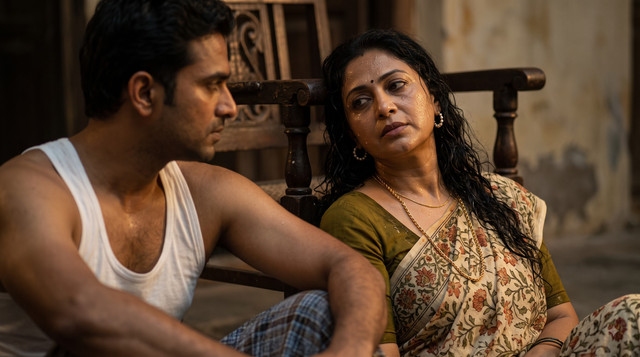
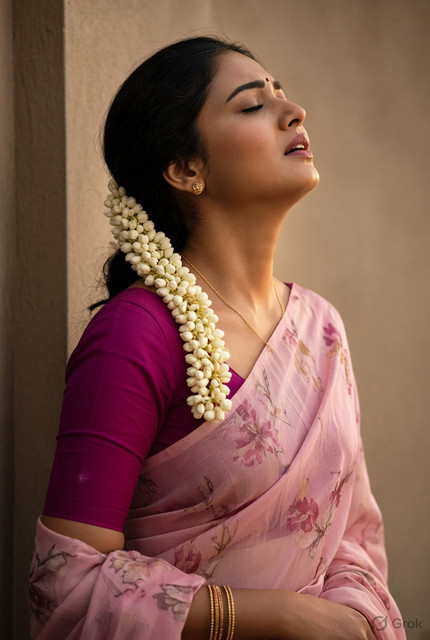
She wore an olive-green blouse that I recognized—one she had owned for years, the fabric soft from countless washings. Her cream-colored floral block-print saree dbangd around her with the casual elegance that had always been hers, even in our poverty. Her wavy hair fell loosely around her shoulders, not pinned up as she usually wore it for work, but down, free, framing her face in a way that made her look younger than her years.

She walked into the room without hesitation. There was none of the visible guilt I had seen in her during earlier encounters, none of the furtive glances or the hesitation at the threshold. She moved as if she had a right to be here, as if this room were as familiar to her as our own kitchen. Her face showed a faint trace of concern—perhaps worry about Appa, or about me, or about the complications of her own heart—but there was no happiness in her expression. Only a quiet, unreadable stillness that seemed to belong to someone I did not fully know.

"Lakshmi," Ravi said, and his voice was different from how he had spoken to me. It was softer, warmer, carrying an intimacy that made my skin crawl. "Come. Sit with me. I want to talk."

He gestured toward the chair near the window—the chair that would place her in profile to me, where I could see her face clearly. My mother offered no resistance. She moved to the chair and sat, her hands folding automatically in her lap, her posture straight but not rigid. Her face was still faintly flushed from the walk, slightly sweaty from the night air, but her expression remained blank, guarded, waiting.

Ravi sat close to her—not across the room, not at a respectful distance, but near enough that their knees almost touched. He rested his entire hand on her thigh, the gesture casual and possessive all at once, and I saw her breath catch slightly at the contact. But she did not pull away.

"Tell me," Ravi said, his voice low and concerned. "Has your husband gone to sleep? Is everything all right in the house?"

The questions were ordinary, almost domestic. They were the questions a neighbor might ask, a friend. But coming from Ravi, in this room, with his hand on her thigh, they carried a different weight. He was asking about Appa not from concern, but from calculation—establishing that the drunkard was unconscious, that the obstacle was removed, that the field was clear.

My mother did not answer immediately. Her eyes remained fixed on some point across the room, her lips pressed together.

Ravi shifted smoothly, his hand remaining where it was. "And Arjun?" he asked, and I felt my whole body tense at the sound of my name. "How is the boy doing? Is he recovering from his fever?"

The performance was masterful. His voice carried such genuine-sounding concern, such careful attention to my well-being, that for a moment I almost believed it myself. But from my vantage point outside the window, I could see the subtle tension in his shoulders, the way his eyes watched my mother's face not with worry but with assessment. He was not asking about my health; he was using my health as another thread in the web he was weaving.

And the humiliation of it settled deeper into my bones. Even my own father had never asked about my health with this much focused attention. Appa's concern, when he was sober enough to feel it, was rough and clumsy, quickly forgotten. But Ravi—this man who was destroying our family—was performing a better version of fatherhood than my own father could manage.

*How much more of this am I going to take?* I wondered, the thought bitter in my throat. *Is this how the rest of my life will move—watching this man be better at everything, watching him take everything, while I stand in the darkness like a ghost?*

[img][Image: s.jpg][/img] [img][Image: Woman-leaning-against-pillow-2-K-202608250056.jpg][/img]


"Yes," my mother said finally, and her voice was flat, ordinary, without warmth or enjoyment. "He is sleeping. The fever has broken."

Ravi's thumb stroked her thigh through the fabric of her saree, a small, intimate gesture that seemed to claim ownership of the information she had just given. "Why are you like this, Lakshmi?" he asked softly. "Always so low and down. What is wrong with you?"

She turned her head slightly to look at him, and in the lamplight I could see the weariness in her eyes, the exhaustion that went far beyond physical tiredness. "People like me," she said slowly, her voice barely above a whisper, "are meant to face all the problems... maybe I am the one who made the mistake."

Tears gathered in her eyes, catching the light like small jewels. They did not fall immediately, but remained there, suspended, as if she had forgotten how to cry properly, how to let her body release what her heart was feeling.

Ravi moved closer, his hand leaving her thigh to lightly tap her cheek—a gesture that was almost playful, almost parental, yet carried an intimacy that made me want to look away. "Lakshmi," he said, and his voice was tender now, soft as warm cloth. "I am here for you. Even if your family goes away, even if everything else crumbles, I will remain until the end. You are not alone in this."

I watched as my mother seemed to fold into herself, her resistance crumbling like wet paper. Slowly, as if moving through water, she slid from the chair to the floor beside him. She rested her head against his chest, and he stroked her hair with long, gentle movements, murmuring words I could not quite hear but could imagine—soothing sounds, promises, the language of comfort that he seemed to have mastered completely.

The sight of it—the intimate care, the tenderness that looked almost parental yet was anything but—made me grip the window frame until my knuckles ached. I felt the ground shifting further under me, the last certainties of my world dissolving. This was not merely sex, not merely the transaction they had originally arranged. This was something more dangerous, something that was rewriting the fundamental architecture of my mother's heart.

They stayed like that for what seemed like a long time—her head on his chest, his hand in her hair, the two of them on the floor in a posture that suggested comfort and safety and belonging. I watched, unable to look away, my own breathing shallow and irregular.

Then, suddenly, my mother pulled away. She sat up, her face still close to his, and spoke with a bluntness that surprised me: "So start quickly, Ravi. Either way it will lead to sex. Just start it and finish it fast."

The words hung in the air between them, harsh and practical, stripping away the tenderness of the moment before. I saw Ravi's face change—his expression shifting from warmth to something that looked almost like hurt.

"Lakshmi," he said, and his voice carried a note of genuine pain. "Is that what you think? That I am with you only for your body? That I bring you here only for that?"

My mother looked away, her jaw set. "Isn't it?"

"No," Ravi said firmly. He reached out and took her hand, holding it between both of his with a gentleness that seemed to contradict everything I knew about him. "The first time, yes—it was for Meena. For the child. I will not lie to you about that. But slowly, Lakshmi... slowly I fell in love with you. I cannot forget you. When you are not here, I think of you. When you are here, I want to know you, not just have you."

He paused, his eyes searching her face. "Please do not reduce what is between us to only that. Please do not make me into a man who only takes. I want to give as well. I want to be something to you."

My mother was silent for a long moment, her expression unreadable. Then, in a voice that tried for lightness but fell somewhere near bitterness, she said: "Then can I leave today? You said you don't want my body, right? So can I go early?"

It was a test, I realized—a challenge thrown out to see if his words matched his actions, if his professed love could survive the denial of the physical.

Ravi answered without changing his voice, without hesitation: "You can go, Lakshmi. There is no problem. I won't force you. But whether you stay or go, I will always love you more than your husband... and even more than your son."

The words struck like stones. I felt them hit my chest from outside the window, felt the breath leave my body as if I had been physically struck. He was declaring his supremacy not just over Appa, but over me—over the bond between mother and son that I had always believed was unassailable.

My mother reacted immediately, her voice sharp with protective instinct: "Why are you involving my son now? He is sleeping in the house. He must be tired because of his fever."

The concern in her voice was real, I could hear it—the genuine worry of a mother for her child, cutting through the complicated tangle of her other feelings. It was the first time since entering the room that she had sounded fully alive, fully present.

Ravi gave a small, humorous smile—the same smile I had seen earlier, but now directed at her. "Yeah, yeah... he must be tired from his fever."

As he spoke, he turned his face slightly toward the window. His eyes found mine instantly, as if he had known exactly where I was standing all along. He offered a brief, private, joking look in my direction—a look that said *I know you're there, I know you heard everything, and I am enjoying this*—then turned back to my mother as if nothing had happened.

The gesture was small, almost casual. It lasted perhaps two seconds. But it was completely devastating. He had used my mother's concern for me as part of his performance, had turned her maternal love into another instrument of my humiliation. And he had done it with a smile.

Inside the room, my mother seemed to make a decision. Without further delay, she began to remove her pallu, her hands moving to the pins that held it in place, volunteering herself with the mechanical resignation of someone accepting the inevitable.

But Ravi stopped her. He reached out and caught her hands, preventing her from undressing.

She looked confused, her brow furrowing. "Why? What happened?"

Ravi spoke calmly, his voice sincere and soft. "Every time we have been together," he said, "I feel that I am the only one who experiences anything. You remain expressionless, distant, as if you are enduring rather than participating. I do not want that tonight."

He paused, his eyes holding hers with an intensity that seemed to demand honesty. "As your other husband," he continued, "I am asking you to try tonight. To be with me not as a duty, not as a transaction, but as a wife. Let us be husband and wife for this one night. Let us attempt to enjoy each other. His eyes were soft now, almost pleading. "Please, Lakshmi. Try."

Amma studied his face for several quiet seconds. I could see the war in her expression—the resistance, the confusion, the slow erosion of her defenses. She had come here prepared to endure, to get through what needed to be done and return home. But he was asking for more. He was asking her to participate, to feel, to cross a line she had been keeping intact.

"I don't know, Ravi," she said finally, her voice barely audible. She was looking down now, her face turned away from him, and I could see the blush rising in her cheeks—the first genuine color I had seen there tonight. "Whether I can enjoy it or not. But I will try."

Those words—*I will try*—left my mouth dry and my chest hollow. I understood in that moment, with terrible clarity, that my mother was now only one step away from falling completely into Ravi's hands. The last internal distance she had maintained, the wall of resistance that had kept some part of her separate from what was happening, was beginning to close.

I watched through the cleaned window as Ravi reached out and gently lifted her chin, turning her face toward him. His expression was tender, victorious, hungry, and caring all at once—a complexity of emotion that seemed genuine and calculated in equal measure.

"That is all I ask," he whispered. "Just try."

And as my mother nodded, her eyes meeting his with a mixture of fear and surrender that I had never seen in her before, I understood that the triangle Ravi had spoken of—the secret shared between him, my mother, and me—was shifting. The balance was changing. Something was ending, and something else was beginning, and I was trapped outside the window, watching it happen, unable to stop it and unable to look away.

The night stretched on around me, dark and endless, while inside the room the light burned steady and warm, and my mother began to try.
[+] 13 users Like Lousy1995's post
Like Reply
#66

Chapter 28: "Husband and Wife


The night had turned still around me, the village sunk into a silence so complete that every sound from inside the room seemed amplified beyond bearing. I stand at the cleaned window, my breath fogging the glass in small, dissipating clouds that vanish almost as quickly as they form. My fingers rest against the wooden frame, the splinters catching at my skin, but I feel nothing. The night is thick around me, pressing against my back like a physical weight, yet my entire consciousness has narrowed to the rectangle of yellow light spilling from the window across the narrow gap between the houses.

It has been only two days.

One day since the fever began. One day since I watched my mother transform from the woman who once pushed Ravi away with genuine resistance into someone who now sits beside him on the edge of his bed, her hand resting in his, her cheeks flushed with a blush that looks almost girlish in its intensity.

The speed of the collapse terrifies me more than the collapse itself. Yesterday morning, she was still arguing, still hesitating, still maintaining some pretense of the boundary between neighbor and... whatever she is becoming now. Yesterday afternoon, she took his cock into her mouth inside our own house, while my father snored in the next room and I watched from the shadows. Last night, she lay with him while Appa and I slept in our own beds just walls away, her body opening to him in the darkness.

And now, not twenty minutes ago, she spoke the words that finished the last of her resistance. "I will try ," she said, her voice barely audible through the glass, but the words struck me like stones. "I will try to be your wife."

The transformation is no longer hidden behind closed doors or happening in fragments I piece together afterward. It is happening in front of me, openly, and I am the only witness.

Inside the room, the light from the single oil lamp casts dancing shadows across the walls. Amma sits on the edge of Ravi's bed, the cream floral saree she wore to dinner now slightly disheveled, the pallu having slipped from its proper place over her shoulder. She has removed the hair clip that usually keeps her thick, wavy hair in a severe bun, and it falls around her shoulders in dark curtains that make her look younger, more vulnerable.

Ravi stands before her. He has removed his shirt, and his chest is bare in the lamplight, the skin smooth and taut over muscle that comes from fieldwork rather than exercise. He is looking down at her with an expression I cannot fully read from this distance—something between tenderness and possession, between patience and hunger.

I should not be here. The thought repeats in my mind like a mantra, but my feet remain rooted to the packed earth beneath the window. I remember Ravi's threat from the godown, delivered with that same calm certainty that makes his words feel like laws of nature rather than mere statements: if I interfere, Amma will be the one who suffers. The warning chains me in place more effectively than any physical restraint could.

I do not want to watch her play this role. The realization rises in my chest like bile. I do not want to see her accept the slow, deliberate foreplay of becoming Ravi's wife—even though, in every practical way, she already is. The thaali he tied around her neck at the temple a weeks ago hangs against her chest now, alongside the one my father placed there 20 years ago. Two gold chains, two claims, two husbands in everything but name.

Yet I cannot look away.

Ravi raises one hand, offering it to her without words. He simply waits, his arm extended, his palm open. The gesture is almost courtly, absurdly gentle given what I know he intends to do with her tonight.

Amma hesitates. Her fingers hover in the air for a long breath, trembling slightly. I can see the war in her face from here—the old Lakshmi who would never touch another man, fighting against the new Lakshmi who has already accepted too much to turn back now. Her eyes are downcast, her lower lip caught between her teeth.

Then, slowly, she places her hand in his.

Ravi closes his fingers around hers with quiet delicacy. There is no sudden pull, no rough claim—only smooth, careful movement. He turns and leads her the few steps to the center of the bed, guiding her with a gentleness that seems calculated to disarm her further. He sits on the edge of the mattress first, drawing her down to sit beside him, thigh against thigh.

I watch the way her body yields to the gentle guidance. Her shoulders relax almost imperceptibly, her spine curving slightly toward him. The last of her earlier defiance seems to dissolve in the warmth of his hand around hers.

"Are you okay, Lakshmi?" Ravi asks softly. His voice carries faintly through the glass, intimate and low.

Amma hesitates, then gives a small, slow nod. Her eyes remain fixed on some point on the floor, but the nod is unmistakable—a permission given, a line crossed.

That single permission is enough. Ravi leans forward and places a neat, gentle kiss on her lips. The contact lingers, soft at first, a simple pressing of mouths that seems almost chaste. Then, gradually, it deepens. His hand rises to cup her jaw, tilting her head slightly, and the kiss becomes something else entirely—a slow, wet joining of mouths that makes my stomach clench.

Amma's eyes close. Whether she is beginning to feel genuine pleasure or only shaping her face to satisfy him, I cannot yet decide. The uncertainty itself is torment. I watch the way her eyelids flutter, the way her breathing shifts from nervous to something deeper, and I feel the familiar, hated arousal beginning to stir in my own body.


Ravi's hands rise and cradle Lakshmi's head, tilting it so he can press the kiss deeper. For a moment she remains passive, receiving his mouth like something happening to her rather than something she is participating in. Then, almost reluctantly, her own hands lift and settle at the back of his head, her fingers threading into his hair.

The kiss turns vigorous. Mouths open, tongues meet, and the wet sound of it carries faintly through the glass—a soft, rhythmic smacking that seems impossibly loud in the quiet night. Ravi's eyes stay half-open, filled with clear lust and open enjoyment. Amma's remain tightly shut, her face turned slightly upward, her expression caught between surrender and resistance.

Watching them, I begin to feel the shift in her body language—the way her shoulders soften completely, the way her fingers tighten in Ravi's hair, the way she leans slightly forward rather than pulling back. In our village, no husband kisses his wife like this. Appa has never kissed her this way; at most, he presses a dry, perfunctory touch to her forehead when he leaves for work or returns home. This deep, hungry mouth-kiss belongs to another kind of marriage entirely—a marriage of passion and deliberate pleasure rather than duty and habit.

The sight forces a raw, unwanted arousal through my body. I harden against my will, the pressure sudden and humiliating in its intensity. A strong urge to reach down and touch myself rises like a tide, but I fight it with everything I have left. If I give in now, if I stroke myself while watching my mother become another man's wife in truth, I will lose whatever thin dignity still remains as her son. I may have already lost most of it, standing here night after night, but I refuse to lose the last scraps. My hands stay clenched at my sides while my cock throbs in silent protest, straining against the fabric of my veshti.

They remain locked in the kiss. Ravi's hands begin to roam slowly over Amma's back, mapping the curve of her spine through the thin cotton blouse. His fingers move with deliberate patience, learning her shape, committing her to memory. They find the remaining hair clip, unfasten it with a small click, and let her hair fall completely loose around her shoulders, a dark waterfall that frames her face.

Even then they do not break the kiss. Amma's hands start to move as well, roaming across Ravi's bare back with growing certainty, pulling him closer. The wet sounds of their mouths fill the quiet room, punctuated by the soft rustle of fabric and the occasional catch of breath.


[img][Image: 1.gif][/img]

As they kiss, their heads slowly rotate, adjusting angles, seeking deeper contact. For a clear moment I can see both of their faces in profile—Ravi's open enjoyment, his eyes half-lidded with pleasure, and Amma's flushed, surrendered expression, her lips parted and swollen, her cheeks dark with color.


Suddenly Ravi's eyes find the window. He does not stop. He continues to kiss Amma deeply, his tongue moving in her mouth, while staring straight at me, his gaze cunning and fully satisfied. The eye contact lasts several long seconds, long enough for the shame to burn through my chest like acid, long enough for me to understand that he knew I was here all along, that he has been performing for me as much as for her.

Only then does he deliberately change the angle of the kiss, turning Amma's head to the opposite side with gentle pressure on her jaw so that their faces are no longer fully visible to me. The message is clear: he knows I am watching, and he wants me to keep watching. He wants me to see what he is taking from her, what she is giving to him.

After several long minutes they finally break apart. A thick, glistening bridge of saliva stretches between their lips before it snaps, and Amma's breath comes in small, shaky pulls. She does not open her eyes immediately.


[img][Image: 2.jpg][/img]


Ravi looks at her with a soft, almost tender smile and asks, "Eh, wife... did you like it?"


Amma does not answer. She turns her face away in sudden shyness, her hair falling forward to hide her expression. The blush on her cheeks has deepened to a dark rose color that spreads down her neck.

Ravi gently cups her chin, turns her back toward him with patient persistence, and asks again, quieter this time, "Did you like it, Lakshmi?"

Still she gives no reply, but the deep blush spreading across her cheeks and the way her lips remain slightly parted, glistening from the kiss, make her feelings unmistakable. She liked it. Despite everything, despite the guilt and the shame and the husband sleeping in the house next door, she liked the way he kissed her.

Ravi seems to read the answer in her silence. He smiles—a small, private expression of victory—and begins to guide her down onto the bed. His hands are gentle but insistent, pressing her shoulders back until she is lying fully on her back. The cream floral saree spreads beneath her like spilled milk, a soft pool of fabric that contrasts with the dark wood of the bed frame.

He does not cover her body with his own. Instead he remains half-seated beside her and begins a slow, deliberate descent. He starts at the side of her waist, placing a soft open-mouthed kiss there, just above the hip bone where the saree has ridden up slightly. Amma's breath catches; a quiet, surprised "ah" slips out, high and fragile in the silence.

Ravi's lips linger, tasting the faint salt of her skin, before he moves lower. He gathers the folds of the saree and draws them aside with careful fingers, exposing the smooth, slightly rounded midriff and the deep, dark hollow of her navel. The skin there is softer, more vulnerable, untouched by sun.

For a moment he only looks, his eyes tracing the curve of her stomach, the dip of her navel, the way her breathing makes the muscles flutter. Then he leans down and presses a deep, lingering kiss directly onto her belly button. His tongue traces the rim in a slow circle, dipping briefly into the hollow, tasting her.

Amma's stomach tenses under his mouth. Soft "ah... ah" sounds and small, broken moans begin to escape her lips even though she tries to press them shut. Her fingers curl into the bedsheet beside her hips, whitening at the knuckles. 

"You keep this covered all day," Ravi murmurs against her skin, his voice vibrating through her flesh, "but it tastes so soft, Lakshmi."

He kisses the navel again, slower, wetter, his tongue pressing more firmly into the hollow, and Amma's thighs shift restlessly on the mattress, her knees drawing together slightly before falling open again.

I watch the way her midriff rises and falls faster, the way the muscles jump each time Ravi's tongue moves, the way her hands open and close on the sheets. The intimacy of that single kiss on her navel feels more invasive than many of the earlier nights. It is so deliberate, so focused on pleasure rather than procreation. Appa has never touched her this way, has never kissed her stomach like it was something to be worshipped.

Ravi's mouth leaves her belly and continues downward. His hands slide under the lower edge of the saree and begin to push the fabric upward along her thighs, inch by inch, revealing the warm brown skin above her knees, then higher, toward the soft inner thighs.

Amma's body stiffens. Suddenly her hands shoot down and stop his wrists, her fingers wrapping tight around his bones. "What are you doing, Ravi?" Her voice is tight, almost panicked, the earlier softness gone, replaced by a familiar resistance.


[img][Image: 3.gif][/img]


Ravi does not pull his hands away. He stays exactly where he is, kneeling between her legs, his head lifted to look up the length of her body with calm, certain eyes. "What do you think I'm doing, Lakshmi?" His voice is low and even, reasonable. "Yesterday you took my cock in your mouth. You did it even though it was the first time. Today it is my turn to help you. Now I'm going to taste my wife properly."


He waits, still holding the bunched fabric, giving her the words without any rush, letting them settle into her understanding.

Lakshmi turns her face sharply toward the wall, her ear burning red against the pillow. "Chi... chi... Don't say it like that. That place is... inappropriate. It is ugly. You shouldn't put your mouth there, Ravi. It is not right."

Ravi's tone stays quiet but grows firmer, the voice of a man who has already decided and will not be swayed. "When I asked you yesterday, you were shy then also. Still you opened your mouth for me. You let me finish on your tongue. Now I want to do the same for you. A husband should know every part of his wife. He should taste her." He pauses, then adds, with deliberate weight, "Now take your hands away, Lakshmi. I am going to do my duty. I am going to enjoy your pussy... savour it... drink it if you give me enough."

He does not raise his voice. The calm certainty is more commanding than any shout could be. It is the voice of a man who knows she will obey, who has learned her patterns of resistance and surrender.

The words "husband" and "duty" land heavily. Amma's fingers slowly loosen their grip on his wrists and then fall away to the sides of her body, defeated. Her hands rest palm-up on the mattress, a gesture of submission that makes my chest ache.

Ravi resumes the slow lifting of the saree. He pushes the petticoat up next, gathering both layers at her waist. In a few deliberate movements Amma's pussy is fully exposed to the low light: dark outer lips, already slightly parted and glistening with a thin sheen of wetness that catches the lamplight, the softer inner pink visible when he gently presses her thighs farther apart.

Her face turns a deep, burning red, visible even from here. She tries to close her knees, but his shoulders keep them open, his head between her legs blocking her attempt at modesty.

"Ravi... please don't look at it like that," she whispers, voice trembling. "It looks ugly... different... not like a young girl's."

Ravi shakes his head slowly, eyes never leaving the place between her legs. "What are you saying, Lakshmi? It is beautiful. Fuller, darker, more womanly than Meena's. This is a wife's pussy. Now I will savour the full taste of it."

He extends one finger and traces the outer lips first, spreading the moisture, learning her shape. Then, watching her face the entire time, he slowly, carefully inserts the finger inside her.

Amma's back arches off the bed. A longer, shakier moan breaks from her throat—"Ahh... Ravi..."—and her walls clench around the single digit. Ravi holds still for a second, feeling her, then begins to move the finger in slow, shallow strokes, curling it gently, learning the heat and tightness of her.


[img][Image: 4.gif][/img]

"Already so warm," he murmurs. "And getting wetter for me."


He withdraws his finger. It shines with her clear wetness. He lifts it to his mouth and sucks it clean while staring directly into her eyes, making sure she sees him taste her. 

Then he lowers his head between her thighs.

The first long, slow lick of his tongue—from the bottom of her opening all the way up through the folds and over the hidden clit—makes Amma's entire body jolt as if shocked. A sharp, helpless cry leaves her. Her hands fly down and bury themselves in his hair, fingers neither pulling him away nor fully pushing him closer.

Ravi settles in with deliberate, hungry patience. He licks her open with broad, flat strokes, then narrows his tongue to tease the entrance, pushing inside her in short thrusts. He sucks the outer lips, tugs gently, and returns again and again to the swelling clit, circling it, flicking it, then sealing his mouth over it and sucking with steady pressure.

Amma's moans lose their restraint. Her hips begin to move in small, involuntary circles, pressing her pussy more firmly against his mouth. The wet, rhythmic sounds of his tongue and lips fill the quiet room—soft, filthy, unmistakable.

I watch her thighs tremble on either side of Ravi's head, watch the way her stomach hollows with every shaky breath, and feel my own cock throb so hard it hurts against the fabric of my veshti.

Ravi takes his time, as if he has all night. He uses his thumbs to spread her open wider so he can see every part of her—the darker outer skin, the bright inner pink, the small clitoris now fully swollen and glistening. He tells her between long licks, voice muffled against her wet flesh:

"So sweet, Lakshmi... sweeter than I imagined. I've wanted to do this since the first night. A husband should know the exact taste of his wife's pussy. Give me more... yes, like that..."

Amma's earlier protests have completely dissolved into broken, continuous sounds. She turns her head from side to side on the pillow, eyes squeezed shut, lips parted. When Ravi seals his mouth over her clit and sucks with a firm, steady rhythm while slipping two fingers back inside her, her back lifts clean off the bed. A sharper, higher cry tears from her throat. Her fingers tighten hard in his hair, holding him against her now.

Her hips rock openly against his face. The wetness increases until it coats his chin and lips. Ravi groans into her, the vibration making her thighs shake harder, and continues licking and sucking as if he intends to draw every possible response from her body before he ever stops.

He does not stay between her legs forever. After the long, thorough licking, he lifts his head. Amma's thighs are still trembling, her pussy glistening and open. He wipes his mouth lightly with the back of his hand, then begins to move upward along her body with deliberate slowness.

He plants soft, open-mouthed kisses on the inner side of one thigh, then the soft skin just above her hip, then the trembling plane of her lower belly. Each kiss is wet and lingering. Amma's breathing remains uneven. Her hands, which had been tangled in his hair, now rest loosely on his shoulders as he climbs higher.

When he finally reaches her face he pauses, looking down at her. Amma's eyes are half-open, dark and dazed. Ravi leans in and kisses her mouth again—deeply, thoroughly—letting her taste herself on his tongue. The kiss is slower than before, thicker, almost lazy with satisfaction. Amma's lips part for him without resistance. A soft, muffled sound rises from her throat as their tongues meet once more.

I watch the exchange of that intimate taste and feel the last remaining distance between them collapse further.

Ravi breaks the kiss only to move to the side of her neck. He presses his lips just below her ear, then lower, along the line of her throat. His tongue traces the warm skin. Amma tilts her head slightly, giving him more access even as a fresh wave of shyness colours her cheeks.

"You tasted so sweet, Lakshmi... sweeter than I imagined," he speaks against her neck between kisses, voice low and close. "Your body is answering me now. Don't hide from it."

Amma's reply is barely a whisper. "Ravi... don't say such things..."

But her hand rises and rests on the back of his head, holding him gently in place rather than pushing him away.

Ravi continues downward with the same unhurried patience. He kisses the hollow of her throat, then the upper slope of one breast where the blouse still covers her. His mouth finds the deep line of her cleavage.

The two thaalis rest there—the original one from her marriage to Appa, and the second one Ravi had tied at the temple. They lie close together against her skin. Ravi lowers his head and kisses exactly in the narrow space between them. His tongue moves slowly, tracing the warm valley, licking the faint sheen of sweat, brushing the gold chains with his lips.


[img][Image: 5.gif][/img]


Amma's breath hitches sharply. "Ravi... the thaali..."


Her voice is thin, caught between protest and something softer.

"Both of them are here," Ravi answers without lifting his mouth completely. "One belongs to that useless sleeping. One belongs to me. I am kissing my wife between them."

He licks again, slower, deeper into the cleavage, letting the chains shift slightly under his tongue. Amma's fingers tighten on his shoulder. A longer, helpless "ahh" escapes her.

Only after he has thoroughly kissed and licked the space between the thaalis does Ravi reach for the pallu of her cream floral saree. He draws it aside with careful fingers, uncovering more of her upper body. The fabric slides across her skin with a soft rustle.

He does not remove the blouse yet. Instead he uses the opened pallu to frame her, then leans down and begins to kiss every newly exposed inch—the upper curves of her breasts above the blouse line, the soft skin near her underarms, the delicate area where neck meets shoulder. His tongue follows the path of his lips, leaving faint wet trails that cool in the night air.

Amma's eyes close again. Her chest rises and falls faster. Soft, continuous sounds leave her mouth now—small moans, broken breaths, the quiet repetition of his name.

Ravi takes his time. He treats her body as something to be learned slowly. He returns to her mouth for another deep kiss, then moves back down to her neck, her cleavage, the thaalis, the upper breasts. He shifts the saree further, exposing one side of her waist, and kisses along the curve. He licks the line of her ribs, the soft underside of her breast where the blouse has ridden up slightly. Every part of her that becomes available receives the same attentive, open-mouthed attention.

Between kisses he speaks to her in a low, steady voice: "Your skin is warmer now... You are letting me in more than before... This is how a wife should be touched, Lakshmi... Slowly. Completely."

Amma's responses are fragmented. "Ravi... enough... It feels... strange... Don't look at me like that..."

Yet her body continues to yield. Her legs remain open. One of her hands stays in his hair. The earlier resistance has softened into a trembling, flushed acceptance.

I watch the long, thorough exploration—the way Ravi's mouth claims every inch of her upper body while the taste of her pussy is still on his lips—and feel the erotic weight of it settle heavily in my own groin. The scene remains unhurried, intimate, and deeply possessive, with no rush toward full undressing or penetration. Only the continuous, deliberate worship of her body through kisses, licks, and quiet husband-and-wife words.

Ravi finally rises from her body and comes back to her face. His lips and chin are still faintly shiny from earlier. He does not wipe them. Instead he leans down and kisses Amma on the mouth again—deep, open, and unhurried—deliberately sharing the taste of her own pussy with her.

The wet sound of the kiss is thick and slow. Amma makes a small, muffled noise of surprise against his tongue, but she does not turn away. Her hands rest on his chest, fingers curling weakly into the fabric of his shirt.

Ravi breaks the kiss just enough to speak against her lips, voice low and rough: "Taste yourself, Lakshmi. This is what your new husband drinks. Sweet... open... already wet for me. Your husband never tasted you like this, did he? He never even tried."

Amma's only answer is a shaky breath and the slight parting of her lips for another kiss. The comparison hangs in the air, heavy and deliberate.

Ravi moves again to her neck, kissing and lightly sucking the warm skin just below her ear. The soft, wet sounds of his mouth are clear in the quiet room—tsch... tsch...—mixed with Amma's uneven breathing.

He trails lower, back into the deep cleavage where the two thaalis rest against her skin. He licks slowly between the gold chains, letting his tongue push them slightly apart.

"These two chains," he murmurs between licks, "one from a man who forgot how to touch you... and one from me. I am the one who is here now. I am the one who is tasting every part of you. Tell me, Lakshmi... does your body know the difference?"

Amma's voice is barely audible. "Ravi... don't speak like that..."

Yet a longer moan slips out when he sucks gently at the soft skin between the thaalis. Her back arches a little, pushing her chest up toward his mouth.

Ravi's hands move to the hooks of her  blouse. He opens them one by one, slowly, giving her time to feel every release. The fabric loosens. He draws the blouse open but does not remove it completely, leaving it hanging off her shoulders.

Her breasts are still covered by the thin blouse-slip, but the upper curves and the deep line of her cleavage are fully exposed. Ravi lowers his head and begins to kiss and lick the newly revealed skin—the soft slopes, the warm valley, the places where the thaalis rest.

The wet sounds grow more intimate: soft licks, the faint click of his tongue, Amma's quiet "ahh... ahh..." that she tries and fails to swallow.

Ravi speaks against her skin: "Your husband sees these every day and does nothing. I wait for nights like this just to put my mouth on them. Feel how hard your nipples are already... even through the cloth. Your body is more honest than your words."

He slips one hand inside the blouse-slip and cups her breast fully, thumb brushing the stiffened nipple. Amma gasps. He keeps kissing her mouth while his hand works slowly, squeezing, rolling, learning the weight of her.

After a while he draws the slip down on one side, freeing one full breast. The dark nipple stands tight in the dim light. Ravi looks at it for a long moment, then lowers his head and takes it into his mouth.

He sucks deeply, tongue circling, teeth grazing just enough to make her jolt. The wet, rhythmic sucking sounds fill the space between them—schlck... schlck...—mixed with Amma's broken moans.

"Ravi... ahh... wait..."

"No waiting tonight, wife," he answers without releasing her. "Tonight you are mine to taste properly. Your husband never sucked you like this. He never made this sound come out of you."

He moves to the other breast, freeing it the same way, and gives it the same slow, hungry attention. Amma's hands are in his hair again, holding on as her chest rises and falls rapidly.

Ravi spends a long time there. He kisses, licks, and sucks both breasts thoroughly, leaving the nipples wet and darker, the surrounding skin marked with faint redness from his mouth. Between every few moments he returns to her lips for deep, sharing kisses, letting her taste the mixture of her own skin and the earlier wetness from her pussy.

His voice stays low and continuous, raw with possession: "Look at you... Breasts heavy, nipples hard, pussy still wet from my tongue... This is how a real husband leaves his wife. Not like the man sleeping in your house who only knows how to drink and forget. I will remember every sound you make. I will remember how your body opens when I treat it like this."

Amma's replies are fragmented and shaky: "Don't compare... It is not right... Ahh... Ravi... your mouth..."

Yet her legs have fallen open wider, and her hips shift restlessly on the bed, seeking friction that has not yet been given.

From the window I can see the clear evidence of her arousal. The petticoat and saree are still bunched at her waist; the dark curls between her legs glisten more heavily now. Small wet sounds come from her body whenever she moves.

Ravi notices too. He slips one hand back down between her thighs without looking, finds her open pussy, and slowly pushes two fingers inside while he continues to suck her breast.

The wet schlick of his fingers moving in and out is unmistakable. Amma cries out softly, hips lifting to meet the thrusts.

Ravi lifts his mouth from her nipple just long enough to speak against her skin: "So wet again... Only from my mouth and my fingers. Your husband never felt you like this, did he? He never made you drip the way you are dripping for me now."

Amma turns her face into the pillow, moaning, unable to deny the sounds her own body is making.

Ravi withdraws his fingers slowly. The soft wet sound is clear in the stillness. He looks at Amma's face for a long moment. Her cheeks are already flushed, lips slightly swollen from kissing.

He speaks in a low, steady voice, without pressure: "I want to see you completely tonight, Lakshmi. Only you and me. No cloth left between us."

Amma does not answer at once. She holds his gaze, then her eyes lower. A deeper blush spreads across her face and down her neck. She gives the smallest nod, almost shy, and turns her face slightly to the side. The quiet acceptance is more intimate than any spoken request.

Ravi helps her sit up on the bed. The movement is careful. Amma's hair falls forward, covering part of her face. She reaches up once to push it back, then lets her hands rest on her lap. Her shoulders are slightly drawn in—the lingering habit of modesty even now.

Ravi kneels in front of her on the mattress and begins with the blouse that is already half-open. He slides the olive-green blouse off her shoulders with both hands. The fabric whispers down her arms. Amma helps by moving her arms slightly, but she keeps her eyes lowered. When the blouse is gone, she is left in the thin slip.

Ravi pauses. He looks at the way the slip clings to her breasts, at the two thaalis resting against her skin. Amma's fingers twitch on her thighs as if she wants to cover herself, yet she does not.

Ravi takes the straps of the slip between his fingers. "Raise your arms a little," he says softly.

Amma hesitates, then lifts them. The slip is drawn upward and off. Her breasts come free—full, soft, nipples still tightened from earlier attention. The thaalis shift and settle between them.

A visible wave of shyness passes over her. She starts to bring one arm across her chest, then stops herself. Her face is a deep, warm red. A small, almost embarrassed breath leaves her lips. Ravi does not touch her immediately. He simply looks, giving the moment weight.

From the window I feel the air leave my lungs. My mother is bare from the waist up under another man's eyes, the two thaalis the only things left on her upper body. The shyness on her face, the way she cannot quite meet Ravi's gaze, makes the scene heavier than pure lust. Something inside me twists—arousal, shame, and a helpless fascination all at once.

Ravi finally raises both hands and cups her breasts gently, as if weighing them. His thumbs move once across the nipples. Amma's breath catches. A soft, involuntary sound escapes her. She bites her lower lip and looks away, the blush deepening.

Ravi leans in and kisses her mouth lightly. "You are lovely like this," he murmurs against her lips. "Every time I see you, I find something new."

Amma does not reply with words. Her hand rises and rests lightly on his forearm—neither pulling him closer nor pushing him away.

Ravi guides her back onto the bed. Her hair spreads across the pillow. He remains beside her, one hand still on her breast, the other resting on the curve of her waist above the petticoat. He kisses her slowly—long, deep kisses that make soft wet sounds in the quiet room. Amma's eyes close. Her fingers curl against his shoulder.

Ravi moves his mouth to her throat, then lower. He kisses the upper slopes of her breasts, the warm skin around the thaalis, the soft undersides. His tongue draws slow circles around one nipple before he takes it into his mouth and sucks gently.


[img][Image: 7.gif][/img]


The wet, rhythmic sound of his sucking mixes with Amma's quiet, broken breaths. Her back arches slightly. One of her hands finds the back of his head and stays there, fingers lightly in his hair.


Ravi lifts his head just enough to speak, lips still brushing her wet nipple. "Your heart is beating fast. I can feel it under my mouth."

Amma's voice is small and shy. "You are... watching too closely."

A faint, almost reluctant smile touches Ravi's mouth. "I am your husband tonight. It is allowed."

He returns to her breast, sucking more firmly. Amma turns her face into the pillow, a longer moan muffled against the cloth.

After a long time at her chest, Ravi sits up. He begins to unwrap the remaining length of the cream floral saree from her waist and legs. The fabric slides away in soft layers until the entire saree is gone, leaving her only in the petticoat.

Amma's bare legs shift restlessly. She presses her knees together for a moment, then lets them fall slightly apart again. The shyness is still present, but it no longer stops the movement of her body.

Ravi's hands settle on the waistband of the petticoat. He looks at her face. Amma's eyes are open now, dark and uncertain. A fresh blush rises on her cheeks. She does not speak, but after a few seconds she lifts her hips a little—the smallest permission.

He draws the petticoat down slowly, past her thighs, past her knees, and off her feet. The last piece of clothing is gone.


[img][Image: 8.webp][/img]


Amma lies fully naked on the bed except for the two thaalis. Her body is open to the low light: breasts marked by his mouth, stomach rising and falling, dark wet pussy still glistening, thighs soft and parted.


She turns her face away at once, one arm coming up as if to shield her eyes. The shyness is stronger now that nothing remains to hide behind. Ravi does not force her to look at him. He simply rests one hand on her stomach, warm and still, giving her time.

My cock throbs painfully. The complete nakedness of my mother, the way she still tries to hide her face even while her body stays open, creates a raw, addictive ache in me. I cannot look away. Every small movement she makes—the twitch of her fingers, the way her toes curl, the visible pulse in her throat—feels magnified.

Ravi begins to touch her again with both hands, unhurried. He strokes from her shoulders down her arms, across her breasts, over her stomach, along the outer sides of her thighs. His palms are warm and deliberate.

Amma's breathing grows uneven. Soft sounds keep leaving her lips—small gasps, quiet "mmh" noises she cannot fully control. Her hips shift once, twice, against the mattress.

Ravi lowers his head and starts kissing her naked body from the beginning again. Mouth on her lips, her throat, both breasts, the line of her ribs, her navel, the soft skin of her lower belly. He takes his time at every place.

When his mouth returns between her legs she jerks, a sharper cry escaping. He licks her slowly, thoroughly, as if he has not already tasted her earlier. The wet sounds are louder now in the silence—open, intimate, continuous.

Between long strokes of his tongue Ravi speaks, voice muffled against her: "You are even wetter than before... Your body remembers my mouth."

Amma's reply is fragmented and shy. "Don't... speak while you... ahh..."

Her fingers tighten in the bedsheet. Her thighs tremble on either side of his head.

Ravi stays between her legs for a long time. He uses his tongue and two fingers together, slow and precise, learning exactly which pressure makes her breath hitch and which rhythm makes her hips lift. Amma's moans become longer and less controlled. Her head turns from side to side. The blush never leaves her face; it only deepens.

Only when her thighs are shaking continuously does Ravi move up her body. He removes his own clothes without hurry—baniyan first, then veshti and underwear. His cock is thick and hard, the head already wet.

He settles between her open legs, the heavy length of him resting against her soaked folds. He does not push inside yet. He simply stays there, skin to skin, and kisses her mouth deeply while rocking his hips in small movements that slide his cock up and down along her pussy. The slick sound is soft and constant.

Ravi rests the thick head of his cock against Amma's entrance pussy. He does not push forward yet. He stays there, the heat of her wetness coating him, and looks down at her face.

Amma's eyes are half-open. A deep flush covers her cheeks and spreads down her neck. She cannot hold his gaze for long; her eyes flicker away, then return, then lower again. One of her hands rests on his upper arm, fingers lightly curled. Her breathing is already uneven.

Ravi leans down and kisses her once, soft and closed-mouthed. "Look at me for a moment," he says quietly.

Amma forces her eyes back to his. The shyness is still there, but beneath it something softer—a restrained, almost reluctant acceptance—shows in the way her lips stay slightly parted.

Ravi begins to press forward. Only the head at first. The stretch is immediate and visible in the way Amma's mouth opens. A long, trembling breath leaves her. Her fingers tighten on his arm.

He holds still, giving her body time to adjust to the thickness. The wet heat of her surrounds just the tip. Soft, involuntary sounds escape her throat—small, broken "ahh... mmh..." noises she tries to keep quiet.

Ravi's own breathing has grown heavier. He watches every change in her expression with complete attention.

He gives her more only when her grip on his arm loosens slightly. Another inch slides inside. Amma's back arches a little. Her eyes close tightly for a moment, then open again, unfocused.

Ravi continues this way—slow, measured pushes, each one followed by a full pause. The wet sound of her body taking him is soft but unmistakable. By the time he is halfway inside, Amma's other hand has risen to his shoulder. Her thighs have fallen further open. The flush on her face is deeper than before.

When Ravi finally sinks the last inches and their bodies meet completely, both of them go still. He is buried to the hilt. Amma's breath comes in short, shaky pulls. Her walls flutter around him in small, involuntary contractions.

Ravi lowers his forehead to hers. His voice is rough and low. "You have all of me now. Every part."

Amma does not answer with words. She turns her face slightly and presses her cheek against his. Her arms move up around his back, holding him in place rather than pulling him closer. The quiet acceptance of his full weight and length inside her is more intimate than any spoken permission.

They remain completely motionless for a long time. Ravi stays deep inside her, letting her feel the complete fullness. He kisses the side of her face, her closed eyelids, the corner of her mouth.

Amma's breathing slowly begins to even out. Her fingers move in small, restless patterns on his back. Occasionally her inner muscles tighten around him without her seeming to decide it. Each time it happens, a faint sound leaves her lips and her blush deepens.

Ravi draws his hips back only a short distance, then slides forward again. The first full stroke is almost painfully slow. The wet sound is thick and clear. Amma's mouth opens against his cheek; a longer moan spills out.

He repeats the movement—short withdrawal, long controlled return—establishing a rhythm so measured that every inch of the friction can be felt. Amma's legs rise and rest against his hips. Her hands stay on his back, sometimes pressing, sometimes only resting.

The slow strokes continue. Ravi keeps the same deliberate pace, never speeding up. Each time he pushes in to the root, Amma's body shifts under him and a soft, open sound leaves her. The two thaalis move between her breasts with the motion.

Ravi speaks in low fragments between thrusts: "So warm inside... I can feel you holding me... Your body is softer tonight..."

Amma's replies are quieter, broken by the rhythm: "It's... deep... Your weight... Don't look at me so much..."

Yet when he kisses her she answers the kiss, and her hips begin to make small answering movements of their own.

After many long strokes Ravi slips one arm under her lower back and lifts her hips slightly. The new angle lets him sink even deeper. Amma's reaction is immediate—a sharper cry, her head pressing back into the pillow, her nails lightly scoring his skin.

He holds the angle and continues the same unhurried rhythm. The wet sounds grow richer. Amma's breasts move with every thrust. Her eyes open and close in uneven intervals, the expression on her face a mixture of shyness, overwhelm, and something quieter that looks almost like reluctant happiness.

Outside the window my entire body is locked in place. I can see every detail: the slow, heavy way Ravi's hips move, the way Amma's thighs tremble, the glistening wetness that coats Ravi's cock each time he withdraws, the changing expressions on my mother's face. The length and thoroughness of the act make it impossible to look away. My own arousal is painful, but I remain motionless, breathing shallowly in the dark.

Ravi keeps the deep, measured fucking going for a long time. Sweat begins to form on both their bodies. The scent of sex fills the small room. Amma's moans have become continuous—low, rhythmic, open. Her hands move restlessly over his back and shoulders.

Occasionally Ravi lowers his mouth to her neck or the upper curve of her breast and sucks lightly while he thrusts, adding another layer of sensation. Each time he does, Amma's inner muscles tighten around him and a fresher sound leaves her throat.

Ravi shifts his weight to one forearm and slips his other hand between their bodies. His fingers find her swollen clit and begin to move in slow, tight circles, matching the rhythm of his thrusts.

Amma's reaction is stronger now. Her back arches. A higher, more broken cry escapes her. Her legs tighten around his waist. The dual stimulation makes her body respond more openly—small, involuntary rolls of her hips, the clear clenching of her pussy around his cock, the way her breath fractures.

Ravi keeps the same deep, controlled rhythm, but the weight behind each thrust has grown. The wet sound of his cock moving inside her is louder now, thicker, almost continuous. Amma's moans have lost most of their earlier restraint. They rise and fall with every stroke, open and shaky.

Her face is turned slightly toward the side of the pillow. The flush on her cheeks is dark and permanent. Her eyes open and close in uneven intervals. For the first time a faint, incomplete softness appears at the corners of her mouth—not a full smile, only the beginning of one—as if something inside her is slowly loosening its grip.

Ravi notices. He lowers his mouth close to her ear, voice rough and low: "You are looking different tonight... Your face is changing while I am inside you. I can see it."

Amma's breath stutters. She tries to turn her face further away, but the small almost-smile stays, fragile and unfinished.

Outside the window I feel the shift like a physical blow. The woman on the bed is still my mother, still carrying the familiar shyness, yet something new is moving across her features. The tight control she has always kept is beginning to crack. That half-formed smile—small, reluctant, almost secret—makes the scene more intimate and more devastating than any of the earlier nights. My cock throbs hard against the cloth, but I remain frozen, unable to look away from the slow transformation on her face.

Ravi slows his thrusts until he is only rocking deep inside her. He brushes damp hair from her forehead and speaks quietly: "I want to see more of your face. Come up here. Sit on me."


[img][Image: 9.gif][/img]


Amma's eyes open wider. A fresh wave of shyness floods her expression. She hesitates, lips parting as if she might refuse, yet the hesitation lasts only a few seconds. The same small, incomplete softness returns to the corner of her mouth. She gives the tiniest nod.


Ravi withdraws slowly, the wet sound clear and intimate. He rolls onto his back and guides Amma with both hands on her waist. She moves awkwardly at first, still shy about the full exposure of the new position. Her breasts hang forward as she straddles him, the  thaalis swinging lightly between them.

She reaches down, takes him in her hand for a moment, and then sinks onto his cock with a long, trembling breath. The thick length disappears into her inch by inch until she is fully seated. Her hands rest on his chest. Her face is burning.

Neither of them moves at once. Amma sits completely filled, breathing hard, eyes lowered. The flush on her face is deeper than ever. A soft, almost embarrassed sound leaves her throat.

Ravi's hands stay on her hips, thumbs stroking the soft skin. "Look at me," he says, voice low. "I want to watch you like this."

Amma forces her eyes up to his. The shyness is still strong, but the unfinished smile flickers again at the edge of her mouth—small, uncertain, and real. Something in her usual closed expression has begun to break open.

Ravi guides her with gentle pressure on her hips. Amma starts to rise and fall in short, careful movements. The wet sound of her body sliding on his cock is softer than before but more intimate. Her breasts move with each slow rise and descent.

At first her eyes stay lowered. Then, little by little, she begins to meet his gaze for longer moments. The small smile grows a fraction clearer, still incomplete, still mixed with residual shyness, yet unmistakably present. Her usual restrained self is loosening; a different woman is starting to show through.

Ravi watches her face with complete attention, speaking in a rough, continuous murmur: "That's it... Move the way your body wants... You look different when you are on top of me... Your eyes are softer... I can see you ."

Amma's breath catches at the words. She does not answer, but her rhythm grows a little more certain. The shy flush remains, yet the almost-smile keeps returning between her open-mouthed breaths.

Amma's movements become longer and more fluid. She sinks down until he is buried completely, then rises until only the head remains inside her, then slides down again. The wet, rhythmic sound fills the room. Her thighs tremble with the effort.

Her hands press more firmly into his chest. Occasionally she leans forward, the thaalis brushing his skin, and the new angle makes her let out a higher, broken sound. Each time the small smile appears more clearly before shyness pulls it back again.

My entire body is rigid. The sight of my mother straddling another man, rising and falling on his cock, her face slowly losing its old closed expression, is more erotic and more painful than anything that came before. I can see the exact moment the little smile forms, the way it fights with her remaining shyness, the way her eyes grow darker and softer. The transformation is incomplete, still fragile, yet it is happening in front of me and I cannot stop watching.

Ravi begins to thrust upward to meet her. The impact of their bodies grows heavier. Amma's moans turn continuous and open. Her head tips back for a moment, then drops forward again. Sweat shines on her throat and between her breasts.

The small smile stays longer now. It is still not full, still mixed with the old restraint, but it no longer disappears completely. Her usual self is breaking, piece by piece, and a different woman—more open, more lost in the sensation—is taking her place.

Ravi's hands tighten on her hips and he begins to guide her more firmly, pulling her down onto each upward thrust. The wet sound becomes louder and filthier. Amma's cries rise with every deep meeting of their bodies.

"You are giving me more of yourself," Ravi says, voice thick. "I can feel it. Your face is not the same as when we started. Stay with me... keep looking at me."

Amma forces her eyes to stay on his. The shy flush and the incomplete smile exist together on her face, creating an expression I have never seen before.

The rhythm grows heavier and less controlled. Amma's movements become shorter and more urgent. Her thighs shake. Her hands open and close against Ravi's chest. The small smile is still there, trembling at the edges of her open mouth, as the pleasure climbs higher.

Ravi slips one hand between them and finds her clit, rubbing in tight circles while she continues to ride him. Amma's body jolts. A long, broken cry leaves her. The last of her usual restraint fractures further; the new, softer expression takes more of her face.

Amma is still on top of him, her movements growing shorter and less controlled. The wet sound of her body sliding on his cock is loud and continuous. Her thighs tremble hard. The small, incomplete smile keeps flickering across her face—appearing for a second between open-mouthed breaths, then breaking under another wave of sensation, then returning again, softer and more dazed each time.

Ravi's hands grip her hips firmly. He thrusts upward to meet every descent, voice rough and low: "Stay with me... I can feel how close you are... Your face is opening... Don't hide it."

Amma's eyes stay on his for longer stretches now. The old closed expression has cracked further. Shyness still colours her cheeks, but the new softness keeps pushing through.

Ravi suddenly slows her movements with both hands. "Not like this," he says, breathing hard. "I want to be deeper when we finish. Lie down for me."


[img][Image: 10.gif][/img]

[+] 8 users Like Lousy1995's post
Like Reply
#67

Amma hesitates only a moment. The incomplete smile wavers, mixed with fresh shyness, then she nods. Ravi helps her lift off him. The thick, wet sound of his cock leaving her body is clear in the quiet room. A thin string of their mixed arousal briefly connects them before breaking.


Ravi guides her onto her hands and knees on the mattress. The position is more exposed, more raw. Amma's hair falls forward, hiding part of her face. Her back is slightly arched, the two thaalis hanging down and swinging freely. A deep blush spreads across her neck and shoulders.

She starts to lower her chest toward the bed in residual modesty, but Ravi's hand on her hip keeps her exactly where he wants her. "Like this," he murmurs. "I want to feel all of you when you come."

Ravi kneels behind her, rubs the head of his cock once through her soaked folds, and then pushes in with one long, controlled thrust. The angle is deeper and tighter. Amma's arms nearly buckle. A sharp, broken cry leaves her throat as he sinks to the hilt.

He stays buried for several seconds, both hands on her waist, letting her feel the full stretch of the new position. Amma's head drops forward. The small smile has vanished under the intensity, replaced by an open, overwhelmed expression that still carries the last traces of shyness.

Ravi begins to move with deep, steady thrusts. Each one pushes her forward slightly on the bed. The wet, rhythmic sound is heavier and filthier than before— schlick... schlick... schlick—mixed with the soft slap of his hips against her.

Amma's moans rise in volume. Her fingers clutch the sheet. Every time he drives in fully, a fresh tremor runs through her thighs and the incomplete softness tries to return to the corner of her mouth before the next thrust breaks it open again.

Ravi leans over her back, one hand sliding under to cup her breast, the other holding her hip. His voice is low and rough against her ear: "You feel tighter like this... So deep... Your body is taking everything I give you... I can see your face changing even from behind."

Amma's reply is fragmented, almost lost in her moans: "It's... too deep... Ravi... your ..."

Yet she pushes back to meet his next thrusts, the movement small but unmistakable. The shy flush remains, but the new, more open woman keeps rising to the surface with every stroke.

Outside the window my legs feel weak. The raw visual of my mother on her hands and knees, back arched, completely filled from behind, her face half-hidden yet still showing that broken, evolving expression, is more devastating than any previous position. I can see the exact way her mouth opens, the way the small smile keeps trying to form and then collapses under pleasure, the way her body has stopped resisting. My own arousal is almost unbearable, but I stay locked in place, forced to witness every detail.

Ravi's pace grows heavier without becoming frantic. He reaches around and finds her clit again, rubbing in firm, steady circles while he continues the deep thrusts from behind. Amma's arms finally give way; her chest drops to the mattress, hips still held high by his hands. The new angle lets him sink even deeper.

Her cries become continuous and open. The last of her usual closed self fractures further. The incomplete smile appears one more time—small, dazed, almost happy—before pure sensation overtakes it.

Amma comes first with a long, trembling wail that turns into broken, repeated cries. Her entire body shakes. Her pussy clamps hard and repeatedly around his cock, the contractions strong enough that Ravi has to grip her hips tightly to keep thrusting through them.

He does not slow down. He fucks her through the full length of her orgasm, voice rough and close to her ear: "That's it... Give it to me... I can feel you breaking open..."

Only when her pulses begin to soften does he drive in to the root one final time and cum with a deep, guttural groan. His body locks against hers as he empties himself in heavy, pulsing waves deep inside her. The force of his release makes both of them shudder. Amma's hands fist the sheet; a last, helpless sound leaves her throat while he finishes.

They stay joined and still. Ravi remains buried deep, chest pressed to her back, breathing hard against her neck. Amma's body is soft and trembling beneath him. One of her hands reaches back weakly and rests on his thigh, the small gesture more intimate than any words.

The room is filled with the smell of sex and the sound of their slowing breaths. The incomplete softness has returned to the corner of Amma's mouth even though her eyes are closed—a quiet, unfinished change that has not yet settled back into her old expression.

Ravi remains inside her for a while longer, then slowly withdraws. A thick trail of their mixed cum release follows. He eases Amma down onto her side and pulls the thin sheet over their lower bodies. Both are still breathing hard. The room smells strongly of sex.

Amma lies with her back partly against his chest, face still flushed, the small incomplete softness lingering at the corner of her mouth. She is quiet for a long moment. The usual restraint has not fully returned, yet she is clearly not completely lost either—there is still a visible conflict in the way she keeps her eyes lowered and her body slightly tense even in the afterglow.

Ravi strokes her arm slowly and speaks in a low, calm voice: "You were different tonight, Lakshmi. I felt it. Come again tomorrow night."

Amma's body stiffens a little. She does not look at him immediately. When she answers, her voice is quiet and careful, still carrying the old hesitation: "Ravi... today was already... a lot. I don't know if I can come every night. Husband is at home. Arjun is still recovering. It is not easy."

Ravi's hand continues its slow movement on her skin. His tone stays soft, but there is a clear edge of certainty underneath: "Then I will come to your house. Later, after everyone is asleep. You already opened the door for me once. You can do it again. Either you come here, or I come there. Those are the only two choices now."

Amma is silent for several seconds. A fresh blush rises on her cheeks. She opens her mouth as if to refuse, then closes it again. When she finally speaks, the words are reluctant and heavy: "...I will try to come. But only if it is safe. Don't come to the house unless I say."

Ravi kisses the back of her shoulder once. "Good. Tomorrow, then."

Outside the  window, I have not moved.

My cock is still painfully hard, and without a single touch a thick pulse of cum suddenly spills from the tip, soaking the front of my veshti in a warm, humiliating rush. Another weaker throb follows, then another. I stand there shaking, staring down at the wet stain spreading across the cloth, the evidence of what I have become impossible to ignore.

A loser. A son who watched his mother get fucked in every position, who listened to her soft moans and incomplete smiles, and who came in his clothes like a pathetic boy without even stroking himself.

The self-disgust hits me harder than the arousal.

Inside the room Amma's quiet voice drifts out one last time, tired and still not fully surrendered: "I should go soon... Before anyone notices."

Ravi's reply is calm and final: "Tomorrow, Lakshmi. Don't make me come looking for you."

I step back into the deeper darkness, the wet cloth clinging to my skin, the words "Tomorrow... or I will come to your house" repeating in my head like a sentence I will never be able to escape.

I turn toward home knowing that the next day or night will arrive whether I am ready or not—and that I already know exactly where I will be standing when it does.
Like Reply
#68

I’ve written the entire chapter with more intimate and sexual moments, and I’m not sure whether you guys are enjoying the way those scenes are being narrated.


So please share your honest feedback, thoughts, and comments. Let me know what you liked, what could be improved, and what you’d like to see more of in the upcoming chapters. Your feedback will really help me improve the writing further.

I’ve also added a few small GIFs, pictures, and references to make the reading experience a little more interesting and engaging. ❤️
[+] 5 users Like Lousy1995's post
Like Reply
#69

The next update will be posted by tonight or, at the latest, early tomorrow morning. Thank you so much for waiting and for all your continued support. There’s a lot more fun, drama, and exciting moments coming in the chapters ahead! ❤️


But I have one important question for you guys this time:

Do you want me to wrap up the story around Chapter 50, or would you like me to continue the story beyond 50 chapters?
Let me know your thoughts in the comments. Your feedback will help me decide how to take the story forward! ❤️
[+] 3 users Like Lousy1995's post
Like Reply
#70

Chapter 29 - The Morning 

The walk home takes longer than it should. My legs feel disconnected from my body, moving on automatic while my mind keeps replaying the same fragmented images: the incomplete smile on Amma's face as she rode him, the way her body had finally stopped resisting and started responding, the wet sound of their joining that seemed to echo even now in the silence of the village night.

It is nearly two in the morning when I reach our house. The lane is empty, the neighboring homes dark, their occupants deep in sleep. I stand at the front door for a long moment, listening. From inside comes the heavy, rhythmic sound of Appa's snoring—deep and alcohol-soaked, the sleep of a man who has drunk enough to forget his own name. There is no other sound. Amma has not yet returned, or she has already slipped in and gone to her room without noise.

I lift the latch with exaggerated care, the metal cold against my sweating palm. The door swings open on hinges that need oiling, and I wince at the faint squeak that seems loud enough to wake the dead. But Appa's snoring continues uninterrupted. I step inside and close the door behind me, pressing my back against the wood for a moment to steady myself.

The house feels different at this hour. The darkness is thicker, the silence heavier. The small oil lamp in the main room has burned down to a dim glow that casts long, wavering shadows across the floor. I can see the shape of Appa sprawled on the cot, one arm hanging off the side, his mouth open. The smell of arrack lingers in the air, mixed with the stale sweat of his unwashed body.

I move through the hall like a thief, placing each foot with deliberate care. The wet stain on my veshti has grown cold against my skin, clammy and uncomfortable, a physical reminder of my shame. I need to clean myself before anyone wakes. Before Amma returns and sees me like this—sees what I have become.

The small bathing area at the back of the house is little more than a narrow space with a tap and a drain. I close the door behind me and strip in the dark, my fingers fumbling with the knot of my veshti. The fabric falls away and I stand naked in the blackness, shivering despite the warmth of the night. I find the tap and turn it on, the water gushing out cold against my feet.

I wash the veshti first, scrubbing at the stiff patch of dried cum with mechanical, hurried movements. The water runs milky for a moment before clearing. I wring it out and hang it on a peg, hoping it will dry before morning. Then I turn to my own body, splashing water over my thighs, my groin, washing away the evidence of my arousal and my release. The water is shockingly cold, but I welcome it. It brings me back to myself, reminds me that I am still here, still Arjun, still my mother's son despite everything I have watched and everything I have felt.

When I am clean, I dry myself with a rough cloth and pull on a fresh veshti. The fabric feels strange against my skin, too clean, too innocent. I stand in the dark for a moment longer, listening. Still no sound of Amma. Perhaps she is already in her room, lying in the dark, thinking of him. Perhaps she is still with him, still letting him touch her, still making those soft sounds that I can hear even in memory.

I make my way to my cot in the small room off the main hall. The mattress is thin, the pillow hard, but I welcome the familiarity of it. I lie down on my back and stare up at the ceiling, invisible in the darkness. I should sleep. I need sleep. Tomorrow will bring its own challenges, its own dangers. But my mind refuses to quiet.

The images come unbidden, vivid and relentless. Ravi's eyes locking with mine through the window while his tongue was still in Amma's mouth. The deliberate message in that gaze: I know you are watching, and I want you to see this. The way Amma had looked different at the end—not just physically open, but emotionally changed, that small incomplete smile lingering at the corner of her mouth like a secret she could not quite keep.

I turn onto my side, pressing my face into the pillow. The fabric smells of sun and soap, ordinary and domestic. It smells like the life we had before all of this began. Before the surrogacy arrangement became something else, before Ravi became a second husband in truth, before I became this thing I do not recognize—this watcher, this voyeur, this son who gets hard while his mother is taken by another man.

I am still awake, still wrestling with the images, when I hear it. The soft, careful lift of the front-door latch. The measured footsteps of someone who does not want to wake the house. The faint rustle of fabric, the barely audible click of a door closing.

Amma has returned.

I keep my eyes closed and my breathing even, feigning sleep. I hear her move through the main room, pausing perhaps to look at Appa on his cot, perhaps to check on me in my doorway. Then her own door opens and closes, the soft thud of wood against wood, and the house is silent again.

Only then does the full weight of the night settle on me. She is home. She has come back from his bed, from his arms, from the complete surrender I witnessed, and she has slipped back into her role as wife and mother as if it were a costume she can put on and take off. The duality of it is more than I can process. The same woman who was naked and open under Ravi only hours ago is now lying in her own bed, perhaps already drifting toward sleep, her two gold thaalis resting against her chest—one from the husband who drinks and forgets, one from the husband who takes and remembers.

I lie awake longer, trying to form a plan. If this continues, the family will collapse. I can see it clearly now, the trajectory of destruction that Ravi spoke of in fragments. Amma drifting further into his orbit, her resistance eroding with every encounter. Appa remaining useless, a shell of a man who sleeps through his own ruin. And myself—reduced to a permanent spectator, unable to act, unable to look away, caught in the web of my own shameful arousal and my impotent concern.

I should confront her. I should tell her that I know, that I have seen, that I understand what is happening even if she thinks it is hidden. I should warn her about Ravi's true nature, about the way he is manipulating her, about the danger she is putting herself and the family in.

But the memory of Ravi's threat stops me. If I interfere, Amma will be the one who suffers. He said it calmly, in the godown, with that same certainty that makes his words feel like fate. And I believe him. I have seen enough to know that he does not make empty threats. He has already taken so much; he would not hesitate to take more, to punish her for my interference.

Confronting Appa is equally impossible. What would I say? Your wife is sleeping with the neighbor? Your wife has become his wife in every way that matters? He would not believe me, or he would blame me, or he would drink himself into a stupor and forget the conversation entirely. And in his rage or his grief, he might hurt Amma. Might throw her out. Might destroy what little remains of our family's dignity.

I could run away. Leave the village, find work in the city, escape this slow-motion catastrophe. But the thought of leaving Amma here alone, unprotected, with Ravi's appetite growing more insistent by the day, is unbearable. I am trapped. We are all trapped, each in our own way, and the trap is tightening around us with every passing night.

Exhaustion finally pulls me under, but my sleep is shallow and troubled. I dream of water rising, of being unable to breathe, of watching someone drown while standing on the shore with my hands in my pockets.

I wake with a start, disoriented, the room already filled with gray light. I check the small clock on the wall—half past five. The heat has begun early today, pressing against the windows, making the air thick and heavy before the sun has even fully risen.

From the doorway I can see Appa still deeply asleep on his cot in the main room, mouth open, one hand curled against his chest. The smell of last night's arrack lingers, sour and sharp. Amma's door remains closed. She must be sleeping still, exhausted from the night before.

The thought rises unbidden: after everything that happened, she must be deeply tired… or deeply satisfied. The faint, incomplete smile that had lingered on her face returns to me with fresh force. That smile had been real, however reluctant, however fragmented. She had felt pleasure. She had felt something beyond the mechanical submission of the earlier encounters. And that is what makes this morning so heavy, so charged with danger.

For the past few days I have avoided the terrace. It has felt too exposed, too connected to the watching that has become my addiction. But this morning something pushes me upward. Perhaps it is the need for air, for space, for a view that is not confined by these walls that feel increasingly like a prison.

I open the main door quietly and step outside. The lane is still mostly empty, the village not yet fully awake. A few distant figures move in the fields, early risers heading to work before the heat becomes unbearable. The sky is pale, promising another scorching day.

I climb the external stairs, my hand trailing along the rough wall. The steps are uneven, worn smooth by years of use. When I reach the top, the terrace spreads out before me, flat and open, the concrete still cool from the night. I walk slowly from one side to the other, trying to empty my mind, looking out over the familiar rooftops and the empty lane.

The air up here is cooler, carrying the faint scent of jasmine from the neighbor's garden and the dusty smell of dry earth. I can see the whole village from this vantage point—the temple spire in the distance, the fields stretching toward the horizon, the cluster of houses with their red-tiled roofs. It looks peaceful. It looks unchanged. No one would guess, looking at this ordinary morning scene, what happened in the night, what is happening to my family behind closed doors and cleaned windows.

Below, the main door opens. I freeze, then step back slightly into the shadow of the water tank so I will not be seen immediately. Amma steps out. She believes I am still asleep inside. She is still wearing the same olive-green blouse and cream floral saree from the previous night; the fabric looks slightly lived-in, the pallu not arranged with her usual morning neatness. There are faint creases in the cotton, signs of having been slept in or crumpled. Her hair is loose, falling around her shoulders in the way Ravi prefers, not yet pulled back into the severe bun she usually wears for daily work.

In her hands she carries the small pot of rice flour. She does not look up toward the terrace. She settles in front of the house and begins the daily kolam, bending low, drawing the white patterns with steady, practiced fingers. The ritual is ancient, unchanged—white lines curving and intersecting on the packed earth, welcoming the morning, honoring the threshold.


[img][Image: Chat-GPT-Image-Aug-29-2026-04-59-27-PM.png][/img]


I watch from above in silence. The ordinariness of the act—the same woman who only hours earlier had been naked and open under Ravi, had been penetrated in multiple positions, had cried out and smiled that incomplete smile—creates a sharp, almost physical dissonance. She looks like any other village wife performing her morning duties. The saree covers the marks he may have left. The loose hair could be simply a preference on a hot morning. There is nothing visible that speaks of the transformation I witnessed.

Yet I know. I know that under that blouse her breasts bear the faint redness of his mouth. I know that between her legs she is still tender, perhaps still wet with his seed. I know that the thaali he tied at the temple rests against her skin alongside the one from her lawful marriage, two claims, two husbands, two lives that do not belong together.

She finishes one section of the design and moves to begin another, her hand moving in smooth, circular motions. The white flour contrasts with the dark earth. The pattern is traditional, learned from her mother, passed down through generations. It speaks of continuity, of stability, of the eternal return of the ordinary.

And then I see him.

A figure appears at the far end of the lane, walking slowly. At first he is just a shape, indistinct in the morning haze. But as the distance closes, the gait becomes recognizable—the confident stride, the slight swagger of a man who has taken what he wanted and is satisfied. The shape becomes unmistakable.

Ravi.

He is wearing a white lungi and a thin cotton shirt, casual morning clothes. He carries nothing in his hands. He looks like any other villager out for an early stroll, perhaps heading to the fields or the shop. But I know better. I know that look in his eye, that set to his jaw. He is not out for a stroll. He is hunting.

He stops directly in front of our house.

Amma is still focused on the kolam and does not notice him at first. Her head is bent, her attention on the white lines she is drawing. The cream floral saree has slipped slightly at her waist, exposing a narrow strip of skin above the petticoat. Her movements are graceful, practiced, unconsciously sensual in their fluidity.

Ravi stands there, watching her. I can see the appreciation on his face from here—the way his eyes trace the curve of her back, the sway of her hips as she reaches for more flour, the loose hair that falls forward and she pushes back with the back of her hand.

Only when he remains standing there for a full minute does she sense his presence. She looks up. The moment her eyes meet his, she freezes. The hand holding the flour pot trembles. Shock and fear flash across her face—naked, unguarded terror that she quickly tries to mask but cannot fully hide.

She rises quickly to her feet, rice flour still on her fingers, the pot clutched against her chest like a shield. Her eyes dart toward the house—toward Appa's sleeping form inside, toward my supposed location in my room—then back to Ravi. She takes a step back, toward the door, as if she might flee inside.

"Why are you panicking, Lakshmi?" Ravi speaks in a calm, almost casual tone, loud enough for me to catch every word from the terrace. His voice carries that same quiet authority he uses in all their encounters, the tone that says he is in control and she is not. "I was just passing by and saw you. I thought I'd say something. But why are you getting so worried? The moment you see me, fear comes into your eyes. What exactly did I do to you?"

Amma's voice is low and urgent, a whisper that she forces to carry. She glances quickly up and down the empty road, her body tense with the need for him to leave, for this not to be happening. "Why are you standing here? Just go away. I already said I will come afterwards, right? Just go. If someone sees us, that's it… my husband will kill me. Just go, Ravi. Please."

Ravi does not move. He stands with his hands loose at his sides, relaxed, as if they are discussing the weather. His tone stays soft but carries the same quiet ownership from the night before, the assumption that she belongs to him and he has every right to be here. "I was planning on going. But when you were drawing the kolam, you looked so beautiful. The way the folds of your saree sat on your hip… and the sweat on your skin made you look even more gorgeous, Lakshmi. That's why I stood here and admired you for a minute. And now you're telling me to go away. You're hurting my feelings. I am also your husband, remember?"

He pauses, letting the words land. Then he continues, his voice dropping slightly but still carrying to my ears on the terrace. "I'm sure your useless husband has never once told you these things… how beautiful you really are. And so what if anyone sees us? No one knows about us. Even if someone does look, we are only talking right now."

A light flush rises on Amma's face; she turns her head away, but the fear returns almost at once, stronger than the faint pleasure his words might have given her. She shifts her weight from foot to foot, trapped between the desire to flee inside and the knowledge that any sudden movement might draw more attention. "It's okay… you can say everything later. Just please go away now. Anyone can see us."

Ravi glances around the empty road, confirming no one is watching, then reaches out and firmly takes her hand. Before she can fully protest he draws her inside the compound, away from the open lane. In a few steps both of them disappear from the road into the relative privacy of the courtyard.

From the terrace my view is partially restricted but still clear enough. I can see the narrow space between the house wall and the low boundary, the external stairs that lead up to the terrace itself—a known blind spot from the street, hidden from the lane by the angle of the wall and the overhang of the stairs. It is not fully private. Anyone entering the compound would see them immediately. But from the road, they are invisible.

Amma pulls her hand free as soon as they are out of direct sight of the lane, her voice low and strained. "What are you doing, Ravi? Please go away. If anyone had seen that… what would they have thought?"

Ravi remains calm. He stands close to her, closer than is proper, his body angled to block any view from the gate. "No one saw us. And what's the problem with me holding my wife's hand?" A faint smile touches his mouth. "But grabbing your hand isn't the real problem here, Lakshmi. It's what comes next… that's going to be the fun part for us. It's going to be thrilling."

Worry floods her face. She understands at once that he has already planned something, that this is not an accidental encounter but a deliberate ambush. "What have you planned now, Ravi? Please don't. This place is open… I can't do anything here. Please just go away."

Ravi's smile deepens slightly. "You're quick to catch on, Lakshmi. Not like my wife Meena." He lowers his voice further, stepping closer so that his chest nearly touches hers. "Alright, I'll ask you quietly. Right now you have two options. Either you can suck my cock… or we can have a quickie right here on the stairs. From the stairs no one can see us from the road. It's a complete blind spot."


[img][Image: 19085128.webp][/img] [img][Image: indian-creampie-sex-video.webp][/img]


Amma shakes her head firmly, rejecting both. The idea of anything in the open—even partially hidden—is still too far, still too dangerous. Her voice carries real panic now, mixed with the residual softness of the previous night that she is trying to push down. "No… no, Ravi. I can't. Not here. Please. Just go."


Ravi shows no intention of backing down. He glances once more toward the lane, then unties his lungi and lets it fall open, openly exposing himself in front of her in the early-morning light of their own courtyard. His cock is already half-hard, thickening in the open air, a heavy dark shape that seems obscene in this ordinary setting.

"The more time you take," he says calmly, "the higher the chance someone will see us. Then there will be real trouble. So finish it quickly… and we can both go back to our normal routine."

From the terrace I feel the words like a physical jolt. The thrill in Ravi's voice at the risk of discovery is unmistakable. He is not just taking her body; he is taking her in the most dangerous possible place, at the most dangerous possible time, and he is enjoying the risk. The last protective belief I had clung to—that some core of resistance and maternal honor still remained, that she would never go this far in daylight, in the open—cracks further.

Amma stands frozen for several long seconds. Her eyes move from Ravi's face to the open lane and back. The practical pressure of possible discovery, the exhaustion of the previous night, and the slow erosion already underway combine in a calculation I can almost see happening on her face. She is weighing the risk of refusal against the risk of compliance. She is calculating how quickly this can be over.

Slowly, with visible reluctance and a fresh wave of shame that colors her face dark red, she bends down. Her hand wraps around him and begins to stroke.

I watch in complete stillness. The last traces of the resistance I had still hoped for are gone. I can see the clear enjoyment on Ravi's face as her hand moves, the way his eyes half-close, the way his hips shift slightly toward her touch. The ordinary morning continues around this act—the rooster crows in the distance, a cart rumbles on the main road, the sun climbs higher. The contrast is more devastating than any of the previous nights.

"Don't just hold it, Lakshmi," Ravi murmurs, his voice low but carrying to my ears. "Start. The longer you wait, the more chance someone will come."

She begins to stroke him with short, reluctant movements. Her palm is dry at first; the friction makes a soft, rough sound. Ravi watches her face rather than her hand.

"Look at me while you do it."

Amma keeps her eyes lowered. A fresh flush spreads across her cheeks and down her neck. She works him faster, trying to end it quickly, but Ravi reaches down and stills her wrist.

"Slower. And use your mouth. Hand is not enough this morning."

Amma's head snaps up. Her voice is a strained whisper. "Ravi… not here. Someone will see. Murugan is inside. Please… just finish with my hand."

Ravi's expression does not change. He glances once toward the lane, then back at her. "The stairs hide us from the road. No one can see unless they walk right into the compound. And your husband is still snoring. You know how he sleeps after drinking." He brushes his thumb across her lower lip. "Open. The more you argue, the longer we stay like this."

The practical threat lands. Amma's shoulders drop. She looks toward the open gate one last time, then leans forward.

Her lips part. She takes only the head into her mouth at first, the movement careful and shallow. The wet sound is soft but unmistakable in the morning stillness. Ravi's breath leaves him in a controlled exhale. One of his hands settles on the back of her head, not forcing, only resting there with clear ownership.

"Deeper," he murmurs. "You did it better last time. Show me you remember."

Amma takes more of him, her movements still cautious. Her free hand braces against his thigh. From above I can see the exact angle of her neck, the way her eyes are squeezed shut, the visible tension in her shoulders. The same cream floral saree from the previous night is still on her body; the pallu has slipped further, exposing the upper curve of one breast.

Ravi begins to guide her with light pressure. "That's it… slower… use your tongue underneath. Yes."

He keeps his voice low, almost conversational, as if they are discussing the weather. "You look beautiful like this in the morning light. Your useless husband has never seen you on your knees for him, has he?"

Amma makes a small, muffled sound of protest around him but does not pull away. Tears of shame and urgency gather at the corners of her eyes; she blinks them back. She works him with growing urgency now, clearly desperate to finish before the village fully wakes. The wet sounds become more continuous—soft, rhythmic, filthy in the open air of their own courtyard.

Ravi's hips shift once, pushing a little deeper. "Relax your throat. You're doing well, wife."

A faint sound carries from the lane—footsteps or a voice, too distant to be clear. Both of them freeze. Amma's mouth stays around him, her body rigid. Ravi's hand tightens slightly on her hair, holding her in place. They remain completely still for several seconds until the sound fades.

Ravi resumes at once, slightly faster now. "Almost there. Hold on to me."

He slips one hand between them and presses his thumb against her clit in tight, rapid circles while she continues the deep, urgent movements. Amma's breath fractures. A higher, muffled sound escapes despite her efforts. Her fingers dig into his arms.

Then, just as his hips begin to tense, he suddenly stills her. His fingers close gently but firmly in her hair and pull her back. His cock leaves her mouth with a wet sound, glistening and fully hard.

Amma looks up, confused and still flushed, a thin string of saliva connecting her lower lip to him for a moment before it breaks. "Ravi… what—"

He cuts her off, voice low and controlled but edged with urgency. "Not like this. Stand up. Go to the stairs."

Amma hesitates, wiping her mouth with the back of her hand. "What are you doing? Just finish… please. Someone will come."

Ravi is already adjusting his lungi, keeping himself exposed. He glances once toward the open gate, then back at her. "The stairs. Now. It's the only place completely hidden from the road. Move."

The tone leaves little room for argument. Reluctantly, Amma rises and steps toward the external staircase. The space beside the stairs is narrow, shadowed by the house wall—a true blind spot from the lane, yet still terrifyingly open to anyone who might enter the compound.

Ravi guides her with a hand on her waist. "Lie back against the steps. Higher… yes. Like that."

Amma sits on one of the lower steps, then lets him ease her further until her back is angled against the incline of the staircase, her legs slightly parted for balance. The position is awkward and exposed. Her cream floral saree spreads across the rough stone. From the terrace above, I have a clear, almost overhead view of everything.


[img][Image: images.jpg][/img] [img][Image: 2560x1440-209.webp][/img]


Ravi kneels between her legs and reaches for the lower folds of her saree. He begins to push the fabric upward along her thighs.


Amma's hands shoot down immediately, gripping the cloth and stopping him. "No… Ravi, not this. Not here. Please. Mouth is one thing… this is different. Anyone can walk in."

Her voice is tight with real panic. The earlier reluctant yielding has hardened again into sharp fear.

Ravi does not pull his hands away. He keeps the fabric bunched at mid-thigh and looks at her calmly. "We don't have time for a long argument, Lakshmi. The village is waking. Either I finish inside you quickly, or we stay out here longer while you keep saying no. Which is more dangerous?"

Amma shakes her head, still holding the saree down. "I can't… not in the open like this. Appa is inside. What if he wakes? What if someone comes for water or to call us?"

Ravi leans closer, his voice dropping further. "Then stop talking and let me do it fast. You already had me in your mouth in your own courtyard. Your body is ready. I felt it. This will take less than a minute if you stop fighting."

He brushes his thumb over the back of her restraining hand. "I am your husband too. Let me take what is mine before someone really does see us."

Amma's breathing is uneven. Her eyes flick toward the open gate, then up toward the house where Appa still sleeps, then back to Ravi's face. The practical pressure of time and discovery weighs heavier than the last of her resistance.

Slowly, her fingers loosen on the fabric. She turns her face to the side, eyes closing in fresh shame, and lets her hands fall away to the steps.

Ravi pushes the saree and petticoat up in one deliberate motion, exposing her fully from the waist down. The morning light touches her dark, still-wet folds. He does not waste time with more touching. He positions himself, rubs the head of his cock once against her entrance to coat it, and pushes in with a single firm thrust.

Amma's back arches against the stone steps. A sharp, choked sound escapes her—half gasp, half suppressed cry. Her hands grip the edges of the stair.

Ravi settles deep in one smooth motion, filling her completely. The position on the incline makes the angle intense. He stays still for only a second, letting her feel the stretch, then begins to move.

The thrusts are short, deep, and urgent. The wet sound of their joining is soft but clear in the quiet courtyard. Ravi keeps most of his weight off her, one hand braced on the step beside her head, the other holding her hip in place.

Amma bites down on her lower lip to keep from making noise. Her eyes remain closed. Each thrust pushes her slightly higher against the stairs. The dual thaalis shift between her breasts with the movement.

Ravi speaks in low, fragmented sentences between strokes, his voice rough: "So warm… even now… You take me better every time… Quick and deep… that's it… No one can see… just feel it…"

Amma's replies are broken and barely audible. "Hurry… please… Ravi… it's too deep like this… Someone will come…"

Yet her legs have loosened around him, and her body meets the thrusts with small, involuntary movements.

A faint sound carries from the lane—footsteps or a voice, too distant to be clear. Both of them freeze for a heartbeat. Ravi remains buried inside her, completely still. Amma's eyes fly open, wide with terror.

The sound fades. Ravi resumes at once, slightly faster now. "Almost there. Hold on to me."

He slips one hand between them and presses his thumb against her clit in tight, rapid circles while he continues the deep, urgent thrusts. Amma's breath fractures. A higher, muffled sound escapes despite her efforts. Her fingers dig into his arms.

Ravi's rhythm grows heavier for several final strokes. He drives in to the root and holds there, his body locking as he comes hard inside her with a suppressed, guttural groan. The pulses are strong and prolonged. Amma feels every throb; a long, trembling sound leaves her throat as her own body tightens around him in reluctant response.

He stays deep until the last wave passes, breathing hard against the side of her neck.

Ravi remains buried inside her for a few more seconds, breathing hard against the side of her neck. Then he withdraws slowly. A thick trace of his release follows, glistening on her skin before he pulls the petticoat and saree back down with deliberate care, smoothing the fabric so nothing looks immediately wrong from a distance.

Amma stays reclined against the stairs, chest rising and falling, face turned away. She does not speak at first.

Ravi ties his lungi, the calm satisfaction already settling into his expression. He brushes his thumb once across the corner of her mouth, then speaks in a low, private voice: "You did well. Even when you were scared, you still took me."

Amma's reply is quiet and strained. "Just go, Ravi. Please. Before someone comes."

He studies her face for a moment longer. " Don't make me wait too long. And next time we won't have to rush like this."

He pauses, then adds with quiet certainty, "You're changing, Lakshmi. I can feel it every time."

She does not answer. She only adjusts her saree with slightly unsteady hands and keeps her eyes lowered.

Ravi glances once more toward the open gate, then upward toward the terrace for the briefest second—long enough to make my stomach tighten. He turns and walks out of the compound at a normal, unhurried pace, as if he had only stopped to greet a neighbor on his way to the fields. Within moments he is gone down the lane.

Amma remains on the stairs a few seconds longer, one hand pressed low against her stomach. Then she rises carefully, smooths her saree again, and steps back into the courtyard. She looks at the unfinished white patterns on the ground.

She returns to the kolam and tries to continue the design. Her fingers move more slowly than usual. The lines are less steady. After a short while she stops, stares at the incomplete pattern, and forces herself to keep drawing.

On the terrace I have not moved throughout the entire sequence. Now, with Ravi gone and Amma bent over the kolam again, I force my body into motion. I descend the external stairs quietly, my face arranged into the most neutral expression I can manage.

I step into the courtyard as if I have only just woken and come outside for air.

Amma looks up at the sound of my footsteps. For a fraction of a second something like panic flashes across her face, then she quickly smooths it away.

"You're awake early," she says, her voice almost normal. "I thought you would sleep longer after the fever."

I keep my tone light and ordinary. "The heat woke me. I went up to the terrace for some air."

I glance at the kolam. "You're doing the design differently today."

Amma's hand stills for a moment on the rice flour. "I… got distracted. It's nothing."

She resumes drawing, her head lowered.

I step closer, standing near her as any son might while speaking to his mother in the morning. I am about to say something else about the day or about Appa still sleeping when my eyes catch on a small, dark detail.

A single short, coarse hair is caught at the corner of her mouth, resting against the edge of her lower lip. It is not one of her own long, wavy strands. It is thicker, darker, unmistakably pubic.

The knowledge of exactly how it got there hits me with fresh force. The image of her on her knees in front of him, of her mouth working him, of the way he must have brushed against her face, fills my mind with devastating clarity.

I keep my voice calm, almost casual, though my pulse is hammering. "Amma… what is that?"

She looks up, confused. "What?"

I lift a hand slightly, not quite touching her, and indicate the corner of her mouth. "That. Near your lip. It looks like a hair."

Amma's hand flies to her face. Her fingers brush the corner of her mouth and find it. For a moment her expression freezes—pure, unguarded shock. Then she quickly plucks the hair away and closes her fist around it.

A deep flush rises from her neck to her cheeks. She does not meet my eyes. "It's nothing," she says too quickly. "Must have been from the flour… or the wind. Sometimes dust and things stick."

She turns her face further away and resumes the kolam with sudden, focused intensity, as if the conversation is already finished.

I remain standing there. The lie is thin. Both of us can feel it. The single coarse hair is now hidden in her closed hand, but the image of it resting against her mouth stays fixed in my mind.

I watch her close her fist around the small dark hair. I do not press the question. I simply stand there while she returns to the kolam with forced concentration.

Amma's hand freezes on the rice flour. She does not look up.

Inside the house the wooden cot creaks as Appa begins to wake.


I remain standing over her, eyes fixed on the closed fist that still holds the hair. I do not ask again. I do not move away. The ordinary morning continues, but the single coarse hair now sits between us like a silent, undeniable fact that neither of us is willing to name.


[+] 12 users Like Lousy1995's post
Like Reply
#71

(29-08-2026, 09:08 PM)aravindkkumar08 Wrote:  Bro awesome update. Thinking of this type of love making scenes writings is only few can write like this. But one request characters become routine just try to change the character even it gives different vibes

working on that , in few chapters ill try to add some new characters .
Like Reply
#72

Chapter 30 - Family Deity


The courtyard lies still between us, the morning light falling in thick golden slabs that seem to trap the dust motes in amber. I remain where I stood, my back against the doorframe, watching Amma’s closed fist hover above the half-finished kolam. The white rice flour patterns curve and intersect on the packed earth, an ordinary welcome to an ordinary day, yet the space around us feels charged with something that resists the simplicity of morning routine.

Amma’s fingers twitch. She opens her fist slowly, letting the short coarse hair fall into the dust at the edge of the white kolam, covering it with a casual sweep of her hand as she reaches for more flour. She does not look at me. Her movements are deliberate, slightly unsteady—the fingers that have drawn  kolam showing a faint tremor that she tries to hide by pressing them into the earth.

“Your father is up,” she says, her voice carefully stripped of the intimacy that had trembled between us moments before. The words hang in the air, a return to the architecture of our lives: husband, wife, son, the roles we play to survive the daylight.

I do not answer. My body still carries the residual weakness of the recent fever, a heaviness in my limbs that makes the morning feel sharper, more exhausting than it should. The sleepless night presses behind my eyes—the images I cannot unsee, the sounds I cannot unhear, the shame that sits in my stomach like a stone. I watch her resume the kolam, her head bent in concentration, the cream floral saree settling around her as she works the white lines into curves and angles.

From inside, the cot creaks—a longer, more decisive sound followed by the heavy shuffle of feet against packed earth. Appa is waking fully now. I can hear him cough, the wet, rattling cough of a man whose lungs have been punished by years of cheap arrack and cheaper tobacco, the phlegm gathering and releasing in a rhythm that has become the soundtrack of our mornings.

Amma’s eyes flick toward the door, then back to the ground. She draws a perfect curve, then another, her hand steadying as the ritual absorbs her. The kolam grows beneath her fingers—white lines on dark earth, the eternal return of order against chaos.

Appa emerges from the inner room, bleary and unsteady. He moves through the doorway with the heavy, unfocused motions of a man who has not fully returned from the bottle, his eyes bloodshot and wandering, his clothes rumpled from sleep and sweat. The smell of stale alcohol radiates from him, sour and sharp, cutting through the morning freshness.

He pauses when he sees me, his eyes focusing with difficulty. “Arjun,” he mumbles, nodding vaguely. “You’re up early.”

I nod back, not trusting my voice. The silence between Amma and me feels like a third presence in the courtyard, something that Appa might sense if he were more aware, but he is not. He moves past us toward the back of the house, his gait uneven, his hand trailing along the wall for support.

Amma keeps her head lowered, her attention fixed on the kolam, but I see the way her shoulders tighten, the almost imperceptible drawing-in of her body as he passes. She does not look up until the sound of his footsteps fades, until we hear the splash of water from the washing area, the clearing of his throat, the private sounds of a man performing his minimal morning rituals.

We stand in the silence that follows, the unfinished kolam between us like an unspoken conversation. I want to say something—about the hair, about what I know, about the weight that presses down on both of us—but the words do not come. Instead, I watch her finish the design, her movements efficient and practiced, the white flour marking the threshold as it has every day of my life.

The morning proceeds with the fragile normalcy of a house trying to pretend it is not broken. Appa returns and sits on the edge of his cot, staring at nothing, his eyes focused on some middle distance. Amma brings him coffee in a steel tumbler, which he accepts without thanks. I drink my own coffee standing near the door, watching the lane, my body still weak, my mind turning over the night’s images like stones in a river.

It is nearly nine when we hear the sound of an auto-rickshaw in the lane—the distinctive putter of the engine, the crunch of wheels on loose gravel, voices carrying in the morning air. Amma looks up from washing the breakfast dishes, her face shifting through recognition, surprise, then something more complicated that looks almost like dread mixed with relief.

“Your grandparents,” she says, drying her hands on her saree. “They didn’t say they were coming today.”

I move to the door and see them—Vellaiamma and Ramasamy, Amma’s parents, climbing out of the auto with the careful movements of the elderly. Vellaiamma carries a small cloth bag of homemade snacks and a few medicinal leaves wrapped in newspaper. Ramasamy holds a walking stick but does not lean on it heavily; his posture remains straight, his white veshti and shirt spotless despite the dust of the road. They live in Thiruvattar, only eight kilometers away, close enough for ordinary visits, far enough that their presence always signals something.

Amma moves past me to greet them, her hands pressed together in respect, her voice bright with the false cheerfulness that descends upon her when she is trying to hide things. “Amma. Appa. You should have sent word. We would have come to the bus stop.”

Vellaiamma waves her hand dismissively, but her eyes are already moving past her daughter, scanning the house, the courtyard, the  kolam, assessing everything with the particular scrutiny of a mother who has not seen her child in weeks. “We took the morning auto. It was no trouble.” She turns to me, her face softening into the warmth that has always been there, unconditional and searching. “Arjun. Come here, child. Let me see you.”

I approach and bend to touch her feet. Her hand rests on my head, blessing me, then moves to my forehead, checking for fever. Her fingers are cool and dry, the skin papery with age, but the touch is firm and knowing.

“You’re still warm,” she says, her brow furrowing. “The fever hasn’t fully left. Are you eating? Sleeping? Your mother said you were sick.”

“I’m better, Paati. Much better. Just tired.”

She does not believe me. Her eyes move over my face, my arms, measuring the weight I have lost, the shadows under my eyes. She adjusts my shirt collar with a small, affectionate gesture, straightening the fabric as if she might straighten my life with the same motion. “Sit down. In the shade. You shouldn’t be standing in this heat.”

Ramasamy has moved past us into the courtyard, his eyes taking in the state of the house—the unwashed dishes in the corner, the general air of neglect, the way the paint peels from the walls in strips that no one has thought to repair. He notices everything without commenting yet, his face settling into the expression of a man who has seen this before and knows he will see it again.

“Thatha,” I say, touching his feet. He places his hand on my head briefly, then gestures for me to rise.

“You’ve grown,” he says, which is what he always says, but his eyes are searching my face with something more serious than the usual grandfatherly assessment. “Are you helping your mother? Are you strong enough for your tasks?”

“I try, Thatha. I do what I can.”

He nods, but the nod is noncommittal, reserved. We move inside, the house suddenly smaller with five adults in it, crowded in a way that makes the air thick and difficult to breathe. Amma brings water, insists they sit in the plastic chairs under the window where the breeze might reach them.

Vellaiamma’s first concern, once seated, returns to me. She pulls me close, her hand on my forehead again, her eyes examining my face with the particular intensity of grandmothers. “When did the fever break? Yesterday? The day before? Are you taking the medicine properly? Your mother said you had a bad night.”

“Two nights ago,” I say carefully. “It broke yesterday morning. I’m just weak now. It takes time.”

“Time and food,” she says firmly. “And rest. You push yourself too hard, Arjun. I can see it. You’re too thin. Your mother is working too hard, and you’re trying to help, but you’re still a boy. You need to recover properly.”

She insists I drink a glass of buttermilk she has brought in a small steel container, the kind she always carries, wrapped in cloth to keep it cool. The taste is sour and familiar, the comfort of childhood, and I drink it obediently while she watches, satisfied only when the glass is empty.

Ramasamy sits in silence for a moment, observing the room, the house, the general atmosphere. Then he speaks, his voice quiet but carrying weight. “Where is Murugan?”

Amma’s hands still for a moment on the water jug. “Inside. He was… he is not feeling well. He’ll come out.”

The words hang in the air, heavy with meaning we all understand. Not feeling well. The polite euphemism for the aftermath of drinking, the shared lie that allows the household to function.

We do not have to wait long. Appa emerges from the inner room, drawn by the voices or perhaps by the need to perform his role as son-in-law, however poorly. He moves with the careful deliberation of a man who knows his balance is uncertain, his eyes still bloodshot, his smile strained as he greets his in-laws.

“Mama athai. . I didn’t expect…” His voice trails off, the sentence unfinished, the thought lost in the fog of his condition.

Ramasamy’s face tightens—not with pure anger, but with the restrained disappointment of a man who has seen this too many times. His jaw sets, a muscle jumping in his cheek, but he does not speak harshly. The silence is more damning than words.

Vellaiamma’s expression is softer but equally knowing. She rises to greet him with the minimum required respect, her eyes sad rather than angry. “Murugan. We heard you were not well. We came to see Arjun, and to check on Lakshmi.”

“I’m fine, I’m fine,” Appa says, waving his hand in a gesture that is meant to be dismissive but comes across as defensive. “Just a little tired. The work… there is no work, you know. The fields are dry. The landlord…” He stops, aware that he is making excuses, aware that they have heard them all before. “I was just going to the shop. There is a supplier… something I must handle before noon.”

The lie is transparent, the escape obvious. He moves toward the door, his gait heavy and slightly unsteady, inventing urgency where there is none. We watch him go, the door closing behind him with a sound that seems final, like the closing of a chapter.

A brief, heavy silence settles over the room. Amma tries to redirect the conversation, her voice too bright. “Tea? I can make tea. Or coffee? Are you hungry? I have…”

“Sit, Lakshmi,” Ramasamy says quietly. “Just sit for a moment. We need to talk.”

Once Murugan is gone, the atmosphere lightens slightly—not because the problems have disappeared, but because the immediate source of tension has removed himself. Vellaiamma returns to me with renewed grandmotherly concern, her hands busy adjusting my collar again, touching my forehead to check for fever.

“Are you taking the tablets regularly? The ones for after the fever? Your mother said the doctor prescribed them.”

“Yes, Paati. Every day.”

“And food? Are you eating rice properly, or just skipping meals?”

“I eat. Amma makes sure.”

She looks toward Amma, who has busied herself with the tea preparations, her movements efficient and automatic. “Your mother works too hard,” Vellaiamma says, not quite to me, not quite to the room. “She always has. Even when she was a girl, she would work until she dropped. Now she does it for two, three people, and never complains.”

Ramasamy shifts in his chair, his silence speaking volumes. He watches his daughter move around the kitchen, and I see in his face the accumulation of years—years of watching her absorb disappointment, years of seeing her potential diminish under the weight of a marriage that has given her nothing but labor and loneliness.

“Lakshmi,” he says finally, his voice rough with emotion he is trying to control. “Come here. Sit. We need to speak seriously.”

Amma brings the tea, sets it on the small table between them, then sits on the floor at their feet, her posture defensive and dutiful. The position is familiar—daughter before parents, the hierarchy of respect that has not changed since she was a child.

“What is it, Appa?” she asks, though she knows. We all know.

Ramasamy sips his tea, gathering his thoughts. When he speaks, it is not with the explosive anger I might have expected, but with the quiet weight of long-building frustration. “We are worried. Your mother and I. We have been worried for years, but now… now it is worse. Murugan’s drinking has become something else. It is not occasional. It is constant. He is destroying himself, and he is destroying this family, and you are the one paying the price.”

Amma’s first instinct is to minimize, to defend, to retreat into the familiar language of the dutiful wife. “Appa, it is not that bad. He has difficulties. The work, the lack of money. He drinks to forget, but he is still my husband. He still tries…”

“Does he?” Ramasamy interrupts, not harshly, but firmly. “Does he try, Lakshmi? When was the last time he brought home a full wage? When was the last time he helped with the house, or asked about your health, or noticed that his son was burning with fever? You defend him because that is what you have been taught to do. But I am your father. I see what you are becoming. I see the tiredness in your face, the way you have aged five years in one. This is not a marriage. This is a burden you carry alone.”

The words land heavily. Amma does not answer immediately. She looks down at her hands, clasped in her lap, the fingers swirling around her saree pallu .  “What choice do I have, Appa? I have a son. I have responsibilities. I cannot just…”

“You have choices,” Vellaiamma says softly, taking over from her husband’s sharper tone. “You have always had choices. We are not saying you should abandon your duty. We are saying that your duty should not mean the end of your life. You are thirty-nine years old, Lakshmi. You have decades ahead of you. Decades of this?” She gestures around the room, at the poverty, at the emptiness Murugan has left behind him. “Is this what you want for yourself? For Arjun?”

The conversation deepens, the words flowing between mother and daughter with the particular intimacy of shared history. Vellaiamma asks, simply and directly, whether Amma is happy with the life she is living.

Amma does not answer at once. When she speaks, her voice is fragmented and careful, carrying the weight of someone already exhausted by secrets and responsibilities. “I don’t know what happiness means anymore, Amma. I know I have Arjun. I know I have to keep going. I have adjusted to this life. I have learned to expect nothing, to hope for nothing. Is that happiness? I don’t know. But it is what I have.”

“You had dreams once,” Vellaiamma says. “Before marriage. You wanted to learn tailoring. You wanted to travel to the city. You were bright, Lakshmi. You still are. This house has dimmed you, but it has not extinguished you.”

Ramasamy becomes sharper, his frustration breaking through his restraint. “You have tolerated too much. The drinking has pushed this past ordinary marital difficulty. A man who drinks away his family’s future is not a husband. He is a liability. I should have stopped this marriage years ago. I saw what Murugan was becoming, and I said nothing because you seemed content. Now I see my mistake. I see what my silence has cost you.”

Amma becomes defensive when he speaks too harshly of Murugan, the old loyalty asserting itself even now. “He is not a bad man, Appa. He is weak. He is lost. But he has not raised his hand to me. He has not forbidden me to work. In many ways, he leaves me alone, which is perhaps what I have needed…” She stops, aware that she has said something true and painful, something that reveals more than she intended.

Before the conversation can grow too heavy, Vellaiamma shifts to something that has been troubling her for weeks. “There is something else. The family deity. We have postponed the visit for too long. The temple in Thiruchendur—we have not made the pilgrimage in three years. With everything that has happened—the fever, the troubles in the house, Murugan’s decline—I feel we must go. The blessing is meant for the thaali, husband ,  for the household, for Arjun’s future.”

Amma hesitates, practical objections rising automatically. “It is two hundred kilometers, Amma. The expense, the travel, leaving the house. And Murugan… he cannot be relied upon to come. He will say he will come, and then he will drink the night before and be unable to move.”

“Then he will not come,” Ramasamy says firmly. “But you and Arjun must go. The blessing is for the mother and son. The father’s presence is not required if he cannot manage his own behavior.”

Vellaiamma persists gently but firmly. “It is tradition, Lakshmi. And necessity. The successive troubles make the delayed pilgrimage feel urgent. The deity’s grace is needed. You know this. You feel it yourself, I can see.”

Amma does not answer immediately. The temple visit hangs in the air, an unresolved thread, a journey that must be made but seems impossible.

The conversation returns to deeper waters. Vellaiamma approaches the subject of Amma’s future carefully and without pressure. She does not announce that Amma must remarry. She simply asks what Amma would do if another kind of life ever became possible.

Amma’s immediate reaction is discomfort and rejection. “Another life? Amma, I am married. I have a son. I am not thinking of such things.”

“I am not saying you should,” Vellaiamma clarifies. “I am saying you should know that options exist. That you are not trapped forever. That if a door opens, you should not refuse to look through it out of some misplaced sense of duty.”

Only after the emotional ground has been laid does Vellaiamma mention the astrologer. “We consulted Gurukkal last month. Not for this specifically, but for the family generally. He looked at your chart again. He said this period of your life—now, the past two years—was one in which a second marriage was indicated. The alignment was favorable. Yet it has not occurred. The window passed, but he said another opens. Not immediately, but in the coming years.”

Amma’s reaction is a mixture of disbelief, nervous discomfort, and dismissal. “An astrologer’s words… they are guidance, not law. I don’t believe in such things the way you do.”

“Perhaps,” Vellaiamma says carefully. “But his words made me think. They made me look at your life more seriously. They made me ask whether you are truly living, or merely surviving.”

The conversation becomes more concrete. Both grandparents stress that if Amma ever considered another marriage, she must not repeat her earlier mistake. The man would need to be responsible, emotionally mature, financially stable, capable of protecting and supporting both her and Arjun, and consistent in action rather than words.

Ramasamy’s anger at Murugan fuels this insistence. “If you ever choose again, Lakshmi—and I say if, not when—you must choose with your eyes open. Not for romance, not for fleeting attraction, but for substance. A man who works, who provides, who stands between his family and the world’s difficulties. Not another weakling who drowns himself in arrack while his wife grows old before her time.”

Vellaiamma acknowledges, carefully and from general life experience, that life is rarely clean or perfectly timed. “Feelings and circumstances can sometimes become complicated,” she says, her voice low and motherly. “Even then, you must think about stability, character, and the long-term future of the family—especially Arjun. The heart is not always wise, Lakshmi. Sometimes it leads us where we should not go. Even in complicated situations, you must still choose with your head. You must still think: will this man carry us, or will he burden us further?”

Earlier in the visit, the grandparents had sent me on a small urgent errand—medicine from the Ayurvedic shop, specific oil for Vellaiamma’s joints, and jaggery from the market. I had left reluctantly, sensing that important conversation would happen in my absence.

Now, returning earlier than expected, drawn by curiosity and the charged atmosphere, I find myself in the narrow side passage beside the main room. The wooden lattice and the angle of the wall allow sound to carry clearly while keeping me out of immediate sight. I stop, my body stilling, my breathing shallow.

I hear fragments at first. Gradually I understand they are discussing Amma’s marriage, her unhappiness, the possibility of another future. My body reacts realistically: shallow breathing, the residual fever making the moment feel sharper, more exhausting. I am terrified of being discovered, yet I cannot move away.

The key idea lodges itself in my mind: Vellaiamma’s insistence that if Amma ever chooses another man, she must choose with extreme care—character, stability, capacity to carry family responsibility—even when circumstances are complicated. The words echo in my head, disturbing and unresolved. Why now? Has Amma already thought about this? Is there already someone?

A movement inside the room, a shift in voices, startles me. I slip away quickly, my heart hammering, and complete the errand while my mind races. I forget one item, have to check the list again, and stand still for a moment staring at nothing. The contrast between the normal market—the heat, the voices, the smell of vegetables and dust—and the private knowledge I now carry is disorienting.

I return home, hands over the purchases, answer Vellaiamma’s casual questions, and behave exactly as expected. No one suspects I heard anything.

Before leaving, the grandparents return to the family-deity visit. They discuss possible timing, whether Murugan can be made to come, practical arrangements, and my need to be part of the blessing. Vellaiamma presses Amma not to keep postponing it.

Small affectionate closing moments: Vellaiamma presses a little money into my hand, blesses me, tells me to take care of my health. Ramasamy offers brief practical advice about studying, about helping my mother, about becoming the man my father is not.

Amma sees them to the gate. The auto-rickshaw returns, and they leave for their nearby village, the sound of the engine fading into the afternoon heat.

The house returns to its usual quiet. Amma resumes ordinary tasks—washing the tea cups, sweeping the floor, the movements of a woman continuing a life she has just been told might change. Nothing visible has changed, yet everything feels different.

I remain still, watching her. Inside me the conversation continues: the possibility of another future for Amma, the astrologer’s words, the description of the kind of man she should choose, the unresolved temple visit, and the uncomfortable acknowledgment that life can be complicated.

The possibility of another marriage is already happened and there is a new husband for herself, but she acted as if nothing happened Infront of her parents .

I look at Amma performing the ordinary domestic action of hanging the washed cups to dry, and for the first time, I find myself seriously wondering whether another future for her is already being considered—and what that might mean for all of us.

The afternoon stretches long and hot, and somewhere in the village, perhaps, the future waits like a door slightly ajar.
[+] 12 users Like Lousy1995's post
Like Reply
#73

Chapter-31 - The Visit


The auto-rickshaw's puttering engine fades down the lane, the sound diminishing until it is swallowed by the distance and the heat haze rising from the packed earth. I stand in the doorway watching the empty space where they sat, where they spoke words that have lodged inside me like splinters I cannot remove. The house feels suddenly larger and quieter, as if their departure has removed some essential ballast, leaving the rooms to expand and echo.

Amma moves past me into the main hall, her footsteps soft against the floor. She collects the cups they used, the ones with the small chips that she keeps for visitors, and folds the extra mats with deliberate, mechanical movements. I watch her from the doorway, my body still weak from the fever, my mind turning over what I overheard—the astrologer's chart, the window for remarriage, the advice to choose a man who can carry the family, even if circumstances are complicated.

Her face shows nothing. She works as if the conversation never happened, as if she did not sit at her parents' feet and discuss the possibility of another life, another husband, another future. The mask she wears is familiar now, perfected over years of hiding disappointment behind duty. But I have seen beneath it. I have seen the hair at the corner of her mouth, the way she closed her fist around it, the way she looked at me afterward as if waiting for judgment.

For a few minutes neither of us speaks. The weight of the morning—the hair, the courtyard, the silence, the overheard words—remains present but unmentioned, a third presence in the room that we both acknowledge without naming. The heat presses against the windows, turning the air thick and heavy.

"Drink the herbal juice," Amma says finally, her voice practical, stripped of the intimacy that had trembled between us earlier. "And rest. The fever is not fully gone."

I answer the same way, matching her ordinary tone. "I will. The heat makes it hard to sleep."

We both pretend the air is normal, that the house has not become a repository of secrets too numerous to count. She moves to the kitchen, and I sit on the edge of my cot, staring at nothing, the words still turning: *choose a man who can carry the family... even if circumstances are complicated... the window for remarriage.*

The afternoon stretches long and slow. I drift in and out of a shallow sleep, my dreams fragmented and uneasy, filled with images of temples and gold chains and hands reaching through darkness. When I wake, the light has shifted to that particular amber of late afternoon, and the house smells of evening preparations—oil heating in a pan, the sharp scent of onions being chopped.

Around dusk, the front door opens with a scbang that announces his presence before I see him. Murugan comes in, not fully drunk but carrying the sour smell of arrack on his shirt and breath like a cloud that precedes him. He drops heavily onto the cot, the wood creaking under his weight, and rubs both hands over his face in a gesture of exhaustion that has become his signature. He sits with his shoulders slumped, his eyes focused on some middle distance that only he can see.

"They went?" he asks without looking up, his voice rough, phlegmy. "Your parents?"

"Yes," Amma answers from near the kitchen shelf, where she is preparing the evening meal. She does not turn around, her voice carefully neutral. "They stayed for some time and left in the afternoon."

"What did they want this time?" There is an edge to the question, a defensive anticipation of criticism.

Amma pauses in her work, the knife stilling against the cutting board. When she speaks, her voice is quiet but steady, carrying the weight of the conversation she has been holding inside. "They are worried. About the house. About you. About Arjun's fever." She turns now, facing him, the light from the kitchen catching the two thaalis at her throat. "They are insisting we go to Thiruchendur. The family deity. We have not gone for five years. They say the blessing is needed for the house and for all of us."

Murugan lets out a short, dry laugh, humorless and bitter. "Temple. When there is no money and no work, suddenly God must be visited." He looks at her properly now, his eyes bloodshot and wandering. "Did they leave anything?"

"A little money for medicines and some snacks."

He stares at her, the calculation visible behind his eyes. "And the trip? Train tickets, the offering, food for two or three days—who will pay for all that?"

"We will manage." Amma steps closer, her hands wiping themselves on her saree. "They said it is important. The problems in the house... the fever, the difficulties... they feel the pilgrimage should not be postponed any longer."

Murugan shakes his head at once, the refusal automatic, practiced. "No. I cannot go. I have to speak to the buyer this week about the last load. If I disappear for two days he will give the work to someone else." He waves a dismissive hand, the gesture final. "You and Arjun go if you must. I am not coming."

Amma steps closer still, her posture shifting from defensive to something more urgent. Her voice remains respectful but grows firmer, carrying an insistence I have not heard in years. "It is not only for me. It is for the whole family. For Arjun's health. For peace in this house. My parents are also worried about you. If you come even for one day it will mean something. We can take the early train and return the next evening. I will manage the expenses with what they left and what I have saved."

Murugan waves his hand again, but the gesture is weaker now, less certain. "I told you, I have work. Temple queues, priests, crowds... I don't have the patience for it right now."

"Always 'right now.'" Amma's voice rises slightly, controlled but pressing. "The last time we went was five years ago. Every year something comes up. This time the fever took Arjun. You yourself were not well. My parents came all the way because they are afraid for us. Please." The word hangs in the air, heavy with unfamiliar begging. "At least say you will try. If the buyer work finishes early, you can still join us. Even if you come only for the main offering it will be enough."

A short silence follows, filled only with the sound of oil heating in the pan, the distant chatter of neighbors. Murugan stares at the floor, his jaw tight, the muscles working beneath the skin. I watch from my position near the doorway, my breath held, understanding that something is being negotiated here beyond a simple temple visit—Amma's need for spiritual cleansing, for family solidarity, perhaps for the blessing that might somehow absolve or protect what she has become.

Finally, he lets out a long breath, the resistance leaking out of him like air from a punctured tire. "I will see," he says, the words reluctant, grudging. "If the work is finished... if the money is clear... then I will try to come. I am not promising. But I will try."

Amma's shoulders lower a little, the tension releasing. "That is enough," she says softly. "Just try."

Murugan lies back and turns his face toward the wall, the conversation over, his attention already retreating into whatever private space he occupies when he is not fully present. The absolute refusal has softened into a reluctant possibility, and Amma stands looking at him for a moment longer, her expression unreadable, before she quietly returns to her work at the stove.

The house settles into ordinary night sounds—the clatter of vessels, the hiss of food hitting hot oil, the creak of Murugan's cot as he shifts his weight. I sit near the doorway, still feeling the residual heaviness of the fever, my body weak but my mind alert, turning over everything. The temple visit is now a real thing, a fixed point in the future toward which we are moving. And I understand, with a clarity that makes my stomach clench, that Ravi will find a way to be part of it.

A little after the lamps are lit, casting their yellow pools of light against the walls, there is a soft knock at the door. Amma opens it, and Meena stands there, thinner than I remember from before her illness, her face carrying the tiredness of recent recovery. She has returned to Ravi's house less than an hour earlier and has come across to see Amma, to restore the ordinary neighborly relations that have been suspended by her absence.

They greet each other warmly but carefully, the warmth of women who share a village and a history but also, now, a secret that only three of them truly understand. Amma makes her sit and gives her water, and their conversation stays on safe ground—the fever, the journey back, medicines, sleep, food. The words flow easily, the rhythms of female friendship that require no effort.

From where I sit, I notice small things that the words do not reveal: Meena still moves a little slowly, her body not yet fully recovered; Amma's smile does not fully reach her eyes, the corners remaining tight with tension; and Meena's gaze lingers on Amma's face a second longer than necessary before she looks away, as if searching for something she cannot name. No one mentions the last six days or anything that could hint at the secret that has grown in Meena's absence.

Meena asks me politely if my strength is returning. I answer briefly, "Yes, thank you," and she nods, satisfied with the minimum. The four of us—Meena, Amma, Murugan on his cot pretending to sleep, and me—exist in this space of performed normalcy, and the performance is exhausting.

Then, while they talk, Meena says she wants to go to the local temple the next morning to offer thanks for her recovery. The words seem innocent, but I feel the shift in the air immediately.

Amma agrees at once, her voice carrying an eagerness that she tries to mask with casualness. "I also need to pray for Arjun's full strength and for some peace in the house. We can go together early, before the heat."

They fix the time—dawn, before the village fully wakes. Meena leaves after a short while, walking slowly back toward her house, and Amma closes the door and stands for a moment with her hand on the latch, her body still, her mind clearly elsewhere.

Later, lying on my cot in the darkness, I go over everything. Meena is back, restored to her place as Ravi's wife, the legitimate claimant to his name and his house. Tomorrow they will go to the temple, Amma and Meena, and Ravi will almost certainly be there. The grandparents' words about another future keep mixing with the memory of Ravi's voice and hands, his certainty, his possession. I decide, with a clarity that surprises me, that I will go with Amma—and that I will watch and listen the moment she tries to speak to him alone.

Sleep comes slowly, resisted by my fever-weakened body and my overactive mind. The house is quiet except for Appa's heavy, irregular breathing, the sound of a man drowning in his own lungs. I keep seeing the short coarse hair at the corner of Amma's mouth, the way she closed her fist around it, the way she looked at me afterward. Somewhere beyond the wall, Ravi and Meena are under the same roof again, the legitimate couple, while Amma lies in her bed with two thaalis around her neck and a future that is splitting in two directions. The thought does not let me rest easily.

---

Amma wakes before sunrise. I hear her moving in the dark—the soft creak of her cot as she rises, the rustle of the nighty being lifted off her body, the quiet splash of water as she begins to bathe behind the partially closed door of the washing area. The door is not fully shut; a narrow vertical gap remains open, whether by accident or design I cannot tell.

I rise from my cot, still heavy with residual fever, and step into the main room. The house is silent except for Appa's slow, drunken breathing from his cot, a rhythm that has become the soundtrack of our nights. I stop near the doorway of the washing area, my heart already beating harder than it should. From this angle I can see her clearly, backlit by the small oil lamp she has lit.

She stands under the low tap, water running over her body in sheets that catch the light and turn golden. Her wet hair is plastered to her head and neck in dark, heavy strands that drip steadily down her back, pooling at her feet. She turns slightly to soap her arms and shoulders, and the movement brings her fully into view.

The sight stops my breath.

She is completely naked, her body illuminated by the flickering lamplight, water streaming over the soft, full curves of her breasts, the dark nipples already tightened from the coolness of the water. The two thaalis—Appa's and Ravi's—lie wet against her chest, the gold chains glinting between her breasts, catching the light with each movement. Her belly is soft and slightly rounded, the skin smooth and glistening, water running down the gentle slope of her stomach and disappearing between her thighs.

She looks completely unguarded, clean, and painfully beautiful in the ordinary act of bathing. The maternal body I have known all my life—the body that carried me, fed me, comforted me—reveals itself now in its full adult femaleness, and the revelation is devastating.

My cock begins to harden at once, pressing against the thin cloth of my veshti, a physical betrayal that I cannot control or deny. I should look away. I know I should look away. But I stand frozen, my hand gripping the doorframe, my eyes tracking every movement.

She finishes rinsing, turns off the tap with a twist of the wrist, and reaches for the thin towel hanging on the peg. She dries her face and neck first, the movements quick and practical, then runs the towel over her breasts and belly. The towel slips once, catching on her wet skin, leaving her fully exposed again for a few seconds before she manages to wrap it loosely around her body under her arms.

The towel is narrow, shorter than she needs. It covers her breasts and upper thighs but leaves the soft outer curves of her hips visible, and the lower part of her belly, and the dark triangle that I should not be seeing. Water still beads on her collarbones and the upper slopes of her breasts, catching the light like tiny jewels.

She steps out of the washing area and crosses the main hall toward her room. The towel gapes slightly with each step, revealing flashes of skin that she does not notice or has given up trying to hide in the privacy of early morning. Her wet hair hangs down her back, dripping small dark spots onto the floor that mark her passage. The two thaalis shift slightly with each step, the gold chains moving against her damp skin.

I press myself deeper into the shadow of the doorway, heart beating so hard I can hear it in my ears, my cock now fully stiff and aching against the fabric. Shame and arousal mix so strongly that my legs feel weak, that I have to lean against the wall to remain standing. I am watching my mother, my own mother, and I cannot stop.

She enters her room. The door is left slightly open, whether from habit or haste I cannot tell. From my new position near the hall I can still see her inside, illuminated by the small lamp on her dressing table.

She stands with her back to the door and lets the towel fall completely to the floor.

For a long moment she is fully naked in the low morning light, and the sight is burned into me forever. Her back is smooth and elegant, the spine visible beneath the skin, narrowing at the waist before flaring into the full, soft curve of her hips and buttocks. When she turns sideways to open the small wooden cupboard, I see the heavy, natural shape of her breasts, the dark nipples, the soft plane of her stomach, and the dark triangle between her thighs that I should not know, should not see.

The two gold thaalis rest between her breasts, moving gently as she breathes, the chains catching the light. Her wet hair clings to her shoulders and the upper part of her back in dark ropes. She is utterly, completely exposed, and I cannot look away.

My cock throbs painfully, straining against the veshti, and I realize with distant horror that I am leaking, that there is wetness spreading at the front of my garment. A thick heat spreads through my groin and lower stomach, radiating outward. Shame and arousal have become indistinguishable, a single overwhelming sensation that makes my vision blur at the edges.

She takes a fresh petticoat from the cupboard first, a white one, and steps into it with the grace of long practice, pulling it up over her hips and tying the string at her waist. The thin white cloth settles against her skin but still shows the dark shadow of her pubic hair and the shape of her buttocks when she moves, the fabric clinging to her dampness.

Next she picks up her blouse and a soft, worn bra. She slips the bra on, leaning forward slightly to settle her breasts into the cups, and the soft weight of them shifts and settles with a movement that makes my mouth dry. She hooks it at the back, her arms twisting, then pulls the blouse on over it. The fabric is light blue, faded from many washes, and it molds to her still-damp skin.

She takes a second, dry towel and rubs her hair firmly, bending forward so that the full shape of her breasts hangs against the blouse, straining the fabric. Strands of wet hair fall across her face. When she straightens, her hair is only damp now, darker and heavier than usual, clinging to her neck in a way that makes her look younger, more vulnerable.

She combs it quickly with her fingers, gathering it, and ties it loosely at the nape of her neck for the moment. Then she opens the folded pink chiffon saree that she has been saving for special occasions. She pleats it with practiced movements, the fabric whispering through her fingers, tucks the first end into the petticoat at her waist, and begins to dbang it around her body.

The thin pink fabric clings lightly to the still-damp skin of her midriff for a second before she adjusts it, the transparency revealing the outline of her navel, the soft curve of her stomach. She brings the pallu up and over her left shoulder, covering her chest, then spends a long moment arranging the folds at her shoulder and waist until everything sits perfectly, the dbang elegant and modest.

Only when she turns toward the small mirror on the wall and begins to adjust the final pleats, checking her reflection with a critical eye, do I force myself to move.

I step back silently, my cock still painfully hard, the front of my veshti tented and wet. I return to my cot and sit on the edge, pressing both hands hard against my thighs, breathing through my mouth in shallow gasps, waiting for the shameful arousal to subside. My heart is still beating too fast, my face flushed with heat that has nothing to do with fever.

The image of her fully naked—wet hair, soft breasts, the two thaalis, the smooth belly, the bare hips—remains burned behind my eyes, refusing to fade. I sit there, trembling, until I hear her open the wardrobe again for the final small adjustments—the clink of her bangles, the soft snap of the compact as she checks her face.

Only then do I rise, arrange my veshti as best as I can to hide the evidence of my arousal, and step out into the main room as if I have only just woken.

She checks her reflection once more in the small mirror, adjusts the pallu with unusual care, and smooths her still-damp hair with a final pat. She looks beautiful, I realize with a pang that feels like grief. She looks like a woman preparing to be seen.

[img][Image: Woman-in-temple-expressing-devotion-202608312012.jpg][/img]


"Get ready," she says, turning to me. "We should go before the heat rises."

Murugan is still asleep, his breathing heavy and irregular. She leaves a covered plate of food for him on the small table near his cot and does not try to wake him. We step out into the cool lane while most of the houses are still closed, the village wrapped in the gray half-light of dawn.

The walk to the temple takes fifteen minutes. Amma moves with a purpose I have not seen in days, her steps quick and determined. She carries a small basket with offerings—flowers, a few coins, a small packet of sacred ash from our own shrine at home. I walk beside her, my body still weak but my mind alert, watching every shift in her expression.

At the temple entrance, they are already waiting.

Ravi and Meena stand near the stone archway, early morning devotees passing around them. Meena looks a little stronger than the previous evening, though the tiredness has not fully left her face; there are still shadows under her eyes, a paleness to her lips that speaks of recent illness. Ravi stands beside her, tall and straight in a white shirt and veshti, looking as if he has never known a moment of weakness in his life.

Polite greetings are exchanged. Ravi asks about my health with careful public concern, his voice carrying exactly the right note of neighborly interest. Meena asks Amma whether the fever has truly left me, and Amma answers that I am recovering, that the temple visit is part of my healing.

We stand in a small group near the main gate, four villagers performing an ordinary morning ritual. On the surface everything is ordinary, the kind of interaction that happens a thousand times a day in a thousand villages across the land.

But Ravi's eyes are not ordinary.

Even while answering Meena, even while nodding at my short replies, his gaze keeps returning to Amma. It moves over her face with a familiarity that makes my skin prickle, then lower—lingering on the way the pink chiffon saree rests against her breasts, on the fresh flowers she has pinned in her hair, on the exposed line of her neck and the faint shine of the two thaalis beneath the thin fabric of her blouse.

The look is controlled enough that Meena does not notice, but from where I stand it is unmistakable. There is open hunger in it, a slow, possessive appreciation that does not belong in a public temple entrance at this hour. He is looking at her the way a man looks at what belongs to him, what he has claimed and intends to keep.

Amma feels it. I see the slight tightening at the corner of her mouth, the way she adjusts her pallu a little higher as if to shield herself, and keeps her eyes resolutely on Meena instead of him. She answers Meena's questions in a normal voice, but her body remains angled carefully, as if she is aware of the weight of his stare pressing against her skin like a physical touch.

Ravi does not look away quickly. Even when Meena turns to speak to him, his eyes drift back to Amma for another long second—taking in the soft dbang of the saree over her hips, the way the morning light touches her still-damp hairline, the fullness of her body that he has seen and touched and knows—before he finally forces his attention back to the conversation.

The four of us form a small, ordinary-looking group. Nothing on the surface is wrong. Yet the way Ravi's gaze keeps claiming Amma in full view of his own wife and of me makes the air between us feel tighter than the polite words being spoken, charged with electricity that could spark if anyone were careless enough to let it show.

We remove our footwear at the entrance, washing our hands and feet at the stone trough, and move into the main courtyard. The early morning crowd is thin—mostly elderly women and a few devout men who prefer the cool hours. The air smells of incense, flowers, and oil lamps, the sacred scents that have greeted worshippers for centuries.

Amma buys a small plate of offerings from the vendor near the entrance—jasmine flowers, a coconut, a few bananas. I stay close to her at first, watching every small movement between her and Ravi, but the crowd is thin enough that we can see each other clearly across the space.

From my position near the side of the main courtyard, partially hidden by a wide pillar, I can see all three of them clearly. The temple layout creates natural divisions—the main shrine in the center, side corridors, stone pillars that break the space into sections.

Meena has stepped about eight or ten feet away toward the left side of the shrine. She is speaking to an older woman she knows, a neighbor from their lane; both are half-turned toward the inner sanctum, their attention on the deity's morning appearance. For a few seconds she is not looking back, her profile turned away from us.

Amma and Ravi stand closer to the right-side wall, partially screened by a stone pillar and the angle of the wall. To any casual glance they appear to be simply waiting, two neighbors sharing a moment of quiet before the prayers begin.

I stand farther back, near a thick pillar at the edge of the corridor, half in shadow.

Ravi's right hand moves first. It settles lightly on the side of Amma's hip, as if steadying her, a gesture that could be innocent from a distance. Then his hand slides lower and he gives a short, deliberate, slightly upward tap(slap) against the curve of her ass through the thin fabric of her saree.


[img][Image: 1.gif][/img]  [img][Image: image.jpg][/img]


The contact is quick and controlled—clear in its possession, hidden from the rest of the courtyard by the angle of their bodies, but unmistakable in its intent. He is marking her, claiming her, reminding her of what exists between them even here, even now, in the house of the god.

Amma's reaction is immediate. Her spine stiffens as if shocked by electricity. Her shoulders draw back a fraction, the muscles in her neck tightening visibly. A flash of sharp warning passes across her eyes—fear and anger mixed, the instinct to protest warring with the terror of being noticed. Her lips press together, whitening at the corners. For a split second her right hand moves as if she might push his fingers away, then she stops herself, freezing the gesture before it can complete.

Ravi's face remains almost unchanged. Only the corner of his mouth lifts in the smallest hint of satisfaction, a private smile that lasts less than a second. His eyes stay on her face, calm and knowing, before he withdraws his hand and lets it fall back to his side. His posture returns to that of a polite neighbor, hands clasped in front of him, attention seemingly on the shrine.

Meena does not turn her head. She remains unaware, her conversation with the older woman continuing uninterrupted.

I stand completely still. The dry taste in my mouth is sudden and strong, my heart hammering against my ribs. The entire action lasted less than three seconds, yet every detail registers with painful clarity—the casualness of his touch, the violence of her reaction, the immediate return to normalcy. No one else in the courtyard appears to have seen it. The temple continues its morning rituals around us, unchanged, while something fundamental has shifted in the space between Amma and Ravi.

After the first round of prayers, after we have circled the sanctum and received the morning blessing, Amma turns to me. Her voice sounds carefully normal, pitched to carry over the ambient noise of the temple.

"Go and get a proper garland and two good coconuts from the stalls outside," she says, pressing a few coins into my hand. "The ones here are small. Take the money from my purse."

I understand at once that she wants me gone for a few minutes. The errand is real, but the timing is deliberate. She needs to speak to him alone, away from my watching eyes.

I take the money, walk toward the outer stalls, then double back along a side corridor that runs parallel to the main courtyard. The temple's architecture—old stone, wooden lattices, the angle of the walls—creates natural hiding places. I find a position behind a wide pillar that gives both a clear view of where they stand and the ability to hear, while keeping me out of immediate sight.

Ravi and Amma stand near the side wall. Meena is still a short distance away, examining some offering items at a small vendor's stall. Their voices are low but reach me clearly, carried by the acoustics of the stone corridor.

"Who came in the auto yesterday?" Ravi asks, his tone casual but carrying an undercurrent of demand.

"My parents." Amma's voice is tight, controlled. "They stayed for some time. They are insisting that I go to Thiruchendur—the family deity. They say our family has delayed the pilgrimage too long. They want the blessing for the house and for Arjun."

Ravi is quiet for a moment, processing this. When he speaks again, his voice is soft but firm, carrying the weight of decision already made. "Then Meena and I will come with you."

Amma's voice tightens at once, panic edging into the whisper. "No. It is a family matter. Murugan may also come. My parents may join. People will talk if both of you come."

Ravi's tone remains calm but unyielding, the voice of a man who has already decided and will not be moved. "Listen carefully. The real reason I am coming is simple. I am also your husband. Your problems are my problems now. Soon you will carry my child. The deity should see the full truth of this family—that is why I must be there."

Amma glances quickly toward Meena and drops her voice further, almost hissing. "Don't speak those words here. Someone will hear. The walls have ears in this place."

Ravi continues, still controlled, relentless in his logic: "For Meena and for everyone else the reason will be different. We also have our own difficulties—her health, the question of a child, peace in our house. We are coming for blessing and peace. That is the cover. No one will question it. But you and I will know the real reason. We will stand before the deity together, and the truth will be acknowledged even if it cannot be spoken."

Amma shakes her head once, a small, desperate movement. "It is dangerous, Ravi. Too many eyes. If anything shows on our faces... if Murugan suspects..."

"Nothing will show." Ravi's confidence is absolute, terrifying in its completeness. "We have managed this long. A temple journey changes nothing. I am coming, Lakshmi. Decide how you want to explain it to your husband, but I am coming."

Meena begins walking back toward them, her steps slow, her attention returning to the group. Both step slightly apart, the distance between them widening by inches that look natural but are calculated. Their faces return to ordinary neighbor expressions within a second, the masks falling into place with practiced ease.

I wait until the conversation has fully ended, until Meena has rejoined them and the ordinary chatter resumes, then walk back into view with the garland and coconuts I have managed to acquire from a distracted vendor. Amma takes them without meeting my eyes for long, her fingers brushing mine with a tremor she tries to hide.

We complete the remaining prayers—the second circumambulation, the offering of flowers, the application of sacred ash and kumkum on our foreheads. Everything looks correct, the performance of faith and tradition uninterrupted. The four of us receive the aarti from the priest, the flame passing before our faces, the smoke rising toward the deity who sees all and judges, or perhaps sees nothing at all.

Outside, final polite words are exchanged. Meena smiles tiredly and says she needs to rest, that the journey has still left her weak. Ravi remains courteous and distant, the perfect neighbor, the helpful friend. They walk one way, toward their house, and Amma and I walk the other, toward ours.

The lane is warmer now, the sun fully risen, the day beginning in earnest. Amma does not speak. I do not speak. Ravi's words keep turning inside me—I am also your husband... soon you will carry my child... I am coming—while the memory of the short, hidden tap on her body replays with perfect clarity, a claim made in sacred space that cannot be undone.

The pilgrimage is no longer a simple act of faith. It has become a stage where all the players will be forced together—legitimate husband and secret husband, legitimate wife and secret wife, the child who knows and watches—and the deity who will see everything.

We reach our house. Murugan is awake when we enter, sitting on his cot, scratching his unshaven jaw. He asks where we went, his voice rough with sleep and the residue of drink.

"Local temple," Amma answers briefly, hanging her keys on the hook. "With Meena and Ravi. Offering for recovery."

He grunts, accepting this, asks if food is ready, and sits waiting to be served like a child or a king. Amma changes out of the pink saree, folding it carefully as if it carries something precious and dangerous, and returns to the kitchen. The ordinary morning resumes on the surface, the rhythm of the house reasserting itself.

I sit in the doorway looking out at the empty lane, the garland I bought still in my hand, the flowers already wilting in the heat. Behind me the familiar sounds continue—clattering vessels, the hiss of the stove, Murugan's heavy breathing.

Meena is back. Ravi has declared again that he is her husband and that he will walk with us to the family deity, that he will stand before the god and claim what is already his in practice if not in law. I am the only one in the house who has heard both the public cover and the private truth, the only one who knows that the journey to Thiruchendur will not be a pilgrimage of healing but a collision of all the separate claims that have been kept apart until now.

The Thiruchendur journey is coming. When it does, all the threads will be pulled tight—Murugan's reluctant participation, Amma's divided heart, Ravi's determination to be acknowledged, Meena's unknowing presence, and my own witness, complicit and trapped.

And nothing about it will remain simple.
[+] 11 users Like Lousy1995's post
Like Reply
#74

Chapter 32  – The Price of the Journey


The morning after the local temple visit arrives with a heaviness that seems to have settled into the walls overnight. I wake before dawn, my sleep shallow and troubled by dreams I cannot quite remember—images of trains and temples, of gold chains that turned to snakes in my mother's hands, of Ravi's eyes watching me from shadows that had no source. The room is still dark, but I can hear Amma moving in the kitchen, the sounds different from her usual morning routine. The clatter of vessels carries an edge, steel striking steel with unnecessary force, as if she is punishing the pots for something they did not do.

I rise from my cot,  my limbs heavy with a fatigue that sleep has not cured. The main room is dim, lit only by the gray light filtering through the small window. Amma stands at the washing stone, her back to me, scrubbing at a pan with a vigor that seems almost violent. Her movements are short and sharp, jerking the cloth through the metal in patterns that speak of anger rather than cleaning.

I move to the doorway and watch her. She has changed into her ordinary house saree, the faded blue cotton that she wears for heavy work, but even this simple garment seems wrong on her today—too tight, too constricting, as if she has grown overnight into someone who no longer fits her own skin. The pink chiffon saree from yesterday hangs on the line outside, visible through the doorway, swaying slightly in the early breeze like a ghost of what she has become.

She notices me standing there, her eyes flicking toward me without warmth, without the soft maternal recognition that has always greeted my mornings. "Drink the milk," she says, her voice controlled but carrying an edge that is new, sharp as a knife's back. "Don't sit idle."

The words are ordinary, the same command she has given a thousand mornings, but the tone transforms them. I nod and move to the kitchen, pouring the milk from the steel jug into a tumbler. It is lukewarm, slightly sweet with the jaggery she has added, and I drink it standing, watching her through the doorway as she continues her aggressive cleaning.

She finishes the washing and moves to comb her hair, standing before the small mirror on the wall near the shrine. Her fingers pull too tightly, dragging the wooden comb through in sharp strokes that must hurt her scalp, but her face shows no pain—only a rigid concentration, as if she is trying to tear something out of herself with each pull. She gathers the hair and ties it severely, the bun smaller and harder than usual, wound tight against her skull as if she is trying to contain her own thoughts within it.

I finish the milk and move to help with the morning tasks, but she waves me away with a curt gesture. "Rest," she says, the word sounding more like an accusation than concern. "Your fever is not fully gone. Sit."

I sit near the doorway, positioned where I can watch her and the lane beyond, where I can see if anyone approaches. The words from the temple still turn in my head, relentless as a prayer wheel: *I am also your husband… soon you will carry my child… I am coming.* Each phrase carries its own weight, its own implications that I am still trying to understand.

The day passes slowly, stretched thin by the heat and the silence. The sun climbs higher, pressing against the windows, turning the air thick and heavy. Appa wakes late, emerging from the inner room with his hair matted and his eyes puffy from sleep and drink. He coughs, the wet sound filling the small space, and asks for coffee without looking at anyone, his voice rough and phlegmy.

Amma brings it to him, setting the tumbler on the floor near his cot with a click that sounds like punctuation—a period at the end of a sentence that has been building for years. He sits staring at nothing, the coffee cooling in his hands, while she returns to her work without a word, without a glance, as if he has become invisible to her.

The silence between them is different today—heavier, more brittle, as if the air itself has crystallized and might shatter with a wrong touch. I help hang clothes in the courtyard, the sun already strong enough to burn the skin, the wet fabric heavy in my hands. Distant temple bells sound from the village center, their clangor carrying across the morning, and occasionally a shout carries from the lane—someone calling a child home, a cart driver urging his oxen forward—but inside our house, the only sounds are the ordinary movements of a family that has forgotten how to speak to one another.

Amma keeps touching the front of her blouse without realizing it, her fingers finding the place where the two thaalis rest beneath the fabric. I watch her do it three times in an hour—small, automatic gestures, checking that they are still there, or perhaps checking that the second one has not somehow become visible, has not migrated to the surface of her skin like a bruise that cannot be hidden. Once she goes into her room and stays there for a long time, the door closed, the silence from within more telling than any sound. When she comes out, her face is carefully blank again, the mask restored, but I can see the effort it costs her—the way her hands tremble slightly before she stills them, the way she avoids meeting my eyes. I pretend not to notice, continuing to fold the dried clothes, but I am watching every movement, every breath, every hesitation.

Late afternoon, just as the heat begins to soften and the shadows lengthen across the courtyard like fingers reaching for something they cannot grasp, there is a knock at the door. Three raps, measured and confident—the knock of someone who knows he will be admitted.

Amma opens it, and they stand there—Ravi and Meena, the picture of respectable neighbourliness, of concerned friends, of exactly what they are pretending to be. Meena carries a small paper bag with some bananas and biscuits, an offering of friendship that now feels loaded with unintended meaning. Ravi looks freshly washed, his hair still damp, wearing a clean shirt that speaks of preparation, of intention, of a man who has already decided how this meeting will end.

"We were passing," Ravi says politely, the lie smooth and practiced, falling from his lips like truth. "Thought we would ask about the Thiruchendur plan. Has anything been decided?"

Amma hesitates for a second, her body language screaming refusal—her shoulders drawing back, her hand tightening on the doorframe—but she steps aside, the habit of hospitality overriding her instinct. "Come in."

They enter, and the house seems to shrink around them, the walls drawing closer as if to contain the tension that follows Ravi like a scent. They sit on the plastic chairs that Amma brings out from the stack against the wall, the good ones that she keeps for visitors. She gives water in the matching glasses, and I remain near the wall, silent and watching, positioned where I can see all of them, where I can read the small movements that betray the larger intentions.

Appa is on his cot in an undershirt, still half-sleepy, his hair standing in greasy clumps, but he sits up slightly when he sees Ravi, aware that a visitor of consequence has arrived. He tries to smooth his hair, to arrange his face into an expression of welcome, but the effort is pathetic in its transparency.

Meena asks about my health, her voice carrying the genuine concern of someone who has recently been ill herself, who knows the weakness that follows fever. Amma answers that I am better, that the fever has truly broken, and for a few minutes the conversation stays on safe ground—the heat, which has been exceptional this year; the price of rice, which has risen again; Meena's remaining weakness and her need to rest more, to not push herself too quickly. The words flow easily, the lubrication of social custom, while the real purpose of the visit waits beneath the surface like a current that might pull us all under.

Then Ravi turns the conversation, his voice casual but carrying the weight of intention, the inevitability of a man who has already mapped the future and is simply waiting for others to catch up.

"About the pilgrimage," he says, looking at Appa rather than Amma, establishing the hierarchy of this negotiation. "Have you fixed the date? Tickets will become difficult if we wait too long. The festival season is coming, and trains fill quickly. If we are to go together, we must decide."

Amma says carefully, her eyes on the floor, her voice tight with the effort of control: "Nothing is fixed yet. There is the question of money… and whether he can come." She does not look at Appa, but the reference is clear, the challenge thrown down without seeming to be.

Ravi nods as if he expected this, as if he has already prepared his response, rehearsed it until it sounds spontaneous. "I checked the trains yesterday. There is one that leaves around six in the evening and reaches Thiruchendur by three in the morning. That timing is convenient. We can rest a little after reaching and be ready for the morning rituals. The return can be arranged similarly, perhaps the following evening or the morning after, depending on how the rituals progress."

He pauses, letting the information settle, then continues in the same even voice, the voice of a man doing a favor that costs him nothing: "There is no need to worry about the expenses. I will book the tickets for all of us—both families. Food and the basic costs of the journey also, I will take care of. It is simpler if everything is arranged together. One less thing to worry about, one less burden on your mind."

The room becomes very still. The offer hangs in the air, heavy and obvious, a gift that is also a claim, a charity that is also a purchase. I watch Amma's hands tighten on the edge of her saree, her knuckles whitening, the bone visible beneath the skin. She understands exactly what is being offered, and exactly what it will cost.

Appa sits up fully, the sleepiness leaving his face at once, replaced by something that looks like hope and relief mingled together—the particular eagerness of a man who has just been offered escape from responsibility, from the shame of his own failure. "You will book for everyone?" he asks, making sure, his voice carrying the naked desperation that has become his signature.

"Yes," Ravi answers, his calm unbroken, his eyes not meeting Amma's. "It is not a problem. Meena and I were planning to go anyway. Adding your names makes no difference to the cost. In fact, it is better—company for the journey, shared blessings, the strength of families together."

Appa lets out a short breath that is almost a laugh of relief, the sound ugly in its nakedness, the sound of a man who has abdicated so completely that he no longer recognizes the shame of his position. "Then what is there to think? If you are booking the tickets, I am also coming. Work can wait two days. Why sit at home when the cost is taken care of?"

He says it openly, without any embarrassment, in front of Ravi, Meena, Amma, and me. The words reveal everything—the years of financial failure, the abdication of masculine responsibility, the willingness to accept another man's charity rather than struggle for dignity, the complete collapse of any pretense of self-sufficiency. I feel my face flush with shame for him, for us, for the spectacle we have become, the poverty of our position exposed so completely that there is nothing left to hide behind.

I see Amma's face change. A dark flush rises up her neck, spreading to her cheeks like a rash, and her lips press into a thin line that disappears into her skin. Her fingers grip the edge of the steel tumbler so hard that the knuckles turn pale, the bone visible beneath the flesh, the tendons standing out like cords. For a moment I think she is going to speak sharply to Appa right there, in front of everyone, that the control she has maintained will shatter publicly and expose us all.

She forces the words back, swallowing them visibly, her throat working with the effort. When she speaks, her voice is tight and low, barely audible, forced through a throat that wants to scream: "We can still try to manage on our own. There is no need to trouble anyone. We have managed before. We can manage this."

Appa waves his hand dismissively, not even looking at her, his attention fixed on Ravi as if he is a savior, a benefactor, the answer to prayers he was too weak to voice. "Why manage and suffer? He is offering. You are the one who kept saying this temple visit is important, that we need the blessing, that Arjun needs the blessing. Now it is arranged. Don't create issues for no reason. Don't let your pride spoil the boy's chance."

Amma says nothing more. She only looks down at the floor, the shame and anger sitting on her face like a physical weight that she cannot dislodge, that she has no strength left to carry. Meena glances between them, slightly uncomfortable, sensing the tension but not understanding its source, not knowing that she is sitting in the middle of a transaction that has already changed the shape of two families. Ravi's expression remains calm, almost gentle, the benevolent benefactor who asks for nothing in return, at least not in words.

"Then it is settled," Ravi says, as if the matter is concluded, as if there was never any question. "The train at six in the evening, two days from now. I will arrange a small lodge near the temple, modest but clean, where we can rest before the morning rituals. On the second day your parents and the other relatives can join for the main offerings. That will be the important day, the day when the full blessing is received, when the deity's grace is most potent."

Appa nods repeatedly, the eagerness pathetic in its transparency, the gratitude of a man who has been relieved of the burden of his own existence. "Yes, yes. That is fine. You book whatever is needed. We will be ready. We will be packed."

Amma remains silent, her jaw locked so tightly that I can see the muscle jumping beneath her skin, her eyes fixed on the floor as if she might find escape there, or answers, or simply the strength to endure what is coming. She does not look at Ravi. She does not look at anyone.

After a few more minutes of practical talk—what to bring, what time to meet at the station, how long the journey takes, whether we should carry food or buy it on the way—Ravi stands. Meena places the paper bag of bananas on the table, a small gesture of neighborly kindness that now feels loaded with unintended meaning, with the weight of a friendship that has become something else entirely. At the door, Ravi looks at Amma for a second longer than necessary, his eyes quiet but satisfied, carrying a message that only she and I can read, a promise and a threat and a claim all bound together in that single glance. Then they leave, their footsteps fading down the lane, and the house closes around the silence they have left behind like a mouth closing over food.

The moment the latch clicks shut, Amma turns on Appa. The control she held in front of the others breaks completely, shattering like glass, like ice, like everything fragile that has been holding her together.

"Have you no shame at all?" Her voice is sharp, already shaking with the force of her anger, with years of suppressed rage finding its voice at last. "Another man says he will pay for your family's pilgrimage and you accept it immediately, in front of everyone, like a beggar? Like a dog waiting for scraps? You could not even refuse once for the sake of dignity? You could not even pretend to consider before saying yes?"

Appa stares at her, surprised by the force, his face slack with incomprehension, with the genuine confusion of a man who has never understood why his failures should matter to anyone. "What is this drama? He has money, we do not. He is willing to spend. Why should I act proud and stay behind? You wanted this trip. You have been crying about it for weeks, months, years. Now it is arranged. Why are you shouting?"

"A man should have some basic self-respect!" Amma's voice rises, cracking with emotion, with the despair of watching her husband abdicate everything that might have made him worthy of the name. "Some sense of what looks proper! This is not a small help—borrowing a tool, sharing a ride. He is paying for all of us—tickets, food, everything. Do you even understand what that means? How it looks? What it makes you? What it makes all of us?"

Appa stands up, defensive, his posture hunched and angry, the aggression of the weak when cornered. "I understand that for once the money problem is not on my head. You have been complaining for years about temples and blessings and peace in the house. Now it is arranged. Why are you shouting? Why must you always find something to complain about?"

"Because you have no spine!" The words come out raw, stripped of all the politeness she has maintained for seventeen years of marriage, seventeen years of making excuses for him, of cleaning up after him, of pretending that he is still the man she married. "Because you drink away what little we have and then sit quietly when another man takes responsibility for your family. You are the husband of this house. At least remember that much. At least pretend to be a man in front of his own wife and child!"

Appa's face twists, the accusation hitting its target, finding the soft center of his self-pity. His voice turns self-pitying and ugly, the whine of a man who has given up trying and now resents anyone who reminds him of what he might have been. "What do you want from me? I am already a failure in this house, aren't I? Every day I hear it in your silence, in the way you look at me, in the way you move around me like I am something rotten. At least now someone is ready to spend. Should I throw that also away just to look like a man in your eyes? Is that what you want? For us to stay behind while they go? For Arjun to miss the blessing because of my useless pride?"

Amma stares at him, breathing hard, her chest heaving with the effort of containing what she wants to say, what she has never said. "In front of his own wife you accepted it like nothing. Meena was sitting right there. She watched you say yes without a single word of refusal, without even a moment's hesitation, without even looking at me to see what I thought. Do you know how that looked? Do you even care how it looked to her? To him? To your own son standing right there watching his father beg?"

The fight turns louder and more bitter, the years of accumulated resentment pouring out in both directions like water from a broken dam. Appa shouts about her parents' constant interference, about years of pressure and disappointment, about how nothing he does is ever enough for her, how she has always expected too much, wanted too much, been too much. Amma refuses to step back, her voice carrying the weight of every burden she has carried alone—the drinking, the lost work, the mornings finding him passed out, the way every real responsibility has been left on her shoulders while he retreated into the bottle, into sleep, into anything that might let him forget.

I stand near the wall, unable to move, unable to look away, unable to intervene. I watch my mother lose the careful quiet she has maintained for so long, watched her become someone I do not recognize—angry, articulate, devastating in her honesty, saying the things that should have been said years ago, saying them now when it is too late, when the damage is already done, when Ravi's offer has already been accepted and cannot be refused without humiliation worse than the original shame.

A vessel on the kitchen shelf rattles when she slams her palm on the table, the sound sharp as a gunshot in the enclosed space. Appa's voice grows hoarse, cracking with the effort of defending the indefensible, of justifying what cannot be justified. The words become uglier, more personal, scbanging at wounds that have never healed, that have festered beneath the surface of their marriage for years.

At the peak, when both are shouting, when the neighbors might hear, when the house itself seems to tremble with the force of their hatred, Amma's voice breaks with anger and shame, tears finally coming, hot and furious and humiliating: "You took another man's money for your family's sacred journey in front of his wife without even pretending to refuse. What kind of man does that? What kind of husband? What kind of father leaves his son to watch him beg?"

Appa finally explodes, the last of his restraint gone, the mask of the penitent husband shattered to reveal the angry, frightened child beneath. "The decision is already made! Tickets will be booked! You can come or sit at home—I don't care anymore! I am tired of your constant complaints, your constant disappointment, your constant reminders that I am not enough!"

He turns his back on her, drops heavily onto the cot, and faces the wall, his shoulders shaking with anger or grief or both, or perhaps with nothing at all, perhaps with the emptiness that has become his truest self. The argument ends in ragged breathing and a thick, trembling silence that feels like it might never lift, that might become the new atmosphere of our lives, the air we breathe from now on.

Amma stands in the middle of the room for a long time, her chest rising and falling too fast, her hands clenched at her sides so tightly that the veins stand out in blue lines beneath her skin, mapping the stress that has become her constant companion. For a moment I think she might cry, might break down completely, might finally become the woman she has been pretending not to be, but no tears come—only a hard, dry anger that seems to have burned away everything else, leaving her hollow and fierce and terrifying.

She turns and walks into the kitchen. I hear the uneven, forceful sound of the ladle striking the pot, as if she needs to hit something that cannot hit back, something that will absorb her rage without consequence, without response. Water runs from the tap and is shut off again with a sharp twist that makes the pipes groan, that threatens to break them. A vessel is set down harder than necessary, the metal ringing against stone like a bell tolling for something dead.

Appa does not speak another word. He remains facing the wall, shoulders tight, the back of his neck dark with heat and shame and the residue of his own uselessness. The house feels scbangd raw, as if a layer of skin has been torn off and nothing has been placed over the wound, leaving everything exposed to the air, to infection, to further damage.

I stay near the doorway, listening to the harsh sounds from the kitchen and the heavy silence from the cot, wondering which will break first, which will give way, which will find some way to heal or at least to scar over. Something between them has shifted permanently today, some final thread has been cut, and I do not know which of them will even try to tie it back together, or if either of them has the strength left to try.

We eat in complete silence that evening. The only sounds are the soft clink of spoons against steel plates and Appa's occasional cough, which he tries to suppress as if even that sound is now forbidden, as if he has lost the right to make any noise in this house. No one asks for water. No one speaks about the tickets or the journey or the fight that hangs over us like smoke, like a cloud that might rain poison. The food tastes of nothing—rice and sambar, the ordinary sustenance of survival, stripped of comfort or meaning or the pretense of family.

Afterward, Appa lies down early, turning his face to the wall again, his body curled in on itself like a question mark, like a body that has already given up on the next day, the next week, the rest of its life. Within minutes his heavy, uneven snoring fills the main room, the sound of a man escaping into unconsciousness because waking has become unbearable, because the reality of what he has become is too painful to face in the light.

Amma sits near the lamp with an old blouse on her lap, repairing a torn edge with stitches that are too small, too tight, angry in their precision, as if she might sew her own heart back together with the same needle. Her hands move fast, the needle flashing in the yellow light, and once she stops completely, presses her fingers hard against her eyes, and stays like that for several seconds before forcing herself to continue, forcing herself to keep moving because stopping means feeling, and feeling means breaking.

Late in the night I wake to drink water, my throat dry from the heat, from the tension, from the words I swallowed rather than speaking. The house is dark except for a thin line of light under Amma's door, a crack of yellow that speaks of sleeplessness, of vigil, of someone keeping watch against something that has not yet arrived. The door is slightly open, a gap of perhaps two inches, whether from habit or haste or the need for air I cannot tell.

From where I stand in the darkness of the main room, I can see her through the gap, a figure in the low lamplight, sitting on the edge of her cot with her shoulders curved inward, protecting something she holds in her hands.

She has loosened her blouse, the fabric hanging open, and she holds the second thaali—the one Ravi tied at the temple, the one that marks her as his in ways that have nothing to do with law and everything to do with possession—between her fingers, staring at it with a frightened, exhausted expression that makes my chest ache with sympathy and dread. She turns the gold chain over slowly, watching it catch the light, as if weighing it, as if trying to understand what it has made her become, whether it is a treasure or a chain, a blessing or a curse.

Then, quickly, as if afraid of being caught even alone, even in her own room, she pushes both thaalis back inside her blouse and closes the fabric with shaking hands. Her face is full of dread, the dread of a woman who has gone too far to turn back but cannot see the way forward, who is trapped between the husband she cannot respect and the lover she cannot acknowledge, between the duty that has become a prison and the desire that has become a danger.

She sits there a long time without moving, shoulders curved inward, protecting the secret that now sits against her heart, before she finally stretches out and turns down the lamp, surrendering to darkness that offers no comfort, no rest, no escape.

The next morning, the coldness remains, settled into the architecture of the house like a new wall that divides everything, that makes movement difficult, that threatens to become permanent. Appa wakes late and sits on the cot without looking at anyone, his eyes red and puffy, his face the color of old bruises. Amma moves through the kitchen with her back to him, her movements mechanical, stripped of the small kindnesses that once marked their interactions. When she places coffee near him, she does not speak. When he asks for food, she answers only with a short "Yes," the word clipped and final, a door closing.

The residual anger from the previous evening has settled into a stiff, tired silence that feels like it might last forever. No apology is offered. None is asked for. The fight has not been resolved; it has simply been left lying in the middle of the house like a dead animal that no one will bury, and they are walking around it, careful not to touch, not to acknowledge, not to remember.

The day passes in this strained quiet, hours stretching like elastic, each minute snapping back into place with a small pain that accumulates until the whole body aches with it.

In the afternoon there is a light knock, three raps that seem to carry the weight of inevitability. Ravi comes alone, standing near the door in his clean shirt, calm and collected, the man who has already won and is simply collecting his prizes. He tells Appa that the tickets have been booked—the train that leaves at six in the evening and reaches Thiruchendur at three in the morning, two days from now. He has also arranged a small lodge near the temple, modest but clean, where they can rest before the morning rituals, before the deity's presence, before everything changes.

Appa receives the news with clear satisfaction, nodding and saying it is good that everything is fixed, that everything is arranged, that there is nothing left to worry about. He does not look at Amma. Amma stands a few steps away, her face unreadable, a mask of neutrality that fools no one, least of all herself. She only nods once when Ravi glances at her, a minimal acknowledgment that speaks volumes, that carries the weight of everything that has passed between them and everything that is still to come.

His eyes rest on her a moment longer than necessary, quiet and certain, carrying the message of ownership and intention, the promise of what awaits her at the end of this journey, before he takes his leave with a polite farewell that seems to echo in the silence after he is gone.

After he is gone, the silence in the house returns, heavier than before, weighted with everything that has been said and cannot be unsaid, everything that has been done and cannot be undone.

The afternoon before departure, the house fills with the small, ordinary sounds of preparation, the rituals of departure that belie the emotional storm beneath, that pretend we are simply going on a journey rather than being herded toward a destination that none of us fully understands. Appa throws two shirts and a veshti into a plastic bag without folding them, the careless packing of a man who has never had to care about appearances because he has never believed he deserved to be seen. I pack my own few clothes, a toothbrush, and a small towel, my movements slow, reluctant to commit to this journey that feels like it will change everything, that feels like a point of no return.

Amma packs with slow, precise movements, her efficiency a defense against feeling, against thinking, against knowing what she knows. She folds her sarees carefully, placing tissue paper between them to prevent crushing, as if the creases matter, as if anything about this journey will be smooth or unwrinkled. She counts the small box of sacred ash and kumkum, checks the little money she still has hidden in her blouse, and verifies the small bottle of oil for ritual purposes, the oil that will anoint her before the deity who sees all.

When she believes she is alone, when she thinks I have gone to help Appa with something outside, she stands in front of the small mirror on her wall and opens the neck of her blouse with shaking fingers.

She begins trying different ways to arrange the two thaalis—one chain laid over the other, both twisted together in a complicated knot that might pass as a single chain from a distance, the second one pushed as far under the cloth as it will go, against her skin, hidden from any casual glance, any accidental exposure. Her face is tense and pale in the mirror's reflection, the face of a woman preparing for war rather than worship, for battle rather than blessing.

Her fingers keep returning to the second thaali, adjusting, concealing, testing, as if she might find some arrangement that will make it invisible, that will make it not exist, that will allow her to stand before the deity without the lie exposed. I can see the practical fear working behind her eyes: the crowded train compartment where people sit shoulder to shoulder, bodies pressed together in the heat; the shared lodge room where she will have to change clothes, where privacy will be a luxury she cannot afford; the possibility that Meena or someone else might walk in unexpectedly, might see what should not be seen; the grandparents and relatives arriving on the second day with their sharp, loving eyes that miss nothing.

In a lodge there will be no locked private room of her own, no guaranteed solitude, no space that is truly hers. One careless moment while adjusting her saree or bathing, one slip of the pallu, one turn at the wrong angle, and the second chain could be seen, the secret exposed to the light, the lie revealed in all its complexity.

She notices me standing in the doorway—my shadow falling across the floor, perhaps, or the creak of the board under my foot, or simply the sense of being watched that has become her constant companion—and immediately drops both thaalis inside her blouse, closing the fabric with quick, almost panicked fingers that fumble in their haste.

Our eyes meet for a second in the mirror's reflection. She does not explain. She does not need to. The fear is plain on her face, the dread of discovery, the knowledge that she is carrying something that could destroy everything if it were seen, if it were known, if it were spoken aloud.

She turns away and continues packing in silence, her shoulders rigid, her movements now slightly less steady than before, slightly more hurried, as if she is racing against a clock that only she can hear, against a destiny that has already been written and is simply waiting for her to arrive.

Outside, the light is beginning to soften toward evening, the sun descending toward the horizon in a haze of orange and gold that seems almost cruel in its beauty, its indifference to the drama unfolding in this small house. In a few hours we will leave for the station, carrying our bags and our secrets, our silences and our fears, our lies and our desperate hopes.

The journey that was meant to bring peace, that was meant to restore blessing to the house, has already changed the shape of the family, bending it into a new configuration that none of us fully understand, that none of us have chosen but all of us must endure.

Amma knows, as I know, that there is no longer any safe way to turn back. The tickets have been bought, the rooms booked, the claims staked, the future written in handwriting that is not our own. All that remains is to travel toward the collision that awaits us at the end of the line, where the deity waits to witness what we have become, where the truth will stand revealed whether we are ready to face it or not.
[+] 12 users Like Lousy1995's post
Like Reply
#75

Chapter 33 - The Night Train

The late afternoon light slanted through the small window of the main room, turning the dust in the air into slow golden threads that seemed to suspend time itself. The last of the bags sat near the door—Appa's half-zipped plastic one with two shirts shoved in without folding, my own small cloth bag with its strap worn thin from use, and Amma's neatly packed hold-all that still smelled faintly of the naphthalene balls she had placed between the sarees to keep them fresh. The house was quiet now, the silence that had settled between Amma and Appa since their fight having calcified into something permanent, a wall that neither seemed willing to breach.

I was standing in the doorway of my room, checking the strap of my bag for the third time, my fingers finding the weak spot where the stitching had begun to fray, when the sound of the inner-room door opening pulled my attention away. I looked up, expecting to see Appa emerging with his usual slouch, his usual air of indifference to the journey ahead.

Instead, Amma came out.

She had changed into the light-pink chiffon saree, the same soft color she had worn to the local temple two days earlier, only this version seemed different—thinner, more delicate, as if the fabric itself had been chosen for the way it would move rather than the way it would cover. The matching blouse was a shade darker, a deep rose that complemented the pallu, the sleeves ending just above her elbows and leaving her forearms bare. The neckline was modest, cut close enough that the soft upper curves of her breasts pressed gently against the fabric with every breath she took, creating a subtle tension in the cloth that drew the eye despite its propriety.

The chiffon itself was almost translucent in the slanting light, the afternoon sun filtering through the window and turning the material into a second skin that revealed as much as it concealed. When she moved, taking a step toward the main room, the thin material clung for a second to the soft roundness of her stomach and the full, heavy line of her hips before floating free again, creating a rhythm of concealment and revelation that made it impossible to look away. The pallu was dbangd carefully over her left shoulder, arranged with the precision of someone who understood the power of display, but even that careful arrangement could not hide the way the saree settled into the natural dip of her waist or the slow, liquid sway of her body as she walked.

She looked younger. Not in the way of makeup or artifice, but in the simple fact of the fabric and the light, the way the chiffon caught the sun and turned her skin golden, the way her hair had been transformed from the severe bun of the morning into something looser, more yielding. The severe bun was gone; her hair was loosely gathered at the nape, a few damp strands still curling against her neck from the bath she had taken, creating an intimacy that felt almost inappropriate for a mother, for a wife, for the woman who had raised me.

The two thaalis rested hidden beneath the blouse, but I knew they were there—one gold chain that belonged to Appa, dull and familiar, and the second, heavier one that Ravi had tied himself at the temple, the secret that she carried against her heart. The knowledge of that second chain, of what it meant, of who had placed it there, made the sight of her in this saree feel dangerous, loaded with meanings that I could not fully articulate.

I stopped breathing for a moment.

My eyes moved without permission, without will, tracking over the soft bounce of her breasts under the chiffon as she took another step, the way the material shifted across her thighs when she moved, creating a whisper of sound that seemed loud in the silence of the house. I could see the faint outline of her petticoat string at her waist, a thin line that marked where the undergarment ended and her own skin began, and the knowledge that only fabric separated me from her nakedness sent heat flooding through my body with devastating speed.

My face flushed first, the heat rising from my neck to my cheeks, and then dropped straight into my groin with the inevitability of gravity. My cock hardened so quickly it almost hurt, the blood rushing to fill it, pressing thick and insistent against the thin cotton of my veshti until I could feel every thread of the fabric against my sensitive skin. I had to shift my weight, turning slightly toward the wall so the tenting would not be obvious, my hands moving automatically to hold my bag in front of me as camouflage.

Jealousy followed at once, sharp and sour, mixing with the arousal to create a cocktail that made my stomach clench. Two men had already put their hands on that body. Appa, who treated her like furniture, who had taken her youth and her labor and given nothing back, and Ravi, who looked at her as if he already owned every inch, who had already claimed what Appa had abandoned. Both of them had seen her without the saree, had felt the weight of those breasts in their hands, the heat between her thighs, the secret places that I could only imagine. I could only stand in doorways and watch, cock aching and shame burning, while the rest of the world moved around her, touched her, took what I could only desire.

Amma did not look at me. She adjusted the pallu once, fingers quick and nervous, pulling it more tightly across her chest as if she could feel the weight of my gaze, then glanced toward the inner room where Appa was still sitting on the cot, staring at nothing, his posture that of a man who had already surrendered to whatever the journey would bring. The air between them was already thick, the residue of their fight having settled into a hostility that required no words to maintain.

"Separate autos," Amma said quietly, still not looking at Appa, her voice carrying the finality of a decision already made. "Too many bags for one."

No one argued. The silence that had lived in the house since the previous day's explosion was still unbroken, still guarding the wounds that neither had tried to heal. She would not sit next to him. That much was clear from the way she positioned herself near the gate, body angled away, eyes fixed on the lane as if looking for escape rather than transportation.

I ended up between them in the first auto, the placement feeling like a metaphor for my entire existence—caught between husband and wife, between legitimacy and desire, between what was proper and what was true. Appa sat on one side, bag on his lap, staring out at the passing walls with the blank face of a man who had already decided nothing mattered, who had abdicated so completely that even the present moment was too much to engage with. Amma sat on the other side, spine straight, hands folded tightly over the handle of her hold-all, her knuckles white with the pressure of her grip.

The space between their shoulders felt wider than the auto itself, a chasm that no words could bridge. Every time the vehicle jolted over a pothole—and the road to the station was pockmarked with them, the monsoon having left its scars—her body swayed slightly toward me and then away again, careful never to brush against him even by accident, as if physical contact might contaminate her, might remind her of what she was trying to forget.

No one spoke. The driver hummed tunelessly, some old film song that had lost its words, leaving only the melody to mark the passage of time. The evening air smelled of diesel and jasmine from someone's compound wall, the sweetness cut by the harshness of the fuel. I kept my eyes on the road ahead, watching the lane narrow and widen, the houses give way to shops, the familiar landscape transform into the approach to the station. But I could feel the heat of Amma's thigh only inches from mine, the warmth radiating through the thin chiffon, and the complete absence of any connection between the two people who were supposed to be husband and wife, who had sworn vows before a god and a village, who now sat like strangers sharing a conveyance by chance rather than by choice.

The awkwardness was not loud; it was heavier than that—like a wet cloth pressed over the mouth of the auto, making every breath feel stolen, every moment feel prolonged beyond its natural length. I could feel my own arousal subsiding slowly, replaced by a tension that was somehow worse, a knowledge of what was coming that made my stomach clench with anticipation and dread.

Appa shifted once, cleared his throat as if he might speak, and said nothing. The sound died in his throat, unborn. Amma adjusted her pallu for the third time, her fingers finding the edge of the fabric and pulling it into place with a precision that spoke of nervousness rather than habit. I sat between them with the memory of her in the doorway still burning behind my eyes, the image of the chiffon clinging to her body, the knowledge that neither of them would acknowledge the other for the entire ride, that I was the only bridge between their silences.

We reached the station first, the auto pulling up to the entrance with a lurch that sent us all forward. The driver named a fare that Appa paid with the exact coins, counting them out with the carefulness of a man who has learned to measure every expense, every loss. We climbed out, Amma's hand finding my elbow for balance, her touch brief and hot through my shirt sleeve, then gone before I could register it fully.

The entrance was crowded with the usual evening chaos—the particular madness of an Indian railway station at dusk, when the day has exhausted itself and the night journeys are beginning. Porters shouted, their voices carrying above the din, calling for passengers, for luggage, for attention. Families dragged steel trunks across the concrete, the wheels screeching against the stone. The smell of fried snacks from the platform vendors mixed with the sharper, more acrid scent of urine from the corners where the toilets overflowed, creating an atmosphere that was at once vibrant and squalid, alive and decaying.

Appa walked ahead without waiting, without looking back to see if we were following, his plastic bag swinging from his fist like a weapon, his eyes already scanning the space for a place to sit, for someone he might know, for any distraction from the reality of his wife and son trailing behind him. He found a stretch of empty platform bench near the entrance and dropped onto it, bag at his feet, legs stretched out in a posture of claim and indifference. He did not look back to see whether we were following, whether we had found our way, whether we existed at all in his world.

Amma and I stood a few feet away with the remaining bags, positioned near a pillar where we could see the entrance and the bench where Appa sat, isolated in his own universe. She kept her face carefully blank, the mask she had perfected over years of disappointment, but the tightness at the corners of her mouth had returned, the strain showing through the composure like cracks in a foundation.

Ravi and Meena arrived less than ten minutes later, their auto pulling up with a sound that seemed louder than the others, or perhaps that was only my perception, my awareness of what their presence meant. Meena still looked pale, her steps slow and careful, the illness having taken more from her than she had admitted. Ravi carried both their bags easily, one in each hand, his white shirt fresh and unwrinkled despite the heat, his hair combed with precision, the same calm expression he always wore in public—the mask of the respectable neighbor, the helpful friend, the man who asked for nothing and offered everything.

Polite greetings were exchanged—voices kept at the exact volume of neighbors who had decided to travel together for blessings, for convenience, for reasons that required no explanation beyond the ordinary. Meena asked about my health again, her voice carrying the genuine concern of someone who had recently been ill herself, who knew the weakness that lingered after fever broke. Amma answered that I was fine, that the fever had truly gone, and for a few minutes the conversation stayed on safe ground—the heat, which had been exceptional this year; the difficulty of finding good porters; the hope that the train would be on time.

Appa raised one hand in a vague greeting from the bench, a gesture that acknowledged their presence without requiring him to stand, to engage, to participate in the social ritual of departure. He remained where he was, and I understood that he would stay there, separate from us, until the last possible moment, that he would perform his role as husband and father only when absolutely necessary, and otherwise would retreat into the anonymity of the crowd.

A railway helper in a faded khaki shirt approached, his uniform stained with sweat and dust, checked the tickets that Ravi held out with the ease of a man who was accustomed to handling such matters, and pointed with his chin toward the far end of the station.

"Platform 8," he said, his voice carrying the indifference of someone who gave directions a hundred times a day. "Last one. Long walk. Train comes in forty minutes."

Appa stood at last, picked up his own bag by the broken handle, and started walking without waiting for anyone. He moved the way he always did in the outer world—shoulders slightly hunched, eyes half-lidded, as if the station, the journey, the people around him were all temporary inconveniences that did not require his full attention, his full presence, his self. He did not offer to take Amma's hold-all, though it was clearly heavier than his own, though she was struggling slightly with its weight and the need to manage her saree at the same time. He did not glance at Ravi, did not acknowledge the man who was paying for this journey, who had arranged everything, who was in every way that mattered already more of a husband than he had ever been. He simply carried his single plastic bag and let the distance grow between him and the rest of us, the space widening with each step until he was almost out of sight.

Ravi's hand closed around the handle of Amma's hold-all before she could protest, before she could adjust her grip, before she could assert her independence in this small way. He lifted it easily, the weight nothing to him, the muscles in his forearm flexing slightly with the effort, and fell into step beside her without asking, without waiting for permission, as if the right to carry her burdens had already been established between them.

"I'll take it," he said, voice mild, already lifting the weight, already claiming the role that Appa had abandoned.

Amma's fingers tightened once on the strap, a reflex of resistance, then released. She did not thank him—the words would not come, or perhaps she understood that thanks would acknowledge too much, would turn a simple act of courtesy into something else, something that bordered on the intimate. The four of us—five if you counted Appa already far ahead, his figure growing smaller against the crowd—began the long walk toward Platform 8, the chiffon of Amma's saree shifting softly with every step, and the awkward silence between husband and wife trailing behind us like a second shadow, like a ghost that would not be exorcised.

The walk to Platform 8 was longer than it looked, the distance deceptive in the cavernous space of the station. Porters pushed past with loaded carts, their shouts warning of their approach, their bodies smelling of sweat and labor. Families dragged steel trunks, the wheels catching on the uneven concrete, creating obstacles that had to be navigated. The overhead lights flickered yellow, casting shadows that moved and shifted, making the crowd seem larger, more threatening, more alive.

Amma walked with her usual careful grace, the light-pink chiffon shifting against her body with every step, the fabric catching the light and turning translucent, revealing and concealing in equal measure. The thin fabric rested softly over the full curve of her breasts, rising and falling with her breathing, creating a rhythm that drew the eye despite every effort to look away. When she turned slightly to avoid a porter, the material pulled taut for a second across her hips and the soft, heavy shape of her ass moved beneath it in a slow, natural jiggle that the chiffon could not hide, that the light seemed to highlight, to celebrate.

Ravi's eyes dropped again and again. I saw it clearly from two steps behind, my position giving me the perfect angle to observe what he thought was unobserved. His gaze lingered on the way the pallu lay against her chest, the gold of the hidden thaalis occasionally catching the light through the fabric, then slid lower to the sway of her hips, the movement of her body as she walked, then lower still to her thighs, her calves, the bare feet that moved with practiced elegance despite the roughness of the platform.

He did not even try to be subtle when Appa's back was turned, when the distance between them made observation safe. My own eyes kept returning to the same places—the soft bounce under the blouse, the liquid movement of her waist, the rounded flesh that shifted with each step, the glimpses of skin where the saree parted. Shame and heat mixed heavily in my stomach, creating a sickness that was also desire, a wanting that was also grief. My cock, which had subsided during the auto ride, thickened again inside the veshti, responding to the visual feast that Ravi and I were sharing, the unspoken complicity of our watching.

Murugan never noticed. He simply walked ahead, the odd man out even in the middle of his own family, carrying only his own bag and leaving the rest of the world to arrange itself around him, to manage itself without his participation, to exist in his absence as it had always done.

Platform 8 was half-empty when we reached it, the crowd thinner here at the far end of the station. A few groups sat on the long benches with their luggage stacked around them like fortresses, protecting their small spaces. The air smelled of dust, of tea from the vendors who had set up near the pillars, and the faint metallic scent of the rails that carried through the platform like a promise of departure, of escape, of journeys that would change everything.

Appa immediately found a concrete pillar and leaned against it, bag at his feet, already scanning the far end of the platform as if looking for someone he might know, some distraction from the reality of his situation. He soon struck up a loud, familiar conversation with a middle-aged man in a railway uniform—some old acquaintance from the town hardware days, someone who remembered him before the drinking, before the failure, before the collapse—and began laughing too loudly, gesturing with his free hand, living in a completely different world from the rest of us, a world where he was still respected, still worthy of attention, still a man.

The four of us stood a little apart, forming a separate constellation, a separate reality.

Ravi set the bags down and spoke in his calm, practical voice, the voice of the organizer, the man who had taken charge without being asked.

"Train should reach Thiruchendur around three in the morning," he said, looking mostly at Amma and Meena, establishing the parameters of the journey, the shape of the night ahead. "I have booked three rooms at a small lodge near the temple. One small single room for Arjun. One room for Meena and me. And a separate room for the two of you." He nodded toward Amma, carefully not including Appa in the glance, the exclusion deliberate and meaningful. "Simple place, clean, walking distance to the temple. We can rest a few hours and then go for the morning darshan, before the crowds become unmanageable."

Meena added softly, her voice carrying the note of someone who had agreed to arrangements she did not fully understand, "The rooms are close to each other, but separate. It will be more comfortable that way. More private."

Amma nodded once, her voice even, controlled, giving nothing away. "That is fine. Thank you for arranging everything. We could not have managed this ourselves."

The politeness was perfect, the surface unbroken. Underneath it, every person standing there—except Appa, lost in his conversation, his performance of normalcy—could feel the same quiet discomfort, the same awareness of what was being arranged, what was being prepared. Murugan's presence sat among us like an extra bag no one had wanted to carry, like a weight that dragged at the edges of the conversation. The looks that passed between Ravi, Meena, and Amma were brief but clear: they were making this journey for Lakshmi's sake, for the blessing, for the arrangement that already bound them in ways that Appa could not perceive. Appa was simply the husband who had accepted the free tickets and now occupied space, who would be managed, worked around, accommodated without being included.

We waited. The time stretched, elastic and uncomfortable. Small talk stayed thin, surface-level, careful. Ravi continued to watch Amma whenever he thought the angle was safe—when she adjusted her pallu, pulling it more tightly around her shoulders, when she turned to look at the signal lights that would announce the train's approach, when the chiffon shifted across her breasts with a breath of wind that carried through the platform from the tracks.

Once or twice his eyes met mine across the short distance, across the space that separated his berth from mine in the journey ahead. He did not look away. A small, knowing smirk touched the corner of his mouth before he turned his attention back to her, a communication that required no words: he knew exactly what I was seeing, exactly how helpless I was, and he was enjoying both my desire and my impotence.

Meena opened a small packet of glucose biscuits and offered them around, the gesture of someone trying to maintain normalcy, to keep the surface intact. Amma took one, the biscuit small and dry in her fingers. The two women stood close, speaking in ordinary tones about the heat, about how long the night journey would feel, about whether the lodge would have proper water in the morning, the kind of water that could be trusted for drinking, for bathing, for the rituals that awaited them.

Amma was holding the empty plastic biscuit cover in one hand, the wrapper crinkling softly as she gestured lightly while answering Meena. As she moved her hand to emphasize a point, the cover slipped from her fingers, catching a draft of air from the passing of a train on the adjacent track, and fluttered to the dirty platform floor.

She bent to pick it up.

The movement was quick, unthinking, the reflex of a woman who had spent her life cleaning, tidying, maintaining order in a world that constantly created mess. The pallu slid off her left shoulder and fell forward, the fabric parting like a curtain. For a clear two or three seconds—time that seemed to expand, to become measurable and significant—the soft upper curves of her breasts were visible above the blouse, exposed to the yellow platform light.

Clean, smooth cleavage, the inner slopes pale against the darker pink of the chiffon, the shadow between them deepening as she leaned, creating a valley that drew the eye with magnetic force. The two thaalis were still hidden, tucked beneath the blouse, but the flesh itself was suddenly open, available, displayed in a way that was accidental and therefore more devastating than any deliberate exposure.

Ravi's eyes locked on it and did not move.

I saw the exact moment his gaze fixed—hungry, open, unblinking, the pupils dilating with desire that he made no effort to hide. Amma's hand closed around the plastic cover, her fingers grasping the cheap material. She started to straighten, then froze for half a second as she felt the weight of his stare, as she realized what had happened, what was being seen.

Her eyes flicked up and met his.

Colour rose in her throat, a flush that spread upward to her cheeks, visible even in the artificial light of the platform. Meena's face turned at the same instant; she followed Ravi's line of sight and saw exactly where her husband's attention had settled, exactly what he was consuming with his eyes. Her own face paled, the blood draining away, leaving her lips tight and white.

Amma's head turned sharply toward me and Appa.

I looked away at once, fixing my eyes on a distant tea stall as if something there had suddenly become interesting, my heart beating hard against my ribs, the image of the exposed cleavage burned behind my eyes like a brand. Appa was still deep in conversation with the railway man, laughing at something, gesturing with his free hand, completely unaware, living in his own separate world, his own performance of a life he no longer possessed.

Amma straightened fully, pulled the pallu back over her shoulder with a quick, deliberate motion that spoke of shame and anger and the desperate need to cover what had been exposed, and smoothed it into place with hands that trembled slightly. Her face returned to its careful, neutral expression, the mask slammed back into position. She said something ordinary to Meena about the biscuits being too sweet, the heat making everything taste wrong, and the moment was closed, sealed, as if it had never happened.

A few seconds later Meena touched Ravi's arm and murmured that she needed to buy water, that the station water would not be safe, that they should find a sealed bottle before the train arrived. They stepped a short distance away, near the edge of the platform, and spoke in low voices—Meena's face tight with something that was not quite anger, not quite grief, Ravi's calm but attentive, making excuses, offering explanations that I could not hear but could imagine.

Whatever words passed between them were too quiet to catch, but the reason was obvious. The cleavage, the stare, the public slip had forced a private correction, a moment of reckoning between husband and wife that would be smoothed over, managed, absorbed into the ongoing pretense of their marriage.

I stood where I was, the taste of jealousy and arousal thick in my mouth, watching Amma adjust her pallu one more time while Appa continued laughing with a stranger, still the odd man out, still noticing nothing, still living in the world he had constructed to hide from his own failure.

The train pulled in with a long metallic screech and the usual chaos of arrival—the heavy sound of brakes, the shouting of porters, the surge of passengers who had been waiting, all merging into a single moment of transition. Our coach was a regular sleeper—no AC, no curtains, just open berths stacked in threes along both sides of a narrow aisle that would become a thoroughfare in the night. The fluorescent lights inside were harsh and yellow, throwing sharp shadows across the steel walls and the worn blue Rexine of the berths, making everything look institutional, temporary, exposed.

Other passengers were already inside: an elderly couple spreading a thin bedsheet on a lower berth, their movements careful and practiced; two college boys shoving bags into the overhead rack, laughing about something private; a woman with a small child settling on the opposite side, the child already fussing with the tiredness of travel. The air was thick with the mixed smells of bodies, of spilled tea, of the faint metallic tang of the coach itself, the scent of journey, of displacement, of lives in motion.

Appa climbed in first, plastic bag still clutched in one hand, claiming a lower berth near the end of our section without discussion, without consultation, dropping the bag on the floor and stretching out immediately, shoes still on, one arm flung over his eyes as if he could block out the world, the journey, his own family. He looked like a man who had already finished the journey in his mind, who had already arrived at whatever destination would allow him to escape consciousness.

Meena followed more slowly, still weak from her recent illness, her steps careful on the metal steps. Ravi helped her up, his hand at her elbow, his touch gentle in a way that seemed almost obscene given what I had seen on the platform, the way he had looked at Amma, the hunger he had made no effort to hide. He guided her to the lower berth across from Appa's, the one that would give him a view of the aisle, of the comings and goings, of Amma. She sat for a moment, murmured a quiet thank-you, and lay down facing the wall, pulling the end of her saree over her shoulders like a shield, like armor, like the protection she needed from her own husband's eyes.

Amma and I took the two berths closest to them—Amma on the lower one beside the window, me on the middle berth above her, positioned where I could see everything, could watch everything, could not escape the theater that was being constructed around me. Ravi swung his own bag onto the lower berth directly across the aisle from Amma, the one that gave him a clear, unbroken view of her the moment he sat or lay down, the angle perfect for observation, for claiming, for possession. He did it casually, as if the choice were pure chance, as if any berth would have served, but I saw the calculation, the selection, the intention behind the placement.

There was a brief scramble of arranging bags, of finding space in the overhead racks, of claiming territory in the confined space. Ravi lifted Amma's hold-all into the overhead rack without being asked, his body close to hers for a moment, his arm extended above her head, the intimacy of the gesture unmistakable. Appa never moved from his berth, never offered to help, never acknowledged that others were struggling with burdens he would not share. Meena remained quiet, turned away. The only real conversation came when a ticket checker passed through and Ravi handed over all the tickets together, speaking in the polite, efficient tone of a man who had organized everything, who had taken charge, who had made himself indispensable.

"Three rooms already booked at the lodge," he reminded Amma quietly once the checker had gone, his voice low enough that Appa would not hear, that Meena might not catch the full meaning. "One single for Arjun, one for Meena and me, one for you and Murugan. We should reach by three. Rest a little, then morning darshan. The blessing will be complete."

Amma only nodded, her voice low, giving nothing away. "Yes. That is good."

I climbed onto my middle berth, the Rexine cool against my back through my thin shirt. From there I could see everything: Amma settling on the lower berth beneath me, the soft pink chiffon spreading across the blue Rexine like a flower opening, Ravi sitting opposite with his back against the wall, already watching her, already beginning the long night of observation that would culminate in whatever was waiting at Thiruchendur.

The train began to move with a slow, heavy jolt that sent us all swaying. The platform lights slid past the windows, then the dark outskirts of the town, the familiar landscape giving way to the unknown. Someone switched off a few of the harsher tube lights; the coach settled into a dimmer yellow glow that made everything seem more intimate, more dangerous, more exposed. Simple food appeared—Ravi had brought a stack of paper packets with lemon rice and curd rice, the staples of train travel, the ordinary sustenance that would fuel the extraordinary night ahead.

We ate mostly in silence, sitting on the edges of the berths, the packets balanced on our laps. Meena took only a few spoons, her appetite still diminished. Appa ate quickly, mechanically, then lay back down and turned his face to the wall, his back to us, his presence reduced to the sound of his breathing. Amma ate neatly, carefully, the chiffon pallu kept close around her shoulders, her movements precise and guarded. Every time she lifted the spoon, the thin fabric shifted across her breasts, drawing the eye, drawing Ravi's eye, which never left her.

Ravi spoke a little, keeping the surface normal, the conversation safe.

"The lodge is small but clean," he said, looking at Amma, his voice carrying information that was also promise. "Running water in the mornings, hot if you ask early enough. We can leave for the temple by five-thirty if everyone is ready. Your parents said they will reach by mid-morning, correct? They will join us for the main offering?"

"Yes," Amma answered, her voice controlled, giving nothing away. "They will come directly to the temple. They know the way."

Meena added softly, her voice carrying the weight of her own uncertainty, "It will be good to have the full family there for the main offering. The blessing is stronger when everyone is present." Her eyes flicked once toward Appa's sleeping form and then away, as if even mentioning family felt awkward with him present, as if his presence contaminated the concept.

After the food packets were folded and thrown into a corner, the coach grew quieter. The rhythmic clatter of the wheels took over, the steady beat that would mark the hours until arrival. Appa's snoring started within minutes—loud, uneven, the sound of a man who had escaped into sleep the way he always did, the way he had escaped into drink, into unconsciousness, into any state that would allow him to avoid the reality of his life. Meena turned fully to the wall and pulled her saree over her head, creating a tent of privacy, a barrier against what she could not acknowledge. Other passengers settled; conversations dropped to whispers, then to nothing. The main sounds became the steady metal rhythm of the train, the occasional creak of a berth, and soft snores from different corners of the coach.

Ravi did not sleep.

He remained on his lower berth, back against the wall, legs stretched out, eyes open and alert. From my middle berth I could see him clearly every time I turned my head, every time I allowed my eyes to move from the ceiling above me. He watched Amma without pause, without pretense, his gaze drinking in every movement, every shift, every breath. When she adjusted the pallu more tightly around her shoulders, his eyes followed the movement of her hands and the soft shape beneath the chiffon. When she reached for the water bottle, unscrewed the cap and drank, his eyes stayed on the line of her throat and the way the blouse tightened across her chest. When she shifted her legs, drawing one knee slightly up before lowering it again, his attention dropped to the curve of her thigh under the thin fabric, the shadow between her legs that the chiffon could not fully hide.

Several times his eyes lifted and met mine across the aisle, across the space that separated witness from participant. He did not look away. A small, private smirk touched the corner of his mouth—barely there, but deliberate, loaded with meaning. It said he knew exactly what I was seeing, exactly how helpless I was, exactly what I desired and could not have, and that he was enjoying both my arousal and my impotence, my presence as audience to his possession.

My stomach stayed tight the entire time, a knot of tension that would not release. Heat sat low in my belly, mixed with a heavy, sour jealousy that made my mouth taste of metal. I could not stop looking at either of them. Every time Amma moved, I felt the same pull in my groin that I had felt on the platform, the same helpless response to her presence, to her body, to the knowledge of what she had become. The image of her cleavage from earlier kept flashing behind my eyes, the accidental exposure that had felt like destiny, like fate, like the inevitable progression of everything that had been building between her and Ravi.

I kept imagining what he was thinking while he stared at her in that saree—whether he was remembering how she looked without it, whether he was already planning the exact moment at the lodge when he would take what he had claimed, when he would make the possession complete. I imagined his hands on her, the hands that had carried her bag, that had brushed against hers when he handed her the water, and the imagining made me hard again, made me ashamed, made me want to look away and made me unable to do so.

Amma seemed aware of the watching, attuned to the weight of his gaze on her skin. Her body stayed carefully composed, rigid with the effort of stillness, but once or twice her fingers tightened on the edge of the pallu, and she turned her face toward the dark window as if the passing night could shield her, as if the blackness outside could offer some protection from what was happening inside. She did not look at Ravi. She did not look at me. She simply sat on the lower berth, the soft pink chiffon moving gently with the sway of the train, while the man across the aisle claimed her with his eyes and I lay above her, hard and silent and unable to do anything except watch, except want, except hate myself for wanting.

The night deepened. The coach slept around us, the rhythm of the wheels creating a hypnosis that most could not resist. Most of the remaining lights were dimmed to a dull yellow that made everything seem more intimate, more dangerous, more exposed. Outside the windows the countryside moved past in unbroken darkness—fields invisible in the blackness, occasional distant lights from villages that had already surrendered to sleep, the shape of trees passing like ghosts against the sky. The open sleeper felt more exposed than ever, the lack of curtains or doors creating a sense of vulnerability, of accessibility, of lives laid bare for anyone who cared to look.

Anyone could rise and walk the aisle at any moment; there were no barriers, no protections, only the narrow passage and the constant noise of the wheels that covered everything, that made every sound part of the general cacophony. I lay still on my middle berth, eyes half-open, listening to the rhythm of the train and the rhythm of my own heartbeat, which seemed louder, more insistent, more desperate.

After a long stretch of stillness, of watching Ravi watch Amma, of feeling the tension build until it seemed the air itself would crack, Ravi rose from his berth.

He moved quietly, carefully, the practiced silence of a man who had done this before, who knew how to move without waking, without drawing attention. He stepped into the aisle, his white shirt ghostly in the dim light, and paused for a moment, looking down at Amma where she sat, still awake, still rigid with the effort of resistance. As he passed her lower berth he slowed for half a second, leaning down slightly, his mouth coming close to her ear.

Whatever word he whispered was too soft for me to catch, lost in the noise of the train, but I saw Amma's body react at once—her shoulders tensing, her fingers tightening on the edge of the pallu, her eyes opening fully in the dim light, wide and aware. The reaction was unmistakable, the response of a body that had been conditioned to his voice, to his presence, to his commands.

Ravi continued toward the end of the coach, toward the toilets, without looking back, without waiting to see if she would follow. He moved with the confidence of a man who knew she would come, who had already calculated her resistance and found it insufficient.

Amma remained sitting up. Even from above I could see the conflict working across her face, the war between duty and desire, between fear and longing, between the wife she was supposed to be and the woman she had become. She looked first toward Appa's berth, listening to the snoring that continued without change, the rhythm of his escape. Then she turned her head toward Meena, confirming the other woman was still facing the wall, still wrapped in her own privacy, still unaware. Her eyes moved once more across the coach, checking the other passengers, checking me.

I kept my breathing slow and even, forcing my chest to rise and fall with the regularity of sleep, my eyes closed to slits that might pass for rest in the dim light. The struggle inside her was visible—the fear, the anger, something else that pulled at her, some force that was stronger than her will to resist. For nearly a full minute she sat frozen, the pink chiffon rising and falling with her quickened breath, her hands clenched in her lap. Then, as if a decision had finally broken through the resistance, as if the pull had become irresistible, she rose quietly, adjusted the pallu once with hands that trembled slightly, and followed the same path Ravi had taken, toward the end of the coach, toward the toilets, toward whatever waited there.

I waited only a few seconds before shifting carefully to the edge of my berth, my movements silent, practiced, the movements of a watcher who had learned invisibility. From that angle, through the dim length of the aisle, I could just see the far end of the coach near the toilets. The floor there was wet and stained, the metal corroded by years of use and neglect. The smell of the toilets was strong even from a distance, the ammonia scent of urine mixing with the metallic odor of the train itself. The metal walls vibrated continuously with the movement of the train, creating a shudder that seemed to pass through everything. There was no real privacy—only relative darkness and the covering noise of the wheels, the illusion of seclusion that would have to suffice.

Ravi was already waiting, leaning against the wall near the toilet door, his arms crossed, his posture relaxed and confident.

The moment Amma reached him he stepped close, his hand rising to take her face, to pull her toward him. She jerked back at once, her whisper sharp and furious even though she kept it low, kept it controlled, kept it from carrying down the aisle to where others slept.

"Don't. Not here. Don't touch me like that."

He lowered his hands but did not step away, did not retreat, maintaining the invasion of her space. Amma's voice came out tight, the words tumbling in a fierce, quiet rush, the accumulation of everything she had been holding back, everything she had not said, everything that the journey had forced to the surface.

"I am already broken from the fight with Murugan. Everything in the house is broken. And now you are here, walking with us to the temple as if it is natural, as if you belong, as if you have any right to be part of this family. Do you know why I finally said yes to you coming? My mother told me the husband must also come to the family deity for the blessing to be complete. That is the only reason. And since you are also my husband now—since you tied the second thaali—I could not refuse. That is the only reason you are on this train. Not because I want you here. Not because I need you. Because the ritual requires it. Because the god requires it."

Her voice cracked, the emotion breaking through the control. She drew a shaky breath and continued, the words spilling out as if they had been held too long, pressurized beyond containment.

"There is something else. The astrologer told my mother some time ago that by this time in my life I would already have married a second time. She never believed it. She thought it was just words, just the usual predictions that mean nothing. But look—what he said has already come true. I am married to two men. I wear two thaalis. I am divided in ways that I never imagined, that I never wanted. And you—you are always thinking about sex. Always playing with my life in the open like this—on platforms, in temples, now on a train where anyone can walk past. You never think how I feel when you do these things. You never think what it costs me to be seen with you, to be touched by you, to be claimed by you in front of everyone. You only think about what you want, what you will take, what you already own."

Tears rose in her eyes and spilled over, tracking down her cheeks in the dim light, glinting like trails of mercury. She wiped at them angrily, furious at her own weakness, at her own inability to maintain the mask.

Ravi stood completely still, clearly dumbfounded by the sudden flood of words, by the intensity of her confession. For a moment he said nothing, his composure shaken, his confidence momentarily disrupted. Then he looked quickly up and down the aisle, confirming no one was approaching, that they were still alone in this pocket of darkness, and stepped closer again. His hand rose slowly and settled against her upper arm, a careful, soothing caress through the thin chiffon, the touch intimate and possessive.

His voice, when it came, was low and steady, stripped of the earlier hunger, replaced by something that sounded almost like tenderness, like love, like the justification for everything he had done.

"I did not mean it only that way. Listen to me. I love you more than Murugan ever did. More than he is capable of. I love you in ways that he has forgotten, that he never learned. Sometimes I think I love you even more than your own son can understand, more than Arjun can see from where he stands. Whenever I see you my life becomes bright—it dances. That is why I cannot look at you the way I look at Meena. That is why I cannot treat you as a neighbor, as a friend, as anything less than what you are to me. I will never leave you. Not in any part of my life. You are already mine in the ways that matter, in the ways that count, in the ways that will last."

He continued in the same quiet tone, the words meant only for her, the words that I should not have been able to hear but did, every one of them burning into my memory.

"I have been waiting for you since afternoon. From the moment you walked out of the house in this saree, from the moment I saw you in the light, I could not think of anything else. You looked so beautiful—the way the cloth moved when you walked, the way your voice sounded when you spoke to Meena on the platform, the way you held yourself even when you were angry, even when you were trying to push me away. Every small thing. I have been carrying it all evening, holding it inside me, waiting for this moment when I could tell you."

Amma's face, still wet with tears, shifted. A faint, reluctant color rose in her cheeks even in the dim light, a flush that spoke of pleasure, of being seen, of being wanted in ways that she had not been wanted for years. She did not pull away from the light caress of his hand. For a few seconds she simply stood there at the end of the coach, teary-eyed and flushing under the weight of his words, the noise of the train covering everything, the darkness protecting them from observation.

Ravi's fingers moved once more, a small, careful stroke along her arm, still checking the aisle with a quick glance, still maintaining the vigilance of the secret keeper. Then Amma seemed to come back to herself, to remember where she was, who she was, what she was doing. She pushed his hand away, turned sharply, and walked back along the aisle toward her berth, her steps quick and unsteady, the chiffon swaying with her haste.

I lay down fully again and closed my eyes to slits, forcing my breathing to stay slow, my body to appear relaxed, my face to show nothing. Ravi followed a short distance behind her, his footsteps soft on the metal floor. As he passed my berth I felt his attention settle on me, the weight of his gaze like a hand on my throat. He had seen through the pretense of sleep, had known I was watching, had allowed it. When I allowed my eyes to open the smallest fraction, he was still looking directly at me, his face caught in the dim light from the window.

A slow, villainous smile curved his mouth—knowing, satisfied, edged with the same possessiveness he had shown all evening, the smile of a man who had won and knew it, who had claimed his prize and was enjoying the acknowledgment of his victory. Then he turned his head toward Amma's berth and let the same lustful glance travel over her body as she settled back onto the lower berth and turned her face to the wall, her posture rigid, her breathing still visible in the rise and fall of the chiffon.

He returned to his own place across the aisle, calm again, composed again, while the train continued through the dark and the three of us remained awake inside the same heavy silence, the same knowledge of what had been said and what would come.

I lay frozen, heart beating so hard I could feel it in my throat, my chest, my temples. The words kept turning inside my head without mercy, without release, without the possibility of forgetting.

*Since you are also my husband now…*

*The astrologer told my mother I would already have married a second time… and it has already come true.*

*I love you more than Murugan ever did… more than your own son can understand…*

*Whenever I see you my life becomes bright—it dances… I will never leave you.*

The image of him staring at her all night, the way he had caressed her arm while she cried, the blush that had risen on her teary face, and the final lustful glance he had thrown toward her berth after smiling at me—every piece settled heavily over my chest, compressing my lungs, making breathing difficult. Jealousy, arousal, and a cold, helpless fear mixed until I could hardly separate them, could hardly identify what I was feeling except that it was overwhelming, that it was consuming, that it would not let me rest.

My cock was still half-hard against the veshti, traitorous, responding to the intimacy I had witnessed even as my mind recoiled from its implications. While my mind kept replaying the sound of her broken voice and the quiet certainty in his, my body responded to the image of them together, to the knowledge of what would happen at the lodge, to the inevitability of their union.

The train continued through the long night, the wheels keeping their steady, indifferent rhythm, the heartbeat of a machine that carried us toward a destination none of us were prepared for. Appa's snoring rose and fell without change, the soundtrack of his oblivion. Meena remained turned to the wall, unmoving, perhaps asleep, perhaps pretending. Amma stayed exactly as she had settled—face to the wall, body rigid, the soft pink chiffon rising and falling with breaths that were too carefully controlled, too deliberate, too aware.

Across the aisle Ravi appeared to rest, one arm folded under his head, eyes closed, the picture of peaceful sleep. But I knew he was awake. The same way I was awake. The same way the air between the three of us remained charged and sleepless, electric with possibility and danger.

I stared at the dark ceiling of the open coach, the metal surface vibrating faintly with every movement of the train, every shift of the tracks. In a few hours the sky would lighten, the darkness would give way to dawn, the train would slow, and we would step down onto the platform at Thiruchendur. There would be the small lodge with its three separate rooms. There would be the short walk to the temple. There would be the moment when Appa and Meena were elsewhere and the door of one of those rooms could close, could lock, could become the space where everything that had been promised would be fulfilled.

The sacred journey had already changed shape, transformed from pilgrimage to assignation, from blessing to consummation. The second thaali hidden against Amma's skin was no longer the only danger, no longer the only secret. The real danger was the clear, unbroken promise Ravi had made—and the way Amma had stood there listening to him call her his wife, listening to him say he would never leave her, while tears and a reluctant flush still marked her face, while her body had leaned toward his touch even as her words pushed him away.

I lay still in the darkness, listening to the wheels, knowing that sleep would not come, that rest was impossible, that the night would stretch endless until the dawn brought whatever it would bring.

Somewhere ahead in the night the lodge was already waiting, its rooms prepared, its beds made, its doors ready to close on secrets that would change everything.

And once we reached it, nothing that had been held back on this train would stay held back any longer.


[img][Image: 12.gif][/img]


[+] 14 users Like Lousy1995's post
Like Reply
#76

[img][Image: Chat-GPT-Image-Sep-4-2026-04-28-07-PM.png][/img]
[+] 4 users Like Lousy1995's post
Like Reply
#77

Chapter-34 The Ride 


The hours that remained of the night stretched endless, elastic with tension. After Amma returned to her berth and settled into the rigid posture of feigned sleep, and after Ravi had resumed his position across the aisle with that knowing smirk still ghosting his lips, nothing more happened. The train continued its relentless rhythm, the wheels singing their metallic song against the tracks, and I remained fully awake, my eyes moving between them in the dimness, watching every small shift, every breath, every tremor of fabric.

Ravi lay still with his eyes closed, his chest rising and falling in the pattern of sleep, but I knew he was not asleep. I could see it in the tension of his jaw, in the way his fingers occasionally twitched against his thigh, in the alertness that radiated from him even in apparent rest. He was waiting, watching through the veil of his eyelashes, aware of everything. Amma stayed facing the wall, her body a rigid line beneath the pink chiffon, her breathing too controlled to be natural, too deliberate to be unconscious. She was awake, I was certain, locked in the same vigil as I, trapped in the knowledge of what had been said at the end of the coach and what it meant for the hours ahead.

Eventually, exhaustion pulled me under. Not true sleep, but a broken, shallow state where consciousness flickered like a candle in wind, where dreams and waking merged into a continuous anxiety. I drifted in and out, my body jerking awake at every jolt of the train, every change in the rhythm of the wheels, every time my mind replayed the words I had overheard: *I love you more than Murugan ever did… more than your own son can understand… I will never leave you.*

The rest of the night passed in this fragmented consciousness, time losing its shape, becoming a thick medium through which I moved with difficulty. When the hand touched my shoulder, I started awake, disoriented, my heart hammering against my ribs.

"Arjun… get up. We have reached."

Amma's voice was close to my ear, quiet and controlled, stripped of the emotion that had flooded it hours before. I opened my eyes to dimness, the coach still shadowed, the light from outside different now—no longer the absolute black of night, but the gray of pre-dawn, the world holding its breath before the sun's arrival.

Around us the others were also stirring, the movements of waking bodies, the rustle of fabric, the clearing of throats. Appa sat up slowly on his lower berth, rubbing his face with both hands, his hair standing in wild clumps, his eyes puffy with the residue of sleep and drink. Meena looked pale and sleepy, her face drawn, the illness still lingering in her features. Ravi was already on his feet, calm and organized, checking the bags with methodical precision, as if he had not spent the night awake, as if he had not whispered words of love and possession to another man's wife at the end of the coach.

I gathered my bag, my movements mechanical, my mind still caught in the fog of broken sleep. The train was slowing, the rhythm of the wheels changing, the brakes beginning to sing their warning song. We were arriving at Thiruchendur, the temple town, the destination that had been spoken of for days, the place where blessings would be sought and secrets would be tested.

We stepped down onto the platform one by one, the sequence of our departure somehow establishing the hierarchy of the journey—Ravi first, handing down the bags with efficient care; Meena following, her steps careful on the metal steps; then Amma, her hand finding my elbow for balance, her touch brief and hot through my sleeve; then myself; and finally Appa, moving slowly, still half-asleep, his body not yet ready for the demands of arrival.

The early-morning air was cool, carrying the distant scent of the sea—that particular salt-and-iodine smell that speaks of vast waters and ancient tides—and beneath it, the sweeter, heavier scent of temple incense, sandalwood and jasmine and something else, something that might have been the accumulated prayers of centuries. The station was quiet at this hour, the chaos of daytime still hours away. Only a few other passengers moved on the platform, their faces drawn with the same fatigue of night travel. A couple of porters sat sleeping against pillars, their carts empty. The low hum of the emptied train filled the background, a mechanical exhalation after the long journey.

Everyone looked drained. The night had taken something from each of us—Appa his remaining vitality, Meena her fragile health, Amma her composure, and I my innocence, if I had ever possessed it. Amma kept her eyes down, her face closed and tired, carrying the weight of the night in the set of her shoulders, in the way she pulled the pallu tightly around her as if for protection. Ravi took charge of the luggage without asking, his movements confident and proprietary, and Appa walked a few steps ahead, still half-asleep, his body moving on automatic while his mind remained elsewhere.

Outside the station, we stood with the bags clustered around our feet and looked for transport to the lodge. The street was dark still, the streetlights casting yellow pools that seemed to accentuate rather than dispel the shadows. For several minutes there were no autos, only empty vehicles parked along the curb, their drivers sleeping on their seats or on the ground beside them, wrapped in thin blankets against the morning chill.

Appa muttered that this was a waste of time, that we should have arranged something in advance, that the cold was seeping into his bones. His voice carried the petulance of a man who has never had to organize anything, who has always expected others to manage the details. Meena stood quietly beside Ravi, her arms wrapped around herself, her face pale in the artificial light. Amma remained silent, her face still carrying the weight of the night, the memory of words whispered in darkness, of hands that had touched where they should not have touched. I kept glancing between Ravi and her, the words from the train toilet confrontation still fresh in my mind, still burning, still unresolved.

Finally one auto came, puttering around the corner with a sound that seemed loud in the morning quiet. The driver slowed down and looked at the five of us and the collection of bags, his face already showing the calculation of difficulty.

"Five people with luggage? Not possible," he said, the words automatic, the refusal expected. "Too much weight. Take two autos."

Ravi stepped forward, his voice calm, carrying the authority of money, of confidence, of a man who has learned that most obstacles can be overcome with the right incentive. "We will manage. I will give extra money. Just take us to the lodge near the temple. The one called Sri Murugan Lodge. We are expected."

The driver hesitated, his eyes calculating the distance, the effort, the extra rupees that might make the inconvenience worthwhile. Then he nodded, the decision made. "One can sit in front. The other four will have to adjust in the back. And extra thirty rupees for the trouble."

"Agreed," Ravi said, and the matter was settled.

Ravi decided the seating quickly, with a decisiveness that felt deliberate, that felt planned, that felt like the continuation of the night's campaign of possession. "Murugan Anna, you sit in front with the driver. You are the eldest. The front seat is yours."

Appa climbed into the front seat without argument, without question, grateful for the space, for the separation from the rest of us, from his wife who had become a stranger to him. He settled into the seat with a grunt, his bag on his lap, already closing himself off from whatever would happen behind him.

In the back, Ravi arranged the rest of us with the precision of a general deploying troops. "Meena, sit on my lap. You are still weak from the fever. You should not be cramped. Lakshmi, you sit in the centre. Arjun, you take the side."

The arrangement felt deliberate and strange, the positioning too perfect to be accidental. I felt a tight discomfort in my chest, a pressure that made breathing difficult, but I was too tired and mentally heavy to object, too caught in the machinery of the journey to resist the placement. I simply climbed in and sat on the outer edge, my bag between my feet, my body angled toward the open side of the auto as if I might escape into the morning air.

Amma sat in the middle, her spine straight, her body rigid with awareness. Meena settled carefully onto Ravi's lap, her weight light, her movements cautious, unaware of the dynamics that surrounded her, or perhaps choosing not to be aware. The space was cramped, intimate, bodies pressed together in the way of Indian public transport, the way of necessity and poverty and shared destination. Bags were pushed around our feet, filling the floor space, creating a barrier between us and the driver. The auto started with a lurch, the engine coughing, then settling into its rhythm.

The ten-minute ride began, and with it the final act of the night's drama.

The auto traveled through the dark, quiet roads of a town still sleeping, still preparing for the day of worship ahead. Street lights were sparse, casting long shadows that seemed to reach for the vehicle, to touch it with fingers of darkness. The only sounds were the engine's steady putter and the occasional bark of a dog, distant and lonely, marking territory in a world that had not yet woken.

I kept my face turned toward the open side of the auto, trying not to look at the others, trying to preserve some illusion of privacy, some sense of separation from the intimacy of our arrangement. The cool morning air washed over my face, carrying the sea scent stronger now, the promise of the temple and the deity waiting in the darkness ahead. But after a short while, despite my resistance, I heard a sound that pulled my attention back—a very small, stifled sound from Amma, almost like a soft intake of breath, quickly suppressed but unmistakable in the quiet.

I turned my head, concerned, alarmed. "Amma… what happened?"

Meena also turned, her face showing worry, the automatic concern of one woman for another. "Akka, are you alright? Do you feel sick?"

Amma's voice came out slightly tight, controlled but carrying an edge of strain that she could not fully hide. "Nothing. Just tired. No proper sleep on the train. The movement of the auto… it is making me dizzy."

Meena accepted the answer, her own fatigue making her less perceptive than she might otherwise have been. She looked away, turning her face toward the road ahead, and I also turned back toward the open side, but my body stayed alert, every nerve ending awake, every sense heightened by the tension I could feel radiating from Amma's rigid form.

A minute later, another soft, suppressed sound came from Amma—lower this time, almost like a quiet gasp she could not fully stop, a sound that spoke of sensation rather than discomfort, of something happening that required silence. I did not ask again. Instead I shifted my weight carefully, turning slightly toward her, and from the corner of my eye, looking down toward the middle of the seat where our bodies were pressed together in the cramped space, I saw what she had been trying to hide.

Ravi's left hand was resting on Amma's right hip. His fingers pressed into the soft flesh through the thin chiffon saree and moved in slow, deliberate circles, kneading her the way someone works soft dough, the way a potter shapes clay, the way a man claims territory he believes to be his own. The movement was small enough to stay hidden in the cramped space, disguised by the motion of the auto and the darkness, but once I saw it I could not unsee it, could not pretend it was not happening, could not look away.

My stomach tightened at once, a fist of tension that made me want to vomit and scream and weep all at the same time.

When my eyes lifted to meet his, Ravi did not pull his hand away. He held my gaze steadily in the dim light of the auto, the passing streetlamps casting moving shadows across his face, and silently mouthed two short words that I could read clearly on his lips, that burned themselves into my memory:

"Watch carefully."

A small, cold smirk followed, the expression of a man who knew exactly what he was doing, who was performing this violation deliberately for me to see, who understood that my presence as witness was part of the pleasure, part of the claim, part of the destruction of everything I had believed about my mother, my family, myself.

Amma's body was rigid beside me, every muscle locked in the effort of silence. In the weak light I caught a flash of anger in her eyes when she saw that I had seen—anger at him for doing this, and at herself for the sound that had escaped, for the weakness that had allowed him to continue, for the complicity of her own body. Her right hand tightened hard on the edge of her saree, the knuckles whitening in the dimness, as if she wanted to push his fingers away, as if she wanted to scream, to protest, to end this public humiliation. For a second her hips tried to shift sideways, seeking even an inch of space, but there was nowhere to go. She was trapped between my shoulder and Ravi's body, between the witness and the perpetrator, between the son who watched and the lover who took. The attempt died almost immediately, suffocated by the reality of their positions.

Across from us, Meena shifted slightly on Ravi's lap, adjusting her position to find comfort in the cramped space. The moment she moved, the moment her weight settled differently, Amma became completely still, her breathing shallow and controlled, every muscle locked so that no further sound would escape, no further evidence of what was happening would be revealed. She became a statue, a figure of stone and will, enduring.

I felt heat rising in my own stomach, a warmth that spread downward with inevitable shame. My cock began to harden inside the veshti against my will, responding to the visual stimulation even as my mind recoiled from it, even as I understood the violation that was being enacted before me. Shame flooded me at the same time—shame that I was growing hard, shame that I was not stopping this, shame that I was complicit in my own arousal, and a bitter realization that Ravi was performing the touching deliberately for me to see, that my reaction was part of his pleasure, part of his victory.

Part of me wanted to speak, to force his hand away, to end it with a word, a shout, a gesture. The larger part stayed frozen, watching, heart beating too fast, body betraying me with every pulse of blood.

Ravi continued the slow circling pressure on her hip for a long while, never increasing the speed, never making the movement large enough to draw Meena's attention, but maintaining the steady rhythm of possession, the constant reminder of his presence, his right, his claim. Each time Meena shifted even slightly on his lap, each time the auto jolted over a rough patch of road, Amma's body went even more rigid, her lips pressed together until they disappeared into a thin line, her eyes fixed straight ahead as if concentration alone could keep her silent, could transport her elsewhere, could make this not happening.

Only when the auto took a longer, darker stretch of road, a section where the streetlights failed and the darkness became complete, did his hand begin to move lower.

The shift was gradual, almost imperceptible, the movement of a man who understood patience, who understood that conquest was more complete when it was slow. His fingers slid from the side of her hip, across the soft curve, and settled fully on the round flesh of her ass. He squeezed once, firmly, possessively, the gesture of ownership, then began rubbing in slow proprietary strokes through the chiffon, mapping the shape of her with his palm and fingers, learning her, claiming her, marking her as his territory.

Amma's reaction was immediate and conflicted, a complex play of resistance and response that I could read even in the darkness. A deeper flush spread across her cheeks and down her neck, visible even in the dim light, the blood rising to the surface of her skin. Her hand on the saree tightened again until the fabric was bunched in her fist, white-knuckled, desperate. For a moment her eyes closed tightly, as if she could shut out the sensation, as if she could deny what was happening to her body even as it responded. When they opened, the anger was still there, but mixed now with something hotter and more unwilling, something that looked like desire, like surrender, like the defeat of her own resistance.

She tried once more to ease her hips forward, away from his hand, but the limited space and Meena's presence on his lap made any real movement impossible. She was forced to sit and take it, forced to endure, forced to be the vessel of his pleasure and her own shame.

Another soft, broken sound escaped her throat when his fingers pressed deeper into the soft flesh, finding the give of her body, the warmth beneath the fabric. She cut it off instantly, but Meena turned her head a fraction at the noise, her brow furrowing in the darkness. Amma quickly cleared her throat and pretended to adjust her pallu, using the movement to hide her face for a second, to compose her features, to bury the evidence of her arousal and her anger.

I cannot look away. My cock is fully hard now, straining against the cloth, the shame of it burning under my skin like a brand. The wish to intervene and the helpless arousal war inside me until I feel almost sick, until my stomach churns with the contradiction of my own responses. Ravi's hand keeps moving—slow, sure, and completely open about its ownership—while Amma sits trapped between us, flushed, silent, and unable to stop him without destroying everything, without revealing what cannot be revealed, without ending the pretense that has become our lives.

The auto continues through the dark roads, the ten-minute ride suddenly feeling much longer than it is, feeling like an eternity, feeling like a journey through the underworld where the rules of ordinary life do not apply and the only law is the law of desire.

The auto slows and finally stops in front of a small, two-storey lodge, the building materializing from the darkness like a stage set. The early-morning darkness is just beginning to thin; a faint grey light touches the edges of the buildings, the first hint of dawn that promises the sun's eventual arrival. The place looks ordinary—faded paint in a color that might once have been blue, a narrow entrance that requires ducking to pass through, a sleepy board with the name written in Tamil and English in letters that have begun to peel. There is nothing about it that suggests danger, nothing that warns of what will happen within its walls.

We climb out one by one, the sequence of our exit somehow reversing the intimacy of our entry. My legs feel stiff from the cramped ride, my body aching from the tension of holding still, of watching, of being witness to what I could not prevent. Amma steps down carefully, her movements controlled, her face still carrying a deep flush that the dim light cannot hide, the evidence of what had happened written in the color of her skin, in the brightness of her eyes, in the way she pulled the pallu tightly around her shoulders and kept her eyes fixed on the ground, refusing to look at anyone, refusing to acknowledge what had passed between them in the darkness of the auto.

The moment her feet touch the road she puts a small distance between herself and Ravi, a physical separation that she could not achieve in the confined space but that she asserts now, as if space itself might restore dignity, might erase memory, might make her clean again.

Ravi behaves as if the last ten minutes never happened. He pays the driver with calm efficiency, counting out the notes with precision, checking the change, counting the bags to ensure nothing has been left behind. He speaks in a normal voice, the voice of the organizer, the man who has arranged everything for the comfort of others. "Come, the rooms are already arranged. Let us go inside. We can rest for an hour or two before the morning rituals begin."

Appa yawns widely, still half-asleep, his body not yet caught up with the reality of arrival, and mutters something about the cold, about needing coffee, about the hardness of the auto seat. He notices nothing—not Amma's face, not the way she stands apart from the group, not the heavy silence that sits between the rest of us like a fourth presence. Meena adjusts her own saree and glances once at Amma, her expression tired but thoughtful, seeing something but not understanding what she sees, then looks away without speaking, perhaps attributing the flush to fever, to tiredness, to the ordinary discomforts of travel.

I pick up my bag and follow, the memory of Ravi's hand on Amma's body still burning behind my eyes, still present in every step I take, every breath I draw.

Inside, the reception area is small and poorly lit, a single bulb hanging from the ceiling casting shadows that make the space seem smaller than it is. A middle-aged man sits half-asleep behind a wooden counter, his head nodding forward, his hand resting on a ledger that has seen better days. He wakes with a start when Ravi steps forward, his voice carrying the authority of the paying customer, the man who has arranged everything.

"We have three rooms booked under my name. Night arrival. Ravi. From the village."

The man checks a register, his finger moving down the page with the slowness of someone who has not yet fully woken, and nods, finding the entry. "First floor. Rooms 3, 4 and 5. Bathroom is attached to every room. Hot water only after five. Cold water available now."

Ravi takes the keys—three metal keys on plastic tags, worn by years of use—and turns to us, distributing them with the precision of his earlier arrangements. "Arjun—you take the single room, number 4. It is small but sufficient for one person. Meena and I will take number 3. It has a double bed. Lakshmi and Murugan Anna, number 5. Also a double bed. The rooms are close to each other. If anyone needs anything, we are only a few steps away."

Appa simply holds out his hand for the key without comment, without acknowledgment of the gift that has been given, the charity that has been accepted, the humiliation that has been swallowed. Amma accepts hers in silence, her fingers closing around the metal as if it might anchor her, might keep her from floating away into the chaos of her own emotions.

We pick up the bags and climb the narrow stairs, the wood creaking under our weight, the sound loud in the morning quiet. The corridor on the first floor is dim, the walls thin enough that soft voices can pass through, that the movements in one room might be heard in the next. The air smells of old wood, of disinfectant, and something faintly damp, the smell of budget lodging everywhere, the smell of transience and pilgrimage and temporary shelter.

I watch Amma walk ahead of me, her shoulders stiff, her steps careful, the pink chiffon swaying with her movement. She has not looked at Ravi once since we left the auto, has not acknowledged his presence or his touch or his claim. She is trying to rebuild the wall between them, to restore the distance that the darkness had collapsed, but I can see that it is too late, that something has shifted, that the boundary has been crossed in ways that cannot be undone.

Appa unlocks room 5 and goes straight inside, dropping his bag and sitting heavily on the bed with a long sigh that speaks of relief, of arrival, of the temporary cessation of movement. Meena opens room 3 and steps in to set her things down, leaving the door half-open, creating a space of transition, of neither fully inside nor outside.

For a few seconds Amma and Ravi are alone in the corridor, only a few steps from me where I stand near the door of my own room, pretending to search for the key in my bag, but hearing every word, every breath, every shift of fabric.

Ravi's voice is low and even, the voice of practical concern that masks other intentions. "Morning darshan starts early. We should leave by five-thirty if we want to avoid the bigger crowd. I will wake everyone. The temple will be less crowded then, the blessing more… intimate."

Amma answers without looking at him, her voice tight and controlled, stripped of the emotion that had flooded it in the auto. "We will be ready. Do not worry about us."

He does not move away. He stands in the corridor, occupying the space between her and her room, between her and escape. "The rooms are close. If you need anything… water, extra sheet… just call. Knock on my door. I will hear. I am a light sleeper."

The politeness is perfect, the language of hospitality and care. The meaning underneath is not. His eyes rest on her face, then drop briefly lower, to her chest, to her hips, reminding her of what his hand had done in the auto and what he still intends, what he will take when the opportunity presents itself. The promise is clear, the threat implicit, the desire unmasked.

Amma's fingers tighten on the key until the metal edges must cut into her palm. A small muscle jumps in her jaw, the only visible sign of the war inside her. For a moment I think she will say something sharp, something that will end this, that will restore the boundary, that will reject his claim. But she only gives a short nod, a minimal acknowledgment, and steps quickly into her room, closing the door firmly behind her, the sound of the latch clicking like a period at the end of a sentence.

Ravi stands there a second longer, looking at the closed door, his expression unreadable, his satisfaction complete. Then he turns and goes into his own room, number 3, the room he will share with his wife while desiring another man's wife, the room from which he will emerge to claim what he believes to be his. As he passes me he glances once in my direction, his eyes catching mine in the dim light of the corridor. The same calm, knowing expression he wore in the auto is still on his face, the expression of a man who has won and knows it, who has marked his territory and is waiting only for the moment to take possession.

I unlock room 4 and step inside, closing the door behind me with a sound that seems loud in the quiet. The room is small and bare, the essentials of budget accommodation everywhere: one narrow cot with a thin mattress that has seen better years, a plastic chair that wobbles when touched, a single window that looks out onto a dark side lane where nothing moves. I drop my bag and sit on the edge of the cot, the springs creaking under my weight.

The walls are so thin I can hear Appa coughing in the next room, room 5, the sound of a man whose lungs have been damaged by years of drink, whose body is paying the price for his failures. I can hear the soft murmur of Meena's voice speaking to Ravi in room 3, the words indistinct but the tone clear—tired, affectionate, unaware. And somewhere in the space between these sounds, I imagine Amma in room 5, sitting on the edge of her own cot, touching the place where Ravi's hand had been, trying to erase the memory, trying to restore herself.

I lie down without removing my shirt, too tired, too overwhelmed for the rituals of settling. My body is still tight with the memory of the auto ride—the slow circling of Ravi's fingers on Amma's hip, the way his hand had moved lower, the flush on her face, the helpless sounds she had tried to swallow, the words he had mouthed to me: *Watch carefully.*

Outside, the grey light grows stronger, the dawn approaching with inevitable speed. In less than two hours we will have to rise, bathe, dress in fresh clothes, and walk to the temple. Grandparents will arrive later in the morning, bringing with them the weight of family expectation, of tradition, of the blessing that is supposed to restore what has been broken. The main offering will take place with the full family present, the ritual that is meant to heal, to protect, to sanctify.

But right now, in this quiet corridor of thin walls and closed doors, the real danger has already entered the lodge with us. It is not in the temple, not in the deity, not in the ritual that awaits. It is here, in these rooms, in the spaces between doors, in the darkness that still lingers before the dawn.

I stare at the ceiling, following the cracks in the plaster with eyes that see nothing, and realize something with complete clarity, with absolute certainty:

Ravi will not wait for a perfect moment.

He will not wait for convenience, for privacy, for the alignment of circumstances that might make his claim safe, defensible, deniable. He will create a moment. He will manufacture opportunity from the materials at hand—the thin walls, the shared space, the exhaustion, the proximity, the desire that he has already awakened and will now complete.

And when he does, I will be only a few feet away, listening through these thin walls, unable to stop whatever happens next, unable to look away, unable to do anything but witness the final consummation of what began with a touch in the dark, what continued with words of love whispered at the end of a train, what will end with the complete possession of my mother by a man who is not her husband, in a temple town that is supposed to be sacred, in a journey that was supposed to bring blessing but has become instead the vehicle of our destruction.

The dawn is coming. The temple awaits. And somewhere in the space between this moment and that arrival, the final act will play out, the claim will be made complete, and nothing will ever be the same again.
[+] 13 users Like Lousy1995's post
Like Reply
#78

Guys, the update will be posted tomorrow with two continuous updates.


Thank you so much for your patience and understanding. Kindly continue to support the story and share your valuable feedback.

Your feedback and support really mean a lot! ❤️
[+] 9 users Like Lousy1995's post
Like Reply
#79

Chapter 35  – Morning Offering

The early morning hours in the lodge passed in fragments of sound and consciousness, the thin walls carrying every vibration, every shift of weight, every whispered word that was not meant for my ears. I woke before the others, my body still tight from the auto ride and the sleepless hours that had preceded it, my mind caught in that strange state between dreaming and waking where the boundaries of reality seem porous, where the things I had witnessed and the things I had imagined merged into a continuous tapestry of anxiety.

Soft movements began in the neighboring rooms—the creak of a cot as someone rose, the running of water in an attached bathroom, the low murmur of voices speaking in the careful tones of those who do not wish to wake others. I lay on my narrow bed, staring at the ceiling where a water stain had formed the shape of a continent I could not name, and listened to the symphony of morning preparation that was taking place around me.

From Room 5, where Amma and Appa had spent the night, I heard the sound of Amma's voice, quiet at first, then growing firmer with the repetition of words that were not being heeded.

"Murugan… get up. It is already late. We have to leave for the temple."

No response followed. I imagined the scene in that room—Amma standing over the bed where Appa lay, perhaps still dressed in the clothes he had worn on the train, perhaps having removed only his shirt in the heat of the night. The silence from his side of the wall was absolute, heavy with the particular quality of deep, drunken sleep.

She tried again, her voice carrying an edge now, the patience wearing thin. "Murugan. The temple will not wait. The morning rituals…"

A grunt, then, the sound of a body turning, of a face being pushed deeper into a pillow. Then silence again, deeper than before, as if he had retreated further into unconsciousness rather than toward waking.

I rose from my bed, my movements slow and careful, and dressed in the clothes I had worn on the journey—the same veshti, the same shirt, now carrying the wrinkles and smells of travel. I washed my face in the small bathroom, the water cold and shocking against my skin, and when I emerged into the corridor, I saw that the door to Room 5 was open, and Amma stood in the doorway, her body rigid with anger and helplessness.

I approached quietly, not wanting to intrude, but unable to look away. From inside the room, the faint but unmistakable smell of liquor drifted out, stronger than it had been in the night, as if the closed air of the room had concentrated it, made it more potent. The smell was sour and sweet at the same time, the particular perfume of cheap arrack that I had known since childhood, the smell that meant Appa had surrendered again to the bottle.

Amma's face was hard, her jaw set, her eyes bright with a fury that had no outlet. "He brought it with him," she said under her breath, almost to herself, the words carrying the weight of final disappointment. "All the way on the train. He must have hidden the bottle in his bag, in his clothes. I did not check. I did not think…"

She stepped back into the room, and I followed to the doorway, watching as she stood over the bed. Appa lay sprawled on his back now, one arm flung wide, his mouth open, the snoring that had filled the night having given way to a deeper, more troubling silence. The empty bottle stood on the floor beside the bed, a silent accusation, a testament to his failure.

"Murugan, get up." Her voice was firmer now, commanding, the voice of a woman who had reached the end of her patience. "It is late. The temple will not wait. The priest is expecting us. Everyone is expecting us."

No response. He lay like a dead man, his chest rising and falling with the slow rhythm of deep intoxication, his face slack and empty of consciousness.

Amma stood over him for a few seconds, her hands clenched at her sides, her knuckles white with the effort of restraint. Then she turned away, her face tight with anger and helplessness, with the recognition that she had married a man who could not be relied upon, who could not even rise for his own family's blessing, who had chosen the bottle over the deity, over his wife, over his son.

I finished washing and dressing in my single room, the movements mechanical, my mind elsewhere, caught in the web of what the day would bring and what it would demand. When I stepped out into the corridor, it was still quiet, the early hour preserving a semblance of peace that would soon be shattered.

A few minutes later, the door of Room 5 opened, and Amma came out.

She had transformed herself. The pink chiffon of the previous day was gone, replaced by a rich maroon silk saree with a broad blue border worked with patterned gold zari that caught the dim light of the corridor and seemed to glow with its own inner fire. The blouse was the same deep maroon, high-necked and modest, the sleeves ending just past her elbows, covering what could be covered while still allowing the shape of her arms to be seen. She had dbangd the saree with care—the pleats were even and tight, falling in perfect lines from her waist, the pallu resting neatly over her left shoulder and pinned in place with a simple gold pin that I recognized from her jewelry box at home.

Her hair was braided simply and coiled into a low, orderly bun at the back of her head, the style of a married woman going to temple, the style of tradition and propriety and restraint. No flowers adorned her hair, no extra chains hung around her neck, no modern touches betrayed the image she was constructing. Only the two thaalis lay hidden beneath the blouse, their weight familiar against her skin, their presence a secret that only she and I and Ravi knew.

In that moment she looked exactly like a traditional married woman dressed for the temple—homely, conservative, restrained, the image of dutiful wifehood that the world expected to see. The silk gave her a quiet dignity rather than any kind of glamour, the deep color serious and somber, nothing about her inviting attention, yet the richness of the fabric and the careful way she had worn it still made her stand out, still marked her as someone who understood the importance of this day, this ritual, this offering.

I stopped without meaning to, my breath catching in my throat at the sight of her. She looked beautiful in a way that hurt, in a way that reminded me of everything she had been and everything she was becoming, the distance between the woman who stood before me and the mother I had known all my life seeming to widen with each passing day.

"Amma… that saree suits you," I said, my voice coming out quieter than I had expected, hushed by the early hour and the gravity of the moment. "You look beautiful."

For a brief second, a small, tired smile touched her lips—the first real softness I had seen on her face since the train journey, since the auto ride, since the darkness had closed around us and changed everything. The smile softened her eyes and made her look younger, made her look like the woman she might have been in another life, with another husband, with a future that had not been stolen from her. Then the smile faded as quickly as it had come, as if she remembered where she was, who she was with, what the day would demand. Her gaze shifted past me toward the closed door of Room 5, and the weight returned to her expression, the burden of the man who lay inside, drunk and useless and sleeping through his own family's pilgrimage.

We stood together near the doorway of Room 5, the silence between us heavy with everything that could not be said. From inside, the heavy, sour smell of liquor drifted out more clearly now, mixing with the closed-room air and the faint scent of the temple oil Amma had already applied to her hair, the combination creating an atmosphere that seemed to mock the sacred purpose of our journey.

Amma's face hardened, the softness from a moment ago disappearing completely, replaced by the mask of endurance that she had worn for so long. "He brought it with him," she repeated, the words carrying the weight of final knowledge, of a pattern that would never change. "All the way on the train. He must have hidden the bottle in his bag, in his clothes where I would not look. I did not check. I should have checked."

She stepped back into the room, and I followed to the doorway, watching as she stood over the bed again, looking down at the man who was supposed to be her husband, her partner, her support. Appa lay exactly as before, sprawled on his back, his mouth open, his breathing shallow and irregular, the sleep of the drunk that was deeper than ordinary rest, closer to unconsciousness than to waking.

"Murugan, get up." Her voice was firmer this time, carrying the edge of command, of a woman who had reached the end of her patience and was prepared to enforce her will. "It is late. The temple will not wait. The priest is expecting us. Your son is expecting you. Get up."

He only grunted, a thick, ugly sound from deep in his throat, and waved one hand irritably in the air as if driving away a fly, an annoyance, a responsibility he did not wish to acknowledge. He did not open his eyes. He did not rise. He simply retreated further into the darkness of his intoxication, leaving her to face the day alone, as she had faced so many days before.

Footsteps sounded in the corridor—steady, purposeful, the tread of a man who had been awake and ready for some time. Ravi appeared, already fully dressed in a clean light-colored shirt and veshti, his hair combed with precision, his face fresh and alert, looking like a man who had slept well and prepared carefully for the day ahead. He looked like everything that Appa was not—organized, capable, present.

He glanced at his phone, checking the time, and then at us, his brow furrowing with concern that might have been genuine or might have been performance. "Why are you both still here?" he asked, his tone calm but carrying a clear edge of urgency. "It is almost six. We should leave by six-thirty at the latest if we want to finish the morning rituals properly. The early hour is best for the blessing, before the crowds come, before the heat rises."

His eyes moved past us into the open doorway of Room 5, taking in the scene—Appa still stretched on the bed, unmoving, the empty bottle visible on the floor, the liquor smell that reached even to where he stood. For a fraction of a second, his expression changed—a flash of irritation and disgust that he could not quite hide, a moment of naked contempt for the man who had failed so completely—before he brought it under control again, smoothing his features into the mask of concerned neighbor, helpful friend. His jaw tightened, but when he spoke again, his voice remained even, controlled, patient.

"Is there a problem?" he asked, though he could see the problem clearly, though the problem lay snoring on the bed before him.

Amma turned to him, her face a mixture of shame and anger, of the desire to hide and the need to explain. "He is… not well," she said, the euphemism hanging in the air between them, understood by all. "The journey tired him. He needs more rest."

Ravi stepped inside the room, moving with the confidence of a man who had been invited, who had the right to be present, to intervene, to take charge. He approached the bed and tried to wake Appa politely at first, his voice carrying the deference that was due to a husband, to the man who was legally, if not actually, the head of this family.

"Murugan Anna," he said, the honorific sounding almost mocking in the circumstances, "time to get up. Temple… we must go to the temple. The deity is waiting."

No response. Appa lay like a corpse, his breathing the only sign of life, and even that was troubled, labored, the breathing of a man whose body was struggling to process the poison he had poured into it.

Ravi tried again, firmer now, placing a hand on Appa's shoulder, shaking him slightly. "Anna. Wake up. We are late. Your wife is waiting. Your son is waiting."

Suddenly, without warning, Appa erupted. His eyes opened, bloodshot and unfocused, and he pushed Ravi hard with both hands, the violence of the gesture shocking in its intensity. The push was strong and unexpected, fueled by the disorientation of deep intoxication, by the anger of a man who did not wish to be woken, who resented the intrusion into his escape.

Ravi lost balance and fell backward onto the floor with a dull thud, his body hitting the thin carpet, his face showing surprise and then rage, the mask slipping for a moment to reveal the hatred beneath.

Amma's face flared with anger, the final straw, the breaking point. "Murugan!" she shouted, her voice sharp and shaking with fury, "What is wrong with you? Get up! How dare you? How dare you push him? He is trying to help you!"

Appa only turned his face to the wall, dismissing her, dismissing Ravi, dismissing the world that demanded things from him that he could not give. He closed his eyes again, retreating into the darkness, leaving them to deal with the consequences of his failure.

Amma immediately moved toward Ravi and extended her hand to help him up. Ravi took it, his fingers closing around hers with a grip that seemed to communicate something beyond gratitude, beyond the simple acknowledgment of assistance. For a brief moment their hands were joined, the touch lingering, and I saw what Ravi's other hand was doing—tightly clenched into a fist at his side, the knuckles white with the effort of restraint, the muscles standing out in sharp relief.

The thought came to me at once, clear and chilling: if Amma and I had not been standing there, if we had not been witnesses, he would have hit Appa. He would have struck him, beaten him, punished him for the insult, for the resistance, for the simple fact of his continued existence. The anger in his eyes was clear and dangerous, the rage of a man who was not used to being denied, who was not accustomed to resistance.

Ravi stood, smoothing his shirt with careful movements, forcing his voice under control, forcing the mask back into place. He looked at both of us and said quietly, the words carrying a weight of conspiracy, "Don't tell Meena about this. Keep it between us. There is no need to worry her, to upset her. This is… a family matter."

Amma nodded, still breathing fast, her own anger subsiding into something more complicated, more dangerous. Softly she asked, her voice carrying a note of concern that seemed genuine, "Are you alright? Don't take it to heart… he is drunk. He doesn't know what he is doing. He is not himself."

Her tone was soothing, almost gentle, the tone of a woman comforting a man who had been wronged, and I watched Ravi's face as she spoke. The raw anger slowly loosened, the fist unclenching, the muscles relaxing. Something else replaced it while he looked at her—the same hungry, possessive expression I had seen before, the look of a man who saw in her vulnerability an opportunity, who understood that her anger at Appa was creating space for him to enter, to claim, to possess.

Amma turned back to the bed and spoke coldly, her voice stripped of the gentleness she had offered Ravi, hardened by years of disappointment. "Murugan, we are going to the temple. When you wake up, bathe and come. The temple is nearby. Don't create anymore trouble. Don't embarrass us further."

No answer came from the bed. He had already retreated, already gone back to the darkness where he did not have to face her, face himself, face the ruins of his life.

We stepped out into the corridor, closing the door behind us, leaving Appa to his sleep, his bottle, his oblivion. Meena was waiting near her door, already ready, her face showing concern, confusion. "Where is Anna?" she asked, her voice carrying the innocence of someone who did not know, who had not seen, who had slept through the drama.

Amma answered evenly, the lie smooth and practiced, "He is very tired from the journey. He will come later after resting a little more. The train journey was hard on him. He needs more sleep."

Meena accepted it without further questions, her own fatigue making her less perceptive than she might otherwise have been, her trust in Amma's word preventing her from seeing the strain beneath the surface.

The four of us left the lodge and walked through the quiet early-morning streets of Thiruchendur, the town still sleeping, the shops still closed, the world not yet aware of the day that was beginning. The air was still cool, carrying the promise of heat to come, the humidity of the coastal town already present in the way the air clung to our skin. Temple bells could be heard in the distance, the sound carrying across the sleeping town, calling the faithful to worship. The smell of the sea was stronger now, the salt tang unmistakable, mixed with the incense that drifted from the temple, the perfume of a thousand years of prayer.

Ravi walked slightly ahead with Meena, playing the role of husband and guide, but his eyes returned to Amma more than once, checking her, watching her, claiming her with glances that Meena did not see or chose not to see. Amma kept her gaze forward, the maroon silk saree moving with her steps, the fabric catching the early light and seeming to glow with its own inner fire. I walked beside her, the compliment I had given earlier already feeling distant under the weight of what had happened in the room, under the knowledge of what Ravi felt, what he wanted, what he would take.

We reached the temple, the ancient structure rising before us, its towers and pillars carved with the stories of gods and demons, of battles and blessings, of the eternal struggle between good and evil that was playing out in miniature in our own lives. It was a famous deity temple, Murugan's own abode, the place where he had defeated the demon Surapadman, where his spear had struck the rock and created the very hill on which the temple stood.

The early crowd was already gathering—pilgrims who had risen before dawn, devotees who had traveled from distant villages, the faithful who understood that the early hour brought the closest connection to the divine. Ravi spoke to one of the priests, explaining that we had come for the family deity offering, giving the necessary details, establishing our legitimacy, our purpose, our need.

The priest listened, nodded, his face showing the weariness of one who had heard such stories a thousand times, and listed a few items still needed for the ritual—flowers, specific fruits, a particular type of oil, and one or two other small things that would complete the offering, that would make it acceptable to the deity, that would bring the blessing we sought.

Ravi immediately said, his voice carrying the confidence of the man who had arranged everything, who would arrange everything, "I will get them. Wait here. It will not take long. The shops are near the bus stop, just 500 meters away from here. I know the way."

He looked at Amma for a fraction longer than necessary before turning away, his eyes communicating what words could not, the promise of return, the threat of absence, the claim that was being established with every gesture, every glance, every moment of attention. Then he walked away toward the shops outside the temple, his steps quick and purposeful, leaving us to wait in the growing light, to feel the heat that was beginning to rise, to anticipate what would come when he returned.

Amma, Meena, and I stood near the entrance steps, positioned where we could see the temple's inner courtyard, where we could hear the chanting and the bells, where we could feel the presence of the divine that seemed to emanate from the very stones. The morning light was growing stronger, the sun climbing above the horizon, turning the sky from gray to gold. The sound of chanting and bells filled the air, the ancient rhythms that had called the faithful for centuries, that would continue long after we were gone.

I watched Ravi's back as he walked away to buy the offerings, the image of his clenched fist after Appa pushed him, the way Amma had given him her hand, the lingering look he had given her before leaving—all sat heavily in my mind, creating a weight that made breathing difficult, that made the sacred surroundings feel profane, that made the whole pilgrimage feel like a charade.

A few minutes later, Ravi returned carrying the flowers, fruits, oil, and other things the priest had asked for, his arms full, his face showing the satisfaction of a task completed, of a role performed. He handed them over to the priest, who checked the items and nodded approval.

Amma stepped forward then, taking charge of the introduction, establishing our connection to this place, our right to be here, our need for the blessing that only this deity could give. She explained that this was her family's long-standing deity, that her mother still followed the same traditions, that her grandparents had brought her here as a child, and she mentioned her mother's name, the family name, the lineage that connected her to this place.

The priest's face changed with recognition when she spoke her mother's name. He remembered the family, recalled previous visits, connected the woman before him to the generations that had come before. "Ah, yes," he said, his voice warming, "Vellaiamma's daughter. I remember. She came last year, the year before. A devout woman. A good family."

The moment of connection passed, and the priest returned to business, his voice becoming serious, carrying the weight of tradition and requirement. He listened carefully to Amma's explanation of the family's situation, the problems in the house, the need for blessing and protection, and then he said the words that changed everything.

"For the full prosperity of the family and the surroundings," he intoned, his voice carrying the authority of his position, "the husband must be present for the main ritual. The blessing is for the family unit, for the marriage, for the union that the deity sanctifies. Without the husband's presence, the ritual is incomplete. The blessing cannot flow properly."

The moment the word "husband" was spoken, Amma's face went pale. She froze for a second, her body rigid, her mind clearly racing to find a response, an explanation, a way out of the trap that had been set. Finally she managed to speak, her voice tight and controlled, "He will come in a few minutes. He is just resting at the lodge. The journey tired him. He will come."

The priest accepted it for now, nodding, but his eyes showed skepticism, the knowledge of a thousand pilgrims who had made similar excuses, who had tried to substitute presence for absence, who had learned that the deity could not be deceived. He continued with his instructions: after today's ritual the family must offer Pongal to the deity, a sweet dish of rice and lentils that symbolized abundance and gratitude, and tomorrow a goat must be sacrificed to overcome the problems, to appease the forces that were working against the family, to ensure that the blessing would be complete and lasting.

Time passed slowly as we waited. The old temple had an open roof in many places, the ancient architecture designed for air flow in a time before electric fans, and as the sun climbed higher, the heat became strong, the morning coolness giving way to the intensity of the coastal sun. Sweat began to darken the blouses of both Amma and Meena, the silk and cotton clinging to their bodies as the temperature rose. Dark wet patches formed under their arms and along their backs, the maroon silk clinging slightly to Amma's body, showing the line of her spine, the curve of her waist, the shape that Ravi had watched with such hunger in the auto.

The priest finally called us forward, his voice carrying across the courtyard, summoning us to the ritual, to the moment of connection with the divine. Everyone looked at one another, the question unspoken but understood. Appa had still not arrived. The silence became awkward, heavy with the knowledge of his failure, of the lie that Amma had told, of the reality that was becoming impossible to hide.

Ravi spoke quietly but firmly, taking charge as he always did, creating solutions where none seemed possible. "Lakshmi and I will go back to the lodge and bring Murugan. You both wait here. Keep our place in the line. We will be quick."

Amma and Ravi looked at each other for a long second, an exchange of meaning that passed without words, an acknowledgment of what they were doing, what they were becoming. Then both nodded, the decision made without consultation with Meena, with me, with anyone who might have objected. They turned and walked away from the temple toward the lodge, leaving Meena and me standing in the growing heat, in the awkward silence, in the knowledge that something was happening that we could not control.

Meena and I were left standing together near the temple steps, the situation feeling uncomfortable, the silence between us thick with everything that could not be said. She tried to make normal conversation, the effort of a woman who sensed that something was wrong but could not identify what, who was trying to maintain the surface of propriety even as the depths shifted beneath her.

"Arjun," she said, her voice light, artificial, "what do you plan to study? What do you want to do in the future? Your mother mentioned you are bright, that you do well in college."

I gave only short, polite answers, my mind completely elsewhere, caught in the image of Amma and Ravi walking back to the lodge together, alone, unchaperoned, the possibilities that opened up in that space, that time, that privacy. All I could think about was that they had gone back to the lodge alone, that Appa lay unconscious in Room 5, that the walls were thin, that the doors could be locked, that anything could happen and no one would know.

I could not stay still. The heat, the waiting, the imagining, all became unbearable. After a few minutes I told Meena, the excuse coming to me without thought, automatic and transparent, "I have a headache from the travel. The sun is too strong. I will just go to the medical shop nearby and buy some medicine. I will come back quickly. Don't worry."

Meena's face showed that she did not fully believe the excuse, that she saw through the lie but did not know what to do with the knowledge, did not know how to stop me or what to say. But she did not stop me, her own confusion and fatigue preventing her from acting.

The moment I was out of her sight I walked fast, then almost ran back to the lodge, my feet carrying me without conscious direction, my heart hammering against my ribs. The receptionist saw me return but said nothing, his face showing only mild curiosity at my haste. I climbed the stairs to the first floor, taking them two at a time, and found the corridor empty, silent, the doors all closed.

I moved quietly along the corridor until I reached Room 5. The door was half-open, and from inside I could hear voices—Amma's and Ravi's, both speaking in low tones. Appa lay exactly as we had left him, mouth slightly open, one arm hanging off the edge of the bed, completely unconscious, the liquor smell heavier in the closed room, a miasma that seemed to have grown thicker in our absence.

Amma shook his shoulder hard and spoke in a sharp whisper, urgent and desperate. "Murugan, get up. The priest is waiting. People are already asking. You have to come. You have to."

No response. She tried again, using more force, her hand gripping his shoulder, shaking him. Appa only made a thick sound in his throat and turned his face further into the mattress, retreating from her, from the world, from responsibility.

Ravi's jaw was tight, his frustration visible, his anger barely contained. He looked at Amma, then at the unmoving body on the bed, the useless husband who stood between him and what he wanted.

"This is useless," he said, his voice low and controlled. "He is not going to wake up. He is not going to come. He has made his choice, and it is not you, not this family, not this deity. Come to my room for a minute. We need to talk. We need to decide what to do."

Amma immediately shook her head, her resistance automatic, the habit of propriety asserting itself even now. "Not now. Not here. Meena is waiting. Arjun is waiting. The priest…"

"It is important," Ravi insisted, his voice carrying the weight of urgency, of secrets that needed to be shared. "It is about the next two days… and about the risk of you getting caught. About the two thaalis. About what will happen when your parents arrive. I am not calling you for anything else. Just talk. Just planning. We need to be careful, Lakshmi. We need to be smart."

Amma looked at Appa's still body, then at the open door, hesitation written across her face, the war between propriety and necessity, between fear and desire. For several seconds she did not move, frozen in indecision. Finally she gave a short, reluctant nod, the decision made, the line crossed. They stepped out of Room 5, and Ravi closed the door quietly behind them, leaving Appa to his sleep, his bottle, his oblivion.

I watched them walk the short distance to Room 3, Ravi's hand at the small of Amma's back, guiding her, claiming her. The moment they entered and the door shut, I moved.

I slipped into my own room, locked the door, and pressed my ear and shoulder against the thin wall that separated me from Ravi's room. The walls were cheap and hollow, the construction of a budget lodge where privacy was an illusion, where every sound carried, where secrets could not be kept. Every word came through clearly, as if they were speaking in my own room.

Amma's voice was the first thing I heard, already strained, already carrying the weight of the decision she had made. "What is so important that you had to call me here now? What could not wait until later, until tonight, until we were alone?"

There was a short silence, the sound of movement, of Ravi positioning himself, of the bed creaking as someone sat. Then Ravi spoke, his tone serious and controlled, carrying the weight of strategy, of planning, of the future he was constructing.

"I am saying this for your protection, Lakshmi. Not for mine. For yours. The priest asked for your husband. Your parents will reach tomorrow. Relatives will be there. If anyone sees two thaalis on your neck, if anyone notices that you are wearing chains from two different men, do you understand what will happen? The talk will not stop with this town. It will follow you home. It will follow Arjun. People will destroy your name, your mother's name, your son's future. They will say you are a fallen woman, a whore, a wife who betrayed her husband. They will say Arjun is illegitimate, that he is not Murugan's son, that he is mine. Do you want that for him? Do you want that for yourself?"

Amma answered immediately, her voice sharp, defensive, the anger that had been building finding a target. "Don't start this again. Don't threaten me with consequences I already know. I am not stupid, Ravi. I know the risks. I have been living with them every day since you tied that thaali around my neck."

Ravi continued, steady but pressing, relentless in his logic. "The astrologer already told your mother you would have a second marriage. It has happened. It is written. Right now the safest thing, the only thing that makes sense, is to remove Murugan's thaali and wear only mine until we finish these two days. Until your parents arrive and leave. Until the danger has passed. Then you can put it back on, or not, as you choose. But for now, for the next forty-eight hours, you must be seen as a woman with one husband, not two. You must be seen as mine, and only mine."

The sound of a sharp, full-strength slap cut through the wall, the crack of palm against flesh, and I flinched, my body jerking with the shock of it, the violence of the gesture.

Amma's voice came out shaking and full of tears, but full of anger too, the complexity of her emotion making her words break and reform. "How dare you? How dare you say that? He is still my husband. This thaali was tied around my neck twenty years ago in front of fire and god. I have worn it every single day of my life since then. Through everything. Through his drinking, through his failure, through every disappointment. You want me to remove it like it means nothing? Like those twenty years meant nothing? Like my son's father means nothing?"

Ravi did not raise his voice, but he did not back down, his own anger controlled, channeled, made into argument. "Twenty years, yes. And in those twenty years what has he given you? What has he built? What has he protected? He drinks every week. He embarrasses you in front of neighbors. He pushed me this morning in front of your own son, showed the world what kind of man he is. Tomorrow your mother and father will see him smelling of liquor in a temple town, unable to rise for his own family's blessing. What face will you show them? What explanation will you give? That he is tired? That he is sick? They will know. Everyone will know. And the shame will be yours to carry, not his. He has already surrendered his shame. He has already given up. Do not let him drag both of you down with him in public."

Amma was crying now, the sobs audible through the wall, the sound of a woman breaking, of defenses crumbling, of the walls she had built being dismantled by the one person who had found the weakness in her fortress.

"He is still my husband," she repeated, but the words were weaker now, carrying less conviction, the repetition becoming ritual rather than belief.

"He is your husband in name only," Ravi countered, his voice dropping lower, becoming gentler, more seductive. "I am your husband in truth. I provide for you. I protect you. I desire you. I am here, present, capable, while he lies in a drunken stupor unable to rise. Which man deserves your loyalty, Lakshmi? Which man deserves to have his chain against your heart?"

There was a long, painful silence. I could hear Amma's uneven breathing, the struggle continuing, the war between what she had been and what she was becoming. When she spoke again her voice was completely broken, the words coming out as fragments, as surrender.

"If I do this… it does not mean I have left him. It does not mean I am choosing you. It only means I am protecting my son. It only means I am doing what must be done for the next two days. Do you understand? Do you promise?"

"I know," Ravi answered quietly, the victory in his voice barely concealed, the satisfaction of a man who had won. "I understand. I promise. It is only temporary. Only for protection. Only for Arjun's sake."

Another silence stretched, longer than before, filled with the sound of movement, of fabric shifting, of the small noises of adjustment. Then I heard the soft, unmistakable sound of a chain being unclasped, the click of the hook releasing, the whisper of gold sliding against skin. Amma's crying grew sharper for a moment, a sob escaping that she could not control, the grief of what she was doing, what she was ending, what she was becoming.

A few seconds later Ravi's voice came, low and careful, carrying the weight of the transaction that had just occurred. "Give it to me. I will keep it safe. No one will know. No one will see. It will be here when you want it back, when this is over, when you decide."

I stood frozen against the wall, listening to the sound of my mother giving away the thaali she had worn for twenty years, the symbol of her marriage, her loyalty, her identity as a wife. The weight of what had just happened settled over the room next door, and over me, and over everything we had been, everything we had believed, everything we had constructed to survive.

Inside the room there was a long, heavy silence after the thaali changed hands, the silence of a transaction completed, of a boundary crossed that could not be uncrossed. Ravi's voice came first, quieter than before, carrying a new intimacy, a new possession.

"Wash your face. Your eyes are red. If Meena or Arjun see you like this they will ask questions. They will wonder what happened here. You must be composed. You must be strong."

Amma did not answer. I heard her footsteps move toward the attached bathroom, the door closing, the tap running for a long time, the sound of water masking other sounds, other emotions. When she came out, the sound of her breathing was still uneven, still carrying the residue of tears.

Ravi spoke again. "Look at me. Can you walk outside normally? Can you face them without showing what has happened?"

A short pause. Then Amma's voice, thick and low, carrying the effort of control. "Don't talk. Just open the door. Let us get this over with."

I unlocked my door carefully and positioned myself near the stairwell, half-hidden in the dim light, where I could see without being seen. A minute later the door of Room 3 opened.

Amma stepped out first. Her face looked freshly washed, the tears erased, but her eyes were still swollen and red at the edges, the evidence of crying visible to anyone who looked closely. She kept her head slightly down, avoiding direct gaze, protecting herself from observation. Ravi followed and closed the door behind him, the click of the lock securing the secret inside.

For a moment they stood in the narrow corridor without speaking, the space between them charged with what had passed, with what had been exchanged, with what had been promised.

Ravi reached out and took her wrist, not roughly, but firmly enough to stop her from walking away, to demand her attention, to assert his claim. "Lakshmi. Look at me."

She lifted her face slowly, reluctantly, her eyes meeting his. Standing so close, in the dim light of the corridor, they looked like a husband and wife sharing a private moment rather than two people hiding a secret, rather than a woman who had just surrendered her marriage to a man who was not her husband. Ravi's voice dropped even lower, becoming intimate, becoming possessive.

"It was necessary. You know that. We both know that. What we are becoming, what we will be, requires this. The old must make way for the new. The dead must be buried so the living can thrive."

Amma's lips trembled. She tried to turn her face away, but he did not let go of her wrist, his grip firm, demanding her attention, her acknowledgment, her acceptance. Then he leaned in and pressed a soft, deliberate kiss on her mouth, the kiss of possession, of victory, of the claim that had been established.

Amma broke the kiss almost immediately, turning her head to the side, her voice low and shaken. "Don't… not here. Not now. Someone might see. Meena might…"

Ravi did not release her. He pulled her into a full hug, one arm around her back, holding her against his chest, the embrace of a man who had won, who was claiming his prize. Amma remained stiff for a second, resisting, her body locked in the effort of denial. Then her body lost some of its resistance, the fight draining out of her, the surrender beginning. Her hands, which had been between them, slowly lowered. She did not return the hug fully, but she also did not push him away. Her forehead rested against his shoulder for a brief moment while she tried to control her breathing, while she accepted what she had become.

Ravi's hand moved slowly up her back, over the smooth silk of the maroon saree, learning her shape, claiming her territory. Then his palm traveled downward, settling on the curve of her waist, then sliding lower until it rested fully on her hip and the upper part of her ass. He pressed once, firmly, fingers spreading slightly against the soft flesh through the saree, the gesture of ownership, of possession, of the right he had established.

The pressure seemed to bring Amma back to herself, the intimacy too much, the public space too dangerous. She pushed against his chest and stepped away, her voice low and shaken, carrying the remnants of resistance. "Enough. Meena is waiting. We have to go. We have to face them. We have to pretend."

She adjusted her pallu with unsteady hands, her fingers fumbling with the fabric, and started walking toward the stairs. Ravi followed a step behind her, his face calm again, the satisfaction of victory written in his posture, in his stride, in the knowledge that she was his now, completely, finally, irrevocably.

The moment I saw the kiss and the hug, something tight and painful locked inside my chest, a knot of jealousy and grief and arousal that I could not untangle. I turned and walked away fast, almost running, without looking back, unable to witness more, unable to bear what I had seen, what I knew, what I could never unknow.

I reached the temple again before they did, my heart still hammering, the image of the removed thaali and the corridor kiss burning behind my eyes, becoming part of my permanent vision, the lens through which I would see everything from now on.

When Amma and Ravi returned to the temple, walking together but apart, maintaining the pretense of distance, Amma's face was carefully composed again, the mask restored, but her eyes still carried the redness of crying, the swelling of tears that had been shed. She now wore only one thaali, Ravi's thaali, the chain that he had tied around her neck in a different temple, in a different ritual, with different promises.

The priest called us forward for the ritual, his voice carrying across the courtyard, summoning us to the moment of truth, to the offering that would be made with a lie at its center.

I stood beside my mother, knowing that something irreversible had just happened inside the lodge, that the sacred offering we were about to make was already built on a lie, that the blessing we sought would be given to a woman who had surrendered her marriage, her loyalty, her identity, to a man who was not her husband, in a temple town that was supposed to be holy, in a moment that was supposed to be sacred but had become instead the seal of our destruction.

The priest called the family for the ritual, his voice carrying the authority of tradition, the weight of centuries of practice. When he asked about the husband again, his eyes scanning the group, looking for the man who was supposed to be present, Amma answered in a controlled voice that carried only the slightest tremor, "He has a slight fever and cannot come today. He is resting at the lodge. He promises to come tomorrow for the main ritual when the rest of the family arrives. He sends his regrets, his devotion, his faith in the deity's understanding."

The priest insisted that the husband's presence was compulsory, that the ritual required the full family unit, that the blessing could not flow properly without the masculine principle present. Ravi stepped in smoothly, his voice carrying the confidence of the man who had arranged everything, who could arrange anything. "Please, Swami, adjust for today. The journey was hard on him. He is not a young man. Tomorrow he will be here, I promise. Tomorrow the full family will be present. Today, let the mother and son receive the blessing on his behalf. Let their devotion stand for his."

The priest finally agreed, the practical necessity overcoming the stricture of tradition, and proceeded with the ritual, the ancient words that had been spoken a million times, that would be spoken a million more.

The kungumam was brought forward, the red powder that symbolized the blessing of the goddess, the mark of the married woman who was protected, who was blessed, who was claimed. The priest held out the small container and told Amma to apply it to her thaali, to mark the symbol of her marriage with the color of prosperity and protection.

Amma's hands hesitated for half a second, the awareness of what she was doing, what she was showing, flashing across her face. Then she reached into her blouse and brought out the single gold chain she was now wearing—Ravi's thaali, the chain he had tied, the symbol of the marriage she had entered into without leaving the first. It was the first time she had taken it out in public, the first time she had displayed what she had become, what she had chosen, what she had been forced to choose.

The priest did not notice anything unusual; he saw only a gold chain, a thaali, the symbol of marriage that he had seen ten thousand times. He continued the ritual instructions, the words flowing over the moment of revelation, the moment of truth that passed unnoticed by all except those who knew.

Amma placed a small mark of kungumam on the thaali, the red powder bright against the gold, then raised the chain and pressed it gently to both her eyes before bowing her head toward the deity, the gesture of submission and devotion that completed the ritual, that accepted the blessing, that sealed the transformation.

From where I stood I could see Ravi clearly. His expression was quiet, controlled, but the pride in his eyes was unmistakable, the satisfaction of a man who had won, who had claimed his prize, who had established his possession in the sight of the deity and the world. When he turned his head and found me watching him, he held my gaze, unflinching, unashamed. A small, controlled smile touched his mouth, the smile of victory, of possession, of the claim that had been established and would now be defended.

He did not need to speak. The look alone said everything: She is wearing only mine now. In front of the god. In front of you. In front of everyone. She is mine.

After the initial ritual, the priest told us that Pongal must be prepared as offering, the sweet dish of rice and lentils that symbolized abundance and gratitude, that would carry our prayers to the deity. Since we had not brought a pot, Amma turned to Ravi and me, her voice carrying the practical necessity of the moment, "Go and buy a small pot, jaggery, and the other things. Quickly. The priest is waiting. The auspicious time is passing."

Ravi and I walked out of the temple toward the row of small shops that lined the approach, the silence between us thick with everything that had happened, everything that had been said and done, everything that remained unspoken but understood. We bought the items without unnecessary talk, the transaction mechanical, the shopkeeper sensing nothing of the drama that surrounded us.

Only when we were heading back, a few meters from the temple entrance, did Ravi speak. His voice was low and cold, meant only for me, carrying the contempt that he had hidden from the others, the contempt that he felt entitled to express now that victory was his.

"You saw it, didn't you?" he said, not looking at me, his eyes fixed on the temple towers ahead. "She is wearing only my thaali now. I told you before—I have already made her mine. You keep following us like a shadow, watching like a dog, but you can't do anything. You are as useless as your father. Less than useless. At least now you understand your place. At least now you know who she belongs to."

I kept my eyes forward and did not answer, the weight of the pot in my hands feeling heavier than it should, the weight of knowledge, of defeat, of the future that had been stolen from me and from my family.

The Pongal was prepared in the open courtyard of the temple, the fire built, the pot placed, the ingredients combined in the ancient recipe. The afternoon sun was harsh, unforgiving, beating down on us without mercy. There was no shade, no relief from the heat that reflected off the stone and burned the skin. Within minutes sweat began to darken the blouses of both women, the silk and cotton clinging to their bodies as they worked. Amma's maroon silk clung to her back and sides, showing the line of her spine, the curve of her waist, the shape that Ravi had claimed. Clear wet patches formed under her arms and along the line of her spine, the evidence of labor, of heat, of the effort of making offering to a deity who seemed to have abandoned us.

The same happened with Meena, but Ravi's eyes stayed on Amma the entire time—on the way the wet saree stuck to her hips when she bent to adjust the firewood, on the movement of her body as she stirred the pot, on the shape that he had touched, that he had claimed, that he would take again when the opportunity presented itself. He did not glance at Meena even once, his wife forgotten, irrelevant, a placeholder in the life he was constructing with my mother.

Amma noticed his stare more than once, her face tightening with awareness, with the knowledge of what he was seeing, what he was remembering, what he was planning. But she did not pull the pallu tighter or turn away. She continued working, her jaw set, accepting the attention, accepting the claim, accepting the future that had been forced upon her.

Meena also saw where her husband's attention was fixed. A brief look of discomfort crossed her face, the knowledge of her own irrelevance, her own replacement. She opened her mouth as if to say something, to protest, to demand attention, then closed it again and kept her eyes on the pot, accepting what she could not change, as women had always accepted what they could not change.

[img][Image: Woman-stirring-pot-of-Pongal-202609092310.jpg][/img] [img][Image: Woman-crouching-with-concerned-e-202609092314.jpg][/img]


The Pongal was offered to the deity, the sweet rice accepted, the blessing given, the ritual completed. The priest finished his prayers, the money was given, the transaction of devotion concluded. We left the temple and walked back to the lodge, all of us tired from the heat and the long morning, the weight of what had been done and what remained to do pressing down upon us.

Lunch was eaten quietly, a parcel of food kept for Appa in his room, where he lay, half-awake but not speaking much, carrying a closed, angry expression, the resentment of a man who knew he had failed but could not acknowledge it, who would blame others for his own weakness.

After lunch everyone took a short rest, the plan to go out for dinner around 7 o'clock, to recover from the day's exertions, to prepare for the morrow when the full family would arrive and the real drama would begin.

By 6 p.m. everyone was awake, gathering in Ravi and Meena's room for light conversation, the forced sociability of people who were traveling together, who were bound by secrets and silences, who could not acknowledge the truth of their situation. Appa stayed in his own room watching television, still carrying the closed, angry expression, the resentment that had become his permanent face, his permanent posture, his permanent identity.

At 7:30 we left for a nearby hotel, a simple place that served the food of the region, the sustenance that travelers needed. Appa joined us this time, his face dark with suppressed anger, his movements jerky and uncoordinated, the aftermath of drink and shame. I could not understand the reason for his anger yet, could not see what had changed in him, what had sparked this new intensity of resentment.

Food was ordered and eaten, the mechanical process of nourishment, the conversation stilted and careful, everyone avoiding the topics that mattered, speaking of weather and travel and the temple, the safe subjects that could be discussed without revealing what lay beneath.

After the meal Amma and Meena said they would return to the lodge first, the heat and the exertion having tired them, the need for rest pressing upon them. Appa suddenly spoke, his voice carrying an edge that I had not heard before, a determination that was new and dangerous. "Ravi, I need to talk to you about tomorrow's ritual. Stay back for a few minutes. There are things we must discuss, arrangements we must make."

Ravi told me to accompany Amma and Meena to the lodge, to ensure their safety, to play the role of escort that was now expected of me. Amma's face tightened with a worried, sad look when she heard Appa's words, the knowledge that something was coming, something that had been building, something that would change everything. I felt the same uneasiness, the same premonition of disaster.

I accompanied them to the lodge, waited until they went inside, then gave a quick excuse about forgetting something at the hotel, my wallet, my keys, some necessary item that required my return. Meena looked at me with suspicion, with knowledge, but she did not stop me, her own fatigue and confusion preventing her from acting.

I hurried back, staying in the shadow of a parked cart near the hotel entrance, concealed from view, able to see without being seen. Appa and Ravi were standing a little distance away from the main door, in the space where the light from the hotel did not reach, where darkness provided cover for what needed to be said, what needed to be done.

Appa's body language was completely different from his usual drunken slouch. Both of his hands were clenched tightly in the collar of Ravi's shirt, twisting the fabric, pulling the smaller man toward him with a strength that seemed to come from rage rather than muscle. His face was dark with rage, and his voice, though low, was shaking with it, carrying the weight of knowledge that had finally come to him, the understanding that had been denied him until now.

"I asked you a simple question," Appa said, the words forced through clenched teeth, the anger making his voice thick and dangerous. "Why did you take Lakshmi into your room this morning when I was sleeping? Why was she there, alone with you, while I lay unconscious? What did you do to her? What have you been doing to her?"

Ravi's face hardened, the mask slipping, the pretense of friendship and neighborliness falling away to reveal the hatred beneath. He did not immediately answer, his silence speaking volumes, his eyes showing the calculation of how to respond, how to escape, how to turn this confrontation to his advantage.

Appa's grip tightened further, pulling Ravi slightly forward, forcing him to meet his eyes, to acknowledge the accusation, to face the man he had cuckolded. "Answer me," Appa demanded, the words carrying the weight of twenty years of failure, of shame, of the knowledge that he had lost what he had never valued until it was gone.

The silence that followed was sharp, cutting, filled with the potential for violence, for revelation, for the final destruction of everything that had been built on lies and secrets.

I stood frozen in the shadows, realizing that the first real crack had opened, that the wall of silence had been breached, that the truth was finally emerging into the light, and that nothing would ever be the same again.

[img][Image: Man-gripping-another-man-s-shirt-202609092312.jpg][/img]

[+] 9 users Like Lousy1995's post
Like Reply
#80

(10-09-2026, 12:08 AM)Brutal Hunk Wrote:  Amazing Update Bro. I'm Immensely Impressed Your Writing Style. But You Promised Two Continuous Updates. Where's The Second One?

(10-09-2026, 05:52 AM)Wangi Wrote:  
Arre arre.. giving him a Oscar in writing...

Detailing to the peak..

(10-09-2026, 06:14 AM)aravindkkumar08 Wrote:  Hey bro lot of emotions in recent episodes thought story will continue with new character and scene but recently update shows the story may end soon.

Yeah, I know that a lot of things happened on the same day, which might make the story feel a little rushed. I actually felt that I had been moving the story too slowly, so I decided to pick up the pace a little.

The story may come to an end around **Chapter 60**, and I’m also planning to start writing a new story after this one.

The **second update will be posted sometime this morning**, so stay tuned!

And thank you so much for all your support, patience, and understanding. ❤️ I had some personal work-related issues, which is why I wasn’t able to update for the past two days. Sorry for the delay, guys.

Please continue supporting the story and stay tuned for the upcoming updates! ❤️
[+] 2 users Like Lousy1995's post
Like Reply


Users browsing this thread: 3 Guest(s)