



28-09-2026, 03:55 PM
Chapter 42 — The Empty Bottles
After leaving Ravi's house, I did not go home immediately. Something in me refused to let Appa out of my sight, some instinct that told me he was dangerous to himself in this state, that the humiliation he had suffered would drive him to actions I could not predict. I stayed back, hidden in the shadows of a nearby wall, and watched him stumble out into the morning light.
His walk was stiff and unsteady, nothing like the deliberate movements of a sober man. He moved like a puppet with half its strings cut, jerking forward in spasms of motion that carried him toward some destination he had not shared with me. His shoulders were hunched, his head down, his hands clenched at his sides as if he were fighting invisible enemies with every step.
I followed him from a distance, keeping to the shadows, my bare feet making no sound on the packed earth of the village lanes. The morning was still young, the sun not yet high enough to burn away the coolness of the night, and the streets were relatively empty—only a few early risers going about their business, too absorbed in their own concerns to notice a drunken man and the boy following him.
Appa did not look around. He seemed oblivious to his surroundings, focused entirely on some internal landscape of pain and shame that consumed all his attention. He walked with the single-minded determination of a man who had only one thought left, one goal that superseded all others.
He went straight toward the arrack shop near the main road.
The shop was a small, mean structure, little more than a shack with a corrugated metal roof and walls of salvaged wood and plastic sheeting. The smell of cheap liquor and stale urine permeated the area around it, a smell I had known since childhood as the scent of my father's defeat. Appa had been coming here for years, ever since the debts began, ever since the shame of his failures became too heavy to carry sober.
He stopped at the counter, and I watched from behind a bullock cart parked across the road. The shopkeeper, a thin man with a permanent cough and stained teeth, greeted him with the familiarity of long custom. They did not need to exchange many words. Appa placed money on the counter—bills that were crumpled and dirty, perhaps the remnants of the three thousand rupees Ravi had forced on him, perhaps money he had kept hidden for exactly this purpose.
The shopkeeper counted the money, nodded, and produced several bottles from beneath the counter—cheap arrack in plastic bottles, the kind that could kill a man if he drank enough of it, the kind that had been slowly killing my father for years. He placed them in a plastic bag and handed them over. Appa took the bag without speaking, his face dark and closed, his eyes fixed on some point beyond the shopkeeper's shoulder.
He turned and walked away, the bottles clinking softly in the bag, and I resumed my following, keeping my distance, my heart heavy with the knowledge of what was coming.
Appa did not head toward home. Instead, he went to the same lake area where I had watched my grandparents speak to Ravi earlier that morning, where they had given him their blessing and their money, where the conspiracy to destroy my father's marriage had been sealed under the shade of a banyan tree.
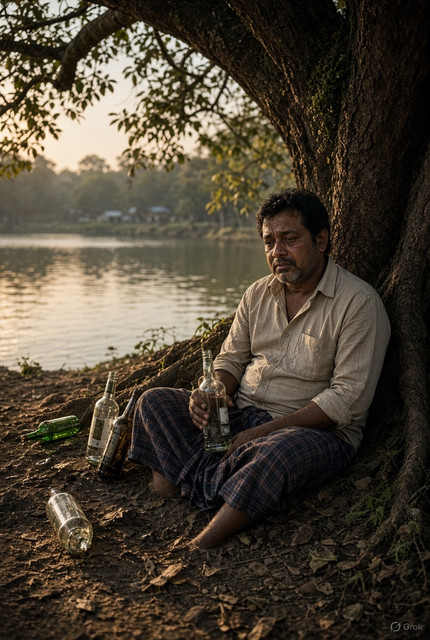
He sat under that same tree, the plastic bag beside him, and opened the first bottle. He did not pour it into a cup, did not mix it with water as he sometimes did to make it last longer. He drank directly from the bottle, tilting his head back, the cheap liquor flowing down his throat in long swallows that made his Adam's apple bob violently.
He drank fast, not slowly, as if he were trying to drown something inside him, as if the alcohol were a weapon he was using against his own consciousness. His eyes were wet—not with the liquor that spilled down his chin, but with tears that he did not wipe away, that he let fall freely down his face, mixing with the arrack on his stubbled cheeks.
Bottle after bottle, he kept drinking in silence. The sun rose higher, the morning progressed into afternoon, and he remained under that tree, surrounded by the empty bottles that accumulated around him like the evidence of his destruction. He did not eat, did not speak to anyone who passed by, did not acknowledge the few villagers who looked at him with the mixture of pity and contempt that had become his due.
I watched from a distance, hidden behind trees and walls, unable to approach him, unable to leave him. The images from the morning kept playing in my mind—Ravi's calm face as he dismissed my father, the wet patch on Appa's lungi, the complete destruction of his dignity. And now this, the final surrender to the bottle that had been his enemy and his refuge for so long.
Eventually, the afternoon began to fade, the sun moving toward the west, and I knew I had to return home. Amma would be wondering where I was, would be worrying about both of us, her husband and her son, both lost in different ways. I cast one last look at Appa, sitting under the tree surrounded by his empty bottles, his head lolling forward, his body swaying slightly with the rhythm of his drunkenness, and then I turned and walked back toward our house.
The house felt heavy and quiet when I arrived, the silence of a tomb rather than a home. Amma was there, moving through the rooms with the mechanical efficiency of a woman who had learned to function despite the weight pressing down on her. She had changed from the multi-colored chiffon saree she had worn to Ravi's house, replacing it with a simple cotton one, pale blue and worn thin with washing. Her hair was pulled back tightly, the jasmine flowers gone, though I could still smell their faint sweetness when I passed close to her.
There was almost no conversation between us. She looked at me when I entered, her eyes asking questions she did not voice—where had I been, where was Appa, what had I seen. I shook my head slightly, a gesture that told her nothing and everything, and she turned away, accepting my silence as she accepted so much else.
She moved around doing small chores—sweeping the already clean floor, washing vessels that did not need washing, rearranging items that had been in the same place for years. Her face looked distracted and tired, the strain of the morning still visible in the lines around her eyes, the tightness of her jaw. The awkwardness from our earlier conversation, from her question about a second marriage, from her tears behind the closed door, still sat between us like a wall we did not know how to climb.
I sat near the doorway, watching the lane, waiting for Appa to return, knowing that he would not come until the alcohol had done its work, until he had drowned whatever was screaming inside him. The afternoon light faded slowly, turning from gold to orange to purple, and the house grew dim as evening came.
As the light outside began to fade, Amma's worry became more visible. She kept glancing toward the door, her movements growing more agitated, the pretense of normal chores abandoned. She stood near the window, looking out at the lane, her face illuminated by the last light of the setting sun, her expression a mixture of anger and fear and something I could not name.
[img]
 [/img]
"He must be drinking somewhere," she said finally, her voice low and tired, not angry but resigned. "Go and look for him. Bring him if you can."
Her tone was that of a woman who had done this many times before, who had sent her son to find her husband in the gutters and fields and hidden corners where he drank himself into oblivion. I nodded and left the house again, grateful for the purpose, for the excuse to be moving, to be doing something other than sitting in that heavy silence.
I went back to the lake, knowing that was where he would be, where he always went when the drinking became serious. The evening was settling over the water, turning it from blue to gray to black, the surface reflecting the last light of the sky in ripples that moved with the breeze.
Appa was still sitting in the same place, under the banyan tree. All the bottles around him were empty, plastic containers scattered like fallen soldiers on a battlefield. His body was slumped against the trunk of the tree, his head lolling to one side, his eyes half-closed. He looked completely drunk, beyond the reach of words or reason, lost in the alcohol that had finally done its work.
I approached him carefully, my footsteps loud on the dry leaves. "Appa," I said, my voice soft but firm. "Come home."
He squeezed his eyes and tried to focus on me, his pupils dilated, his gaze unfocused and wandering. He did not answer clearly, only made a sound that might have been acknowledgment or might have been dismissal. When I took his arm and tried to lift him, tried to pull him to his feet, he pushed me away with sudden force that surprised me with its strength.
I lost my balance and fell back onto the ground, my palms scbanging against the rough earth, my hip hitting a root. Anger rose in me for a moment—hot, sharp, the anger of a son who had had enough of his father's weakness—but I controlled it, breathing deeply, pushing it down into the place where I kept all the emotions I could not afford to feel.
I tried again, standing up, brushing the dirt from my hands. "Appa, get up," I said, my voice harder now. "Let's go home. Amma is waiting. Everyone is waiting."
This time his voice came out, broken and heavy, slurred almost beyond recognition. "Go... leave me. Go away. I don't want to go there. I don't want to see her. I don't want to see anyone."
He did not look at me properly, his eyes fixed on some point in the middle distance, some vision that only he could see. I stood there for a while, looking down at him, at the man who had once been my father, who had once been strong and proud and capable, now reduced to this drunken wreck under a tree.
Finally, I left him there. There was nothing more I could do, no words that could reach him, no strength that could lift him. I walked back home with heavy steps, carrying the failure with me, the knowledge that I had left him there to drink himself to death or unconsciousness, whichever came first.
When I returned, Amma was waiting near the doorway, her face tense with worry that she tried to hide. I told her what had happened—that he was at the lake, that he had finished the bottles, that he refused to come. I added, trying to convince myself as much as her, "He will come on his own. When he sobers up, when he runs out of drink, he will come."
Amma listened quietly, her face unreadable. Some of the tension in her features reduced, though the worry did not fully leave. She nodded once, accepting my report, accepting the situation that had become her life.
"Go to sleep," she said, her voice soft but firm. "Don't keep thinking. Go lie down. I will also sleep. I am leaving the door slightly open... he will come."
She went into her room, the room that had once been shared with Appa, now her private space. I went to mine, the small room that had been my sanctuary, now feeling like a prison.
I lay on the cot staring at the ceiling, the cracks in the plaster forming patterns that seemed to shift and move in the dim light. The images from the morning kept returning—the sight of Amma under Ravi, the sound of her moans, the wet patch on Appa's lungi, Ravi's calm face as he dismissed my father with contempt. My mind felt heavy and restless, turning over these images again and again, unable to process them, unable to escape them.
I thought of Appa sitting under the tree, surrounded by empty bottles, drowning his shame in cheap liquor. I thought of Amma in the next room, lying alone on the cot where she had been with Ravi that morning, her body still carrying his scent, his seed. I thought of myself, caught between them, witness to everything, powerless to stop any of it.
Eventually, exhaustion claimed me, pulling me down into a sleep that was not restful, filled with dark images and the sound of breaking glass.
A sudden heavy bang woke me up, the sound loud and violent in the quiet night. My heart jumped, my body jerking upright on the cot. I listened for a moment, disoriented, then realized the sound had come from the front of the house.
I got up quickly and came out into the hall. The main door had been pushed open hard, hitting the wall with force that had shaken the house. Appa was standing there, framed in the doorway, completely drunk, his body unsteady, swaying slightly as he tried to maintain his balance.
He looked terrible. His clothes were stained with dirt and vomit, his hair wild, his face flushed and swollen with alcohol. Even with the loud sound he had made, Amma did not come out of her room. Either she was asleep, or she was pretending to be, or she simply did not want to face him in this state.
Appa began walking toward Amma's room, murmuring something under his breath that I could not make out. His steps were uneven, stumbling, his hand reaching out to the walls for support. He was holding an empty bottle in one hand, the neck gripped tight like a weapon.
I quietly moved to the main door and closed it, since he had left it open, the night air rushing in. Then I positioned myself near Amma's room, my heart pounding, and looked through the gap in the door that had been left slightly ajar.
Inside, Amma was lying on the cot, her body still, her breathing regular. It was unclear whether she was truly asleep or only pretending, whether she had heard him come in and was choosing not to react, hoping he would pass out before causing trouble.
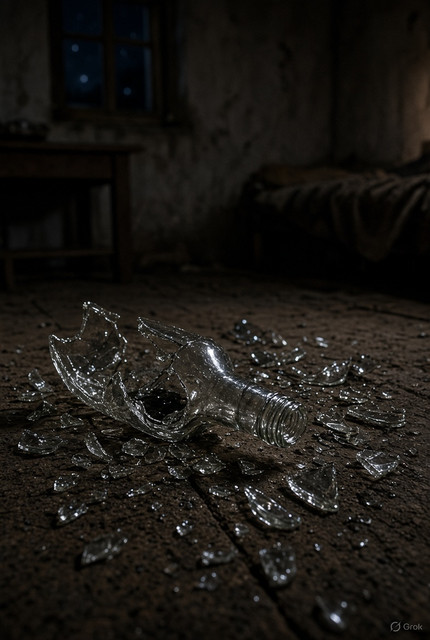
Appa stood near the cot and stared at her for a long moment, his breathing heavy and audible in the quiet room. The empty bottle in his hand hung loose at his side, then suddenly he raised it and threw it down. It hit the floor and shattered, the sound sharp and violent in the quiet house, glass scattering across the floor.
[img]
 [/img]
Amma still did not react. Her body remained still, her eyes closed, her face composed into the mask of sleep.
Seeing her silence, Appa's face tightened further. The drunken anger in him grew, fed by her refusal to acknowledge him, her refusal to wake and face what he had become. He pulled off his shirt with rough movements, the fabric tearing slightly, and dropped it on the floor. Then he untied his lungi and let it fall, stepping out of it with the clumsiness of a man whose coordination had been destroyed by alcohol.
He stood completely naked in front of the cot, facing Amma. His body looked terrible in the dim light—thin where it had once been strong, his stomach sagging, his legs unsteady, his cock small and half-hard against his thigh. He looked like a caricature of the man he had been, a ruined version that bore little resemblance to the husband who had once tied a thaali around her neck.
From the gap in the door, I watched him standing there, my chest feeling tight, my breathing shallow. I understood what he was about to do, understood that the alcohol and the humiliation had combined to create a rage that would not be denied. For a moment I felt completely torn—whether I should step in and stop this, or whether I should stay silent and let whatever was going to happen continue. The house was quiet except for Appa's heavy breathing. Amma still had not opened her eyes.
Without any warning, Appa climbed onto the cot and dropped his full naked weight on Amma. The sudden movement shook the cot, the wooden frame creaking under the impact. Amma's eyes snapped open in shock, a short, startled sound leaving her throat—a gasp of surprise and fear that cut through the night.
She stared up at him, fully awake now, her face showing clear shock and confusion. She was still wearing the same multi-colored chiffon saree from the morning, though it was disheveled now from sleep. The jasmine flowers were no longer in her hair, lost somewhere in the course of the day. For a moment she could not even speak, her mind struggling to process the sight of her naked husband on top of her, the smell of alcohol overwhelming everything else.
Appa did not say a single word. He did not accuse her of anything, did not mention Ravi or what he had seen that morning, did not demand explanations or apologies. He only breathed heavily, his eyes dark and unfocused from the alcohol, his body pressing down on hers with a weight that made her gasp for breath.
He grabbed the pallu of her saree and pulled it away from her chest roughly, the fabric tearing slightly under his force. He did not try to remove the full saree with any care or gentleness. Instead, he pushed the fabric and her cream petticoat upward, bunching them around her waist in a rough tangle that exposed her thighs and the lower part of her stomach.
Amma's hands immediately moved down, trying to push the cloth back down, trying to cover herself, trying to stop him. "What are you doing...?" she said, her voice shaky and low, trying not to be loud, trying not to wake me if she thought I was sleeping. "Stop... you are drunk... this is not..."
Appa did not answer. He used his knees to force her legs apart, his body heavy and uncoordinated but determined. His small, half-hard cock brushed against her inner thigh as he pressed his body down on her, seeking entry, seeking the satisfaction that had been denied him for so long.
He spat on his palm—a thick, disgusting glob of saliva mixed with alcohol—and rubbed it over his small cock, trying to create some lubrication. Then he tried to push inside her, his hips jerking with the uncoordination of drunkenness.
Amma twisted her hips, trying to close her legs, trying to prevent his entry, but he held her down with his weight, his hands gripping her thighs hard enough to leave marks. After a few rough attempts, he forced the head of his cock into her pussy, pushing past her resistance with the determination of a man who did not care about her comfort, only about his own release.
Amma's face tightened in pain and anger, her features contorting with the violation. A sharp, suppressed sound came from her throat—a gasp of discomfort and outrage. She turned her face to the side, eyes pressed shut, her jaw clenched against the sensation of him inside her, the roughness of his entry, the smell of alcohol and sweat and defeat that surrounded him.
He began thrusting in short, unsteady, drunken movements. There was no control in his body, no rhythm, no consideration for her pleasure or comfort. His breathing was heavy and uneven, loud in the quiet room, the sound of a man drowning in his own humiliation. The cot creaked under the rough motion, the wooden joints protesting the violence being done on its surface.
Amma kept her hands against his shoulders, pushing weakly, trying to create some distance, some space between them, but she did not scream. She did not call for help, did not alert me or the neighbors or anyone who might stop this. Her pride, or her shame, or her acceptance of what her marriage had become kept her silent, enduring it with her face turned away, her expression tight with disgust and helplessness.
Her breasts moved under the blouse with each of his thrusts, the fabric shifting, the shape of them visible in the dim light. She kept her face turned away from him, her eyes closed, refusing to look at him, refusing to acknowledge what was happening.
From the gap in the door, I watched without moving, my body frozen, my mind screaming conflicting instructions. My chest felt tight, my heart pounding against my ribs. Part of me wanted to push the door open and drag Appa off her, to stop this violation, to protect my mother from her husband's drunken rage. Another part stayed frozen, locked in place by the knowledge that interfering now would reveal that I had been watching, that I had seen everything, that I was complicit in the destruction of our family by my silence.
Appa still had not said a word about Ravi or what he had seen earlier. He was only taking his anger out on her body in silence, using her as a vessel for his frustration, his humiliation, his complete defeat.
His movements remained rough and poorly controlled because of the alcohol. He gripped her thigh with one hand, his fingers digging into the soft flesh, and kept pushing into her pussy with short, uneven thrusts that spoke of his desperation more than his desire. Amma's breathing was sharp and angry, audible in the quiet room, the sound of a woman enduring rather than participating.
She did not hold him. She did not look at him. She only endured it with her face turned away and her hands still pressed against his chest, creating what little distance she could between their bodies.
My mind kept turning over the same thoughts, circling like vultures around a dying animal. Should I stop this? If I walk in now, what will I even say? That I was watching? That I saw everything this morning? That I know why he is doing this, know the humiliation that drives him, know that he saw his wife with another man and is now trying to reclaim her in the only way he knows how?
The images from Ravi's house mixed with the scene in front of me—Amma under Ravi, open and responding, her body moving with his, her moans filling the air, and now Amma under Appa, stiff and irritated, her body closed and resistant. The difference was sharp and painful, a blade that cut through any illusion that this marriage could be saved, that these two people could ever find their way back to each other.
Appa's thrusts grew shorter and faster, his body beginning to tense. He pressed his face into the pillow near Amma's head, his breath hot and uneven against her neck, his body shaking with the effort of his drunken arousal. One of his hands squeezed her exposed thigh hard enough to leave pressure marks that would bruise by morning. He was completely lost in his own rough need now, beyond thought, beyond reason, beyond any consideration of the woman beneath him except as a means to his release.
Amma turned her face further into the pillow, eyes pressed shut, waiting for it to end, her irritation clear in the way her body remained tense and unresponsive under him. There was no soft moan, no parted lips, no sign of the pleasure she had shown with Ravi—only tight endurance and disgust.
I remained frozen at the door gap, my fingers pressing hard against the wooden frame, my nails digging into the wood. Every rough movement on the cot sent a sick feeling through my stomach, a mixture of pity and rage and helplessness that made me want to scream. Part of me wanted to push the door open and drag Appa off her, to stop this violation. Another part stayed locked in place, telling me that interfering now would only make everything worse, would reveal my own complicity, my own voyeurism, my own inability to stop any of what was happening to our family.
My breathing felt uneven, my hands slightly shaking against the door frame. I hated that I was watching, but I could not look away, could not break the spell of witness that had trapped me since the beginning of this nightmare.
Appa's breathing grew heavier, more desperate. His movements became more focused on his own release, his body tensing as he approached the edge. A low, drunken sound came from his throat as he pressed deeper, his face contorted with the effort of his arousal, his body shaking with need.
With a final uneven push, Appa's body jerked. He came inside her with a low, broken sound, his small cock pulsing weakly as he emptied himself into her, his seed mixing with Ravi's from that morning, the two men marking her in ways that she would carry for hours, for days, perhaps forever.
His body stayed heavy on top of her for a few seconds, breathing hard, the smell of alcohol and sweat thick in the room. Then Amma immediately pushed at his shoulder, her voice cold and sharp, cutting through the silence.
"Get off."
The words were like a slap, a dismissal, a final rejection. Appa slowly rolled off her and lay on his back beside her, still naked, still breathing heavily, his small cock, now softening, resting against his thigh with a thin smear of cum. He stared at the ceiling with unfocused eyes, the drunken satisfaction sitting on his face mixed with emptiness, the knowledge that this had changed nothing, that he had not reclaimed her, that she was still Ravi's in every way that mattered.
Amma quickly pulled her petticoat and saree back down, covering her thighs, restoring some semblance of dignity. She turned her body away from him, facing the wall, her shoulders stiff with anger and disgust. She did not speak again, did not look at him, did not acknowledge his presence beside her.
I finally stepped back from the door, my mind heavy, knowing that nothing between them had been repaired. If anything, it had only become more broken, the final fracture in a marriage that had been dying for years.
The room stayed heavy after Appa rolled off her, the silence oppressive, filled with the smell of sex and alcohol and defeat. The only sounds were his uneven drunken breathing and the soft rustle of cloth as Amma pulled her petticoat and saree down properly, restoring her clothing with sharp, angry movements.
She did not look at him. Her body language screamed her rejection, her disgust, her complete withdrawal from any connection with the man who had just used her. She turned fully toward the wall, leaving her back to him, creating a barrier that could not be crossed.
Appa lay on his back, still naked, one arm resting over his forehead, covering his eyes as if he could not bear to look at what he had become. He did not try to touch her again, did not speak, did not apologize or explain. For a few minutes, neither of them spoke, the silence between them more complete than any words could have made it.
After some time, Amma sat up on the edge of the cot. Her face was tight with anger, her jaw set, her eyes hard. She adjusted her blouse with quick, efficient movements, pulling the fabric into place, smoothing down her saree. Without looking at Appa, she stood up and walked out of the room toward the bathroom area, her footsteps firm on the floor, her back straight with the dignity she was trying to maintain.
Appa turned his head slightly and watched her leave, but he still said nothing, his face empty, his eyes dead.
I stepped back quietly from the door and returned to my room, positioning myself where I could observe without being seen. My chest still felt tight, my stomach churning with the aftermath of what I had witnessed. The image of what just happened sat heavily in my mind, mixing with the images from the morning, creating a tapestry of destruction that I could not escape.
I sat on my cot in the dark and waited, my ears straining for sounds from the hall, for some indication of what would happen next.
After a while, I heard the bathroom door open, the sound of water running. Amma came back into the hall. She had washed her face, the water leaving her skin fresh and clean, and adjusted her saree more neatly, restoring her appearance to something approaching normal. Her expression was still hard, her eyes distant, but she had composed herself, put on the mask that she wore for the world.
She did not look toward Appa's room immediately. Instead, she drank a little water from the pot near the kitchen, standing in the dim light of the hall, her figure outlined against the darkness.
As she moved under the dim light, I noticed something clearly, something that made my breath catch in my throat.
The thaali around her neck was not hidden inside her blouse the way she usually kept it when Appa was around. The chain and pendant were resting openly against her chest, fully visible over the saree, the gold catching the faint light from the window.
It was Ravi's thaali.
Until now, she had been careful about it inside the house, hiding it, tucking it away, maintaining the pretense that she was still only Murugan's wife. Tonight, she was not hiding it. Tonight, she was wearing it openly, displaying it, perhaps as a message, perhaps as a declaration, perhaps simply because she no longer cared what he thought.
A few minutes later, Appa stepped out of the room. He had put his lungi back on, though it was tied loosely, hanging crooked on his thin frame. His walk was still unsteady from the alcohol, his movements clumsy as he made his way toward the water pot. He poured some into his hand and washed his face roughly, the water dripping down his chin, mingling with the remnants of his tears.
When he turned, his eyes fell on Amma.
For a moment he froze, his body going still, his gaze locking on the thaali resting openly on her chest, the gold chain and pendant that he had not given her, that he could never have afforded to give her, that marked her as belonging to another man.
The change in his face was immediate. The drunken haze in his eyes sharpened into something darker, something more dangerous. His jaw tightened, a muscle jumping beneath the skin. He stared at the thaali without speaking, his breathing growing heavier again, the rage returning.
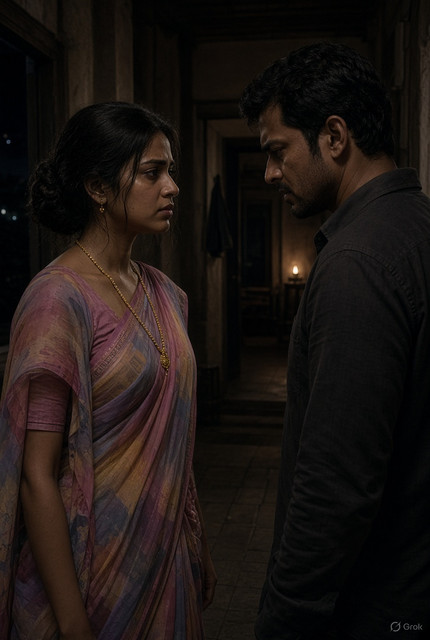
Amma noticed his stare. Instead of turning away or hiding the chain, instead of tucking it inside her blouse or covering it with her hand, she remained standing as she was. Her face showed no fear—only irritation and a cold tiredness, the expression of a woman who had endured enough.
Appa's voice finally came out, rough and low, barely recognizable as human. "That... what is that on your neck?"
Amma looked at him directly, her eyes meeting his with a steadiness that spoke of her transformation, her crossing of a line from which there was no return. "You know what it is."
Appa's face hardened further, the color draining from his cheeks, leaving him pale in the dim light. He took a step closer, his eyes locked on the chain, unable to look away from the symbol of his defeat.
"That is not my thaali," he said, his voice rising with anger, though it still carried the roughness of alcohol, the slur of his drunkenness. "Who gave you this gold thaali? Who tied it on you? Where is my thaali? The one I tied? The one that made you my wife?"
His voice cracked on the last word, the pain breaking through the rage.
Amma's expression sharpened, the irritation she had been holding back coming out clearly in her tone, cutting through his accusations. "Why are you asking now?" she said, her voice hard and cold. "After coming home like this... after throwing bottles... after forcing yourself on me when I was sleeping? Now you want to know who tied it? Now you want to pretend you are still my husband?"
She did not step back. She took a step forward, confronting him, her voice rising slightly but remaining controlled. "You lost the right to question me like this a long time ago. When you started drinking. When you stopped providing. When you let another man step into your place because you were too weak to hold it."
The words were like knives, each one finding its mark. Appa's hands curled tightly at his sides, his body trembling with the effort of control. For a moment it looked like he might shout, might strike her, might do something violent and final. But the words seemed to catch in his throat, choked by the truth of them, by the knowledge that she was right, that he had failed, that he had lost her long before Ravi tied that chain around her neck.
He only stood there, staring at the thaali on her neck with raw anger and humiliation on his face, unable to speak, unable to act, unable to do anything but witness his own complete defeat.
Amma looked at him for another second, her eyes cold and tired, then turned away. "I am going to sleep," she said, her voice flat and final. "Don't start anything more tonight. There is nothing left to say."
[img]
 [/img]
She walked past him, her shoulder brushing his arm, and went back into the room. This time she did not leave the door fully open. She pushed it partially closed behind her, the latch clicking softly, the sound of finality.
Appa remained standing in the hall, the anger and humiliation clear on his face, his eyes still fixed on the place where she had been standing, the image of the unfamiliar thaali still burning in front of him. His chest heaved with suppressed emotion, his hands opening and closing at his sides, his body shaking with the effort of containment.
From my room, I watched all of it in silence, understanding that something fundamental had shifted. Until now, Amma had at least tried to keep Ravi's thaali hidden when Appa was around, had maintained some pretense of loyalty to her first marriage. Tonight she was no longer doing even that. The chain was out in the open, and she had not backed down when he saw it, had not apologized or explained or tried to soften the blow. She had confronted him, accused him, dismissed him.
The distance between them had grown even wider tonight, a chasm that could never be bridged. And for the first time, it felt like Amma was no longer trying as hard to protect the old surface of this marriage, no longer invested in maintaining the fiction that they were still husband and wife in any meaningful way.
Appa finally turned and walked back into the room he had left. He did not speak again, did not shout or break anything or continue the confrontation. The house fell into a tense, broken silence, the silence of a marriage that had finally died, killed by alcohol and infidelity and the slow erosion of years.
I lay back on my cot and stared at the dark ceiling, my mind heavy with everything I had witnessed. The morning at Ravi's house, watching my father hide in the store room while another man possessed my mother. The empty bottles at the lake, the defeat in Appa's eyes as he drank himself toward oblivion. The forced act in the room, the violence of his drunken attempt to reclaim her. And now the thaali resting openly on Amma's chest, the final declaration that she was no longer his, that she had moved beyond him, that she had chosen Ravi and the life he offered over the ruin that Appa had become.
All of it sat heavily in my mind, a weight that pressed down on my chest, making breathing difficult. The distance between Amma and Appa was now complete, unbridgeable, final. They were no longer husband and wife, no longer partners, no longer even enemies. They were simply two people occupying the same space, bound by habit and history but separated by a gulf that nothing could cross.
And I was trapped in the middle, witness to everything, powerless to stop any of it, carrying the knowledge of my family's destruction like a stone around my neck.
The night deepened around us, the darkness complete and oppressive. Somewhere in the village, Ravi was probably sleeping peacefully, satisfied with his victory, dreaming of the next time he would possess my mother. Somewhere, my grandparents were sleeping, believing they had done the right thing for their daughter. And in this house, three people lay awake in separate rooms, bound together by blood and silence and shame, each carrying their own portion of the ruin that had become our lives.
I closed my eyes, but sleep did not come. The images kept playing, the sounds kept echoing, the weight kept pressing down. Tomorrow would bring new developments, new degradations, new steps in the destruction that Ravi was orchestrating with such calm precision. And I would watch, as I always watched, unable to intervene, unable to look away, unable to do anything but bear witness to the end of everything I had known.
