


22-08-2026, 10:20 AM
The Goddess
By Novelist Casanova
In the heart of Tamil Nadu, far from the cities and the busy roads, there is a forest that seems to go on forever. Deep inside that forest, ten kilometres from the nearest proper path, our village sits hidden and secluded, wrapped completely by thick green that never thins.
Tall teak and banyan trees stand like old guardians, their roots gripping the earth, their branches meeting overhead so that even at noon the light comes down soft and green. The only way in is a narrow path that winds between the trees for the full ten kilometres. The walk is hard. The ground stays uneven, roots push up without warning, and in many places the path grows so narrow that only one person can pass at a time. In the heat the air remains trapped under the canopy, and by the time a traveller reaches the first houses the body is tired and slow. Along the way the forest opens in places to small waterfalls that fall from rocky ledges into clear pools, and to dark caves set into the hillsides where the stone stays cool even at midday. Then the trees close in again, and the path remains the only thread connecting this quiet place to the outside world.
To reach the nearest town we have to walk those same ten hard kilometres through the forest, carrying whatever we need to buy or sell. There is no shorter route.
Twenty-five families live here. The houses are modest — simple, close together, with thatched roofs and small courtyards of beaten earth. Each courtyard holds a tulsi plant in a raised square of bricks and a low wall that marks one family’s space from the next. Smoke from morning and evening cooking fires rises slowly and hangs under the tree canopy before drifting away. Cattle stand tied in the shade of the bigger trees; goats wander freely between the houses; chickens scratch in the dust. The air always carries the mild smell of wet leaves, wood smoke, cow dung, and the gentle sweetness of jasmine that grows wild along the path.
Most of the men are farmers. They work the small stretch of paddy land near the river and the few clearings the forest has allowed them. At first light they leave with sickles and ploughs; by evening they return with the day’s work settled in their bodies. In the centre of the village stands the open meeting ground under a single enormous banyan. That is where the Village Head calls everyone when something needs deciding. He is an old man with a white mundu and a quiet voice, and every family listens when he speaks. Boundary disputes, water-sharing, the repair of the common well, the date for the Goddess festival — all of it is settled under that banyan. No one argues once the Head has given his word. The forest itself seems to agree; after every meeting the village returns to its slow, ordered rhythm as if the trees have been listening too.
The river is our eastern boundary. It comes out of the deeper forest, curves past the washing stones and the small stretch of sand, then disappears again into the trees. In the dry months it runs shallow and clear; in the monsoon it rises and roars, but even then it stays inside its banks. On the far side the forest continues, darker and thicker, and no one from our village goes there without reason. The Goddess temple stands a short walk upstream, half-hidden by peepal trees, its stone walls cool even in the worst heat. The idol inside is old, black stone polished by generations of oil and hands, and the whole village treats that small temple as the heart of everything.
Life moves slowly and in circles. Men leave at first light for the fields; women work in the courtyards and at the river; children run between the houses until the light fades. At night the forest closes in completely. Only the oil lamps in the doorways and the glow of the temple lamp keep the darkness from swallowing the twenty-five houses whole. Jackals call from the tree line, and sometimes an elephant moves far off, the sound of breaking branches travelling long distances through the still air. But inside the circle of houses everything remains ordered, quiet, and held together by the simple rule that the Village Head’s word is final and the Goddess watches over all of us.
This is how our village has always been — a secluded Tamil settlement, beautiful, sealed, and complete ten kilometres inside the forest.
I always knew how we looked.
Our faces alone could stop a man mid-step. Wide, dark eyes sat large and slightly almond-shaped under soft brows, eyes that held a quiet, unhurried look, as if we already knew what a man was thinking before he spoke. The surface across our cheeks and foreheads was smooth and warm-toned, glowing with the kind of softness that comes from river water and open air. High cheekbones caught the light whenever we turned our heads. Our noses were straight and finely cut, and below them our mouths were full — lower lips naturally thicker, soft, and always a little parted, as though waiting for something. When we smiled, even a small smile, the corners of those lips lifted slowly and made the whole face warmer. Thick black hair framed everything. Most days it was tied in a heavy knot at the back, yet several long strands always escaped, falling across the temple, sliding along the cheek, or resting against the side of the neck where the surface looked especially smooth.
Our bodies were built to be stared at. Shoulders were rounded and soft, never sharp. From those shoulders our chests rose full and heavy. Breasts sat high and weighty, the kind that pressed firmly against the blouse with every breath and shifted with a slow, natural heaviness whenever we walked or bent. The deep line between our breasts stayed visible even under ordinary cotton blouses. Waists pulled in sharply, creating a clear, deep curve that the eye followed without permission. From that narrow waist our hips flared wide and round, the shape there full and firm, moving in a steady, rolling sway with each step. The saree stretched tight across those hips, outlining the exact shape of both ass cheeks so clearly that a man could almost feel the warmth of them just by looking. Thighs were thick and strong, pressing together as we walked, the soft inner thighs hidden yet suggested by the way the saree moved between them.
Even the smallest movements made us harder to look away from. When we lifted pots of water, our breasts rose and settled again with a heavy, liquid motion. When we bent to pick something from the ground, the saree pulled tight across the round swell of our ass cheeks and the deep hollow of our lower backs. When we simply stood and talked, one hand resting on a hip, the full shape of our bodies remained completely present — breasts, waist, hips, thighs — all of it soft, abundant, and quietly demanding attention. There was nothing thin or sharp about us. Everything was rounded, warm, and full in a way that made a man’s hands ache without him realising why.
We never tried to be noticed. That was what made us dangerous. The beauty sat on us as naturally as the forest sat around the houses. A man could look once and tell himself he would look away, but the image stayed — the dark eyes, the full mouth, the heavy breasts moving under the blouse, the wide hips rolling with each unhurried step. In a place this quiet, our bodies became the strongest presence of all, impossible to forget once seen.
We married women always wore sarees.
From the first light until we finally changed at night, the saree stayed on our bodies. We dbangd it the old way — neat front pleats falling straight down between our thighs, the end of the saree pulled tight across the waist and tucked firmly, the pallu either resting over one shoulder or brought across the chest so that it pressed and rubbed over the upper curve of our breasts. Under the saree we wore a blouse and a petticoat. The blouse was stitched close, pulling tight across our heavy breasts with every breath. Under the blouse we wore a regular Indian everyday bra — full coverage, plain cups that cradled each breast completely, no padding, no underwire, the underband sitting firm beneath the weight, the straps resting on our shoulders, fastening with hooks at the back. That bra lifted and held our breasts, yet the natural heaviness still made them sway and settle with every step, the deep line between them pushing visibly against the blouse whenever the pallu shifted.
Under the petticoat we wore only our panties. The petticoat string sat low on our hips, just above the line of our pubic hair. The panties were regular Indian everyday hipster panties, full coverage, the waistband resting low, the front panel stretched snug over our pussy, the back panel pulled tight across both ass cheeks so that the full round shape of each cheek showed clearly under the petticoat. When we walked the panties moved against us — a constant soft pressure on our pussy lips, a light rub between our thighs, the panties sliding over the curve of our ass with every step. The saree never hid us completely. It only framed us. The way it clung to our hips, the way it tightened across our ass when we bent, the way the pallu slipped and revealed the heavy push of our breasts under the blouse — everything about us was made to be looked at, to make a man’s eyes stay longer than they should.
At night we removed everything. We took off the saree, the blouse, the petticoat and the bra. Our breasts came free, heavy and uncovered, nipples tightening in the air. Then we pulled a full-length nighty over our heads. The nighty fell all the way to our ankles, loose and plain, short sleeves, round neck. Under that full-length nighty we wore only our panties. Nothing else. Our breasts hung free inside the nighty, the nipples brushing the inside with every turn. We had electricity in the village, but power cuts came often, so many nights we moved around in the dark with only the nighty and the panties on our bodies, the shape of our bare breasts and the outline of our pussy clear whenever anyone looked.
The unmarried young girls dressed differently. They wore skirts that ended at the knee or just above the knee, and simple T-shirts. The shorter length of those skirts made them naughty without trying. When the girls walked, sat on the low walls, or climbed the steps near the river, the skirt lifted easily. A small breeze or a quick step was enough to flash the bare upper thighs and the tight shape of their full-coverage cotton briefs underneath. Under the T-shirt they wore training bras — the plain beginner kind made for teenage girls, non-padded, soft-cup, full coverage, thin adjustable straps and back hooks, just enough to hold their smaller, developing breasts. Their panties were full-coverage cotton briefs, the everyday style that sat high on the hips and covered them from the front of the pussy to the back of the ass, yet the short skirt still turned every movement into a quiet upskirt chance that made the older men glance twice.
But the river was different.
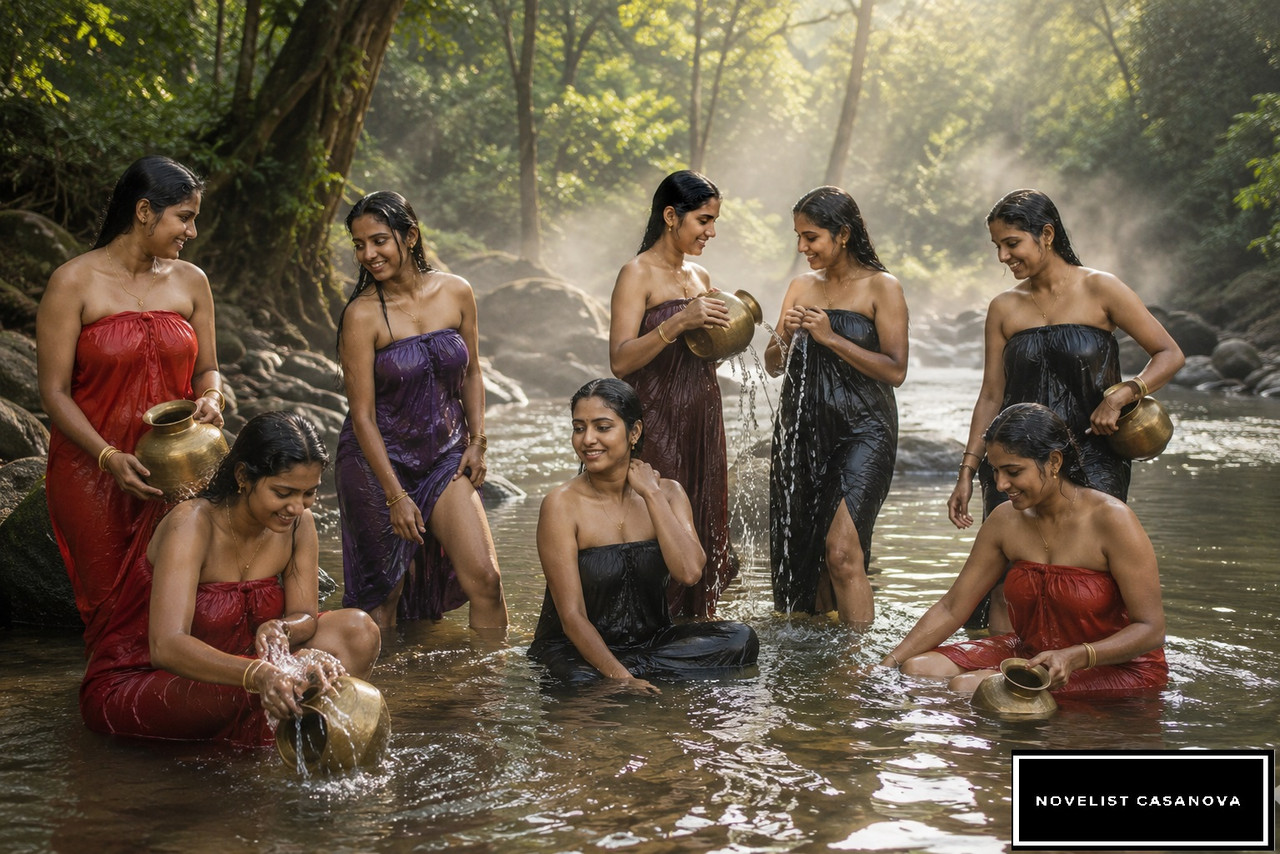
When we went to play in the river we followed the old village way, the way that left almost nothing hidden. We stood on the stones and removed our sarees first. Then we unbuttoned and removed our blouses. Then we reached behind and unhooked our bras, sliding the straps down our arms until our heavy breasts came free, open to the air, nipples already tight and dark. We untied the petticoat, lifted it up, and tied it firmly above our chests so that the petticoat now covered only our breasts, the knot sitting between them, the lower edge resting just above our nipples. Everything below that knot was bare.
Then we removed our panties.
We slid them down over our hips, over the full curve of our ass cheeks, down our thighs, and stepped out of them. Completely naked from the petticoat knot downward. Our bare pussy, our bare ass cheeks, our bare thighs — all of it open. We stepped into the river like that. The cool water rose over our feet, our calves, our thighs, and finally licked directly against our bare pussy lips and the cleft of our ass. Every movement made the water push between our legs. When we bent or laughed or splashed, our bare breasts shifted heavily inside the high-tied petticoat, and below the knot there was nothing at all — only wet skin, open pussy, and the river touching us everywhere a man would want to touch.
There were not many young married women in our twenty-five families, yet the ones who lived here carried a shared, unmistakable heat that no man could ignore for long.
Our bodies had been shaped by years of farm work, by carrying children, and by the long hard walks through the ten kilometres of forest. Everything about us had grown full and heavy in the best way. Our hips were wide and deep, the kind that filled the saree until it stretched tight across the sides and the back, clearly showing the round swell of both ass cheeks with every step. When we walked the ass cheeks lifted and settled in a slow, rolling rhythm that pulled the eye and held it. Our breasts were heavy and high, the weight of them always present. They pressed firmly against the blouse, the regular Indian everyday bra underneath holding them together yet never able to stop the natural sway. The deep line between our breasts stayed visible whenever the pallu shifted, and the upper curve of each breast pushed against the blouse with every breath we took. Our thighs were thick and strong, pressing together as we moved, the soft inner thighs touching with every step, the saree sliding between them and hinting at the warmth hidden higher up.
When three or four of us stood together talking under the banyan or at the washing stones, the air itself grew warmer. We stood close. Our shoulders almost touched. The heavy weight of our breasts shifted whenever we laughed or turned our heads. The wide curve of our hips stayed in full view from every angle. The petticoat and the full-coverage panties underneath could not hide the clear shape of our ass cheeks; the saree only made that shape sharper. Men of the village looked. They always looked. Their eyes moved first to our breasts, then down to the place where the saree stretched across our hips and the outline of our pussy, then back up again. They forced themselves to look away after a few seconds, but their eyes returned — longer the second time, hungrier. Outsiders who somehow reached our forest path stared without shame. They watched the way our breasts moved inside the blouse, the way our ass cheeks flexed when we shifted our weight, the way our thick thighs pressed together and then parted slightly when we took a step.
We knew exactly the effect we had. We felt their eyes on the heavy push of our breasts, on the deep curve of our waists, on the full roundness of our hips and ass, on the thick line of our thighs. We felt them imagining what the regular Indian everyday bra and the hipster panties looked like underneath. We did not flaunt it. We did not need to smile or pose or raise our voices. We simply stood the way we always stood, spoke the way we always spoke, bent to pick something up or adjust the pallu, and our bodies did all the work. The heat came from us without effort — from the weight of our breasts, from the roll of our hips, from the quiet knowledge that every man who saw us wanted to put his hands on us.
In a place this sealed and quiet, our bodies were the loudest, hottest presence of all. Full. Heavy. Soft in the places men wanted to squeeze and strong in the places men wanted to hold. Impossible to look at only once. Impossible to forget once seen.
